RPC: Making Remote Computers Feel Like They're Right Next Door
The Problem You Never Knew You Had
Imagine you are writing a program that needs to calculate something complex, like processing a huge image or crunching financial data. Your laptop is not powerful enough, but your company has a beefy server sitting in a data center across the country. How do you use that server's power from your code?
You could manually package up your data, send it over the network, write code on the server to receive it, process it, package the result, send it back, and write more code to unpack the response. That works, but it is tedious and error prone. Every time you want to use a remote resource, you write all this networking code again.
What if instead, you could just write something like and have everything else happen automatically? That is exactly what Remote Procedure Call (RPC) does. It makes calling functions on a computer halfway across the world feel as simple as calling a function in your own code.
result = remoteServer.processImage(myImage)What Is RPC Really?
RPC stands for Remote Procedure Call. Strip away the jargon and it means calling a function that runs on a different computer. The magic is that it feels local even though it is remote.
Think about making a phone call. You dial a number, someone answers, you have a conversation, they give you information, you hang up. You do not think about the cell towers, the routing, the signal processing. You just talk and listen. RPC does the same thing for programs.

Diagram 1
When you write
getUserData(userId) in your code, you might think that function is running on your computer. But with RPC, it could be running on a server in another city, querying a database, processing the results, and sending them back. Your code does not care. It just calls the function and gets the result.The Traditional Way vs The RPC Way
Let me show you why this matters with a concrete example.
Imagine you are building a weather app. You need to get temperature data from a weather service. The traditional way without RPC looks like this:
You open a network connection to the weather service. You format a request asking for temperature data in a specific format, maybe JSON or XML. You send that request over the network. You wait for a response. You parse the response to extract the temperature. You handle errors if the network fails or the response is malformed. You close the connection.
That is a lot of work just to get a number.
With RPC, you write something like: . Done. All the networking, formatting, parsing, and error handling happens behind the scenes. You just call a function and get a result.
temperature = weatherService.getTemperature(cityName)
Diagram 2
The difference is dramatic. The first approach makes you think about networks and protocols. The second lets you think about your actual problem: getting temperature data.
How RPC Actually Works Under the Hood
Here is what happens when you call a remote function using RPC:
Your program calls what looks like a normal function. But instead of executing locally, that call goes to a piece of code called a stub or proxy. This stub knows the function is actually remote. It packages up your function name and arguments into a message. This packaging process is called serialization or marshalling.
The stub sends this message over the network to the remote server. On the server side, another stub receives the message. It unpacks the function name and arguments. It calls the actual function on the server with those arguments. The function executes and returns a result. The server stub packages up the result and sends it back over the network.
Your local stub receives the response, unpacks the result, and returns it to your code. Your code gets the result and continues, completely unaware that anything complex happened.
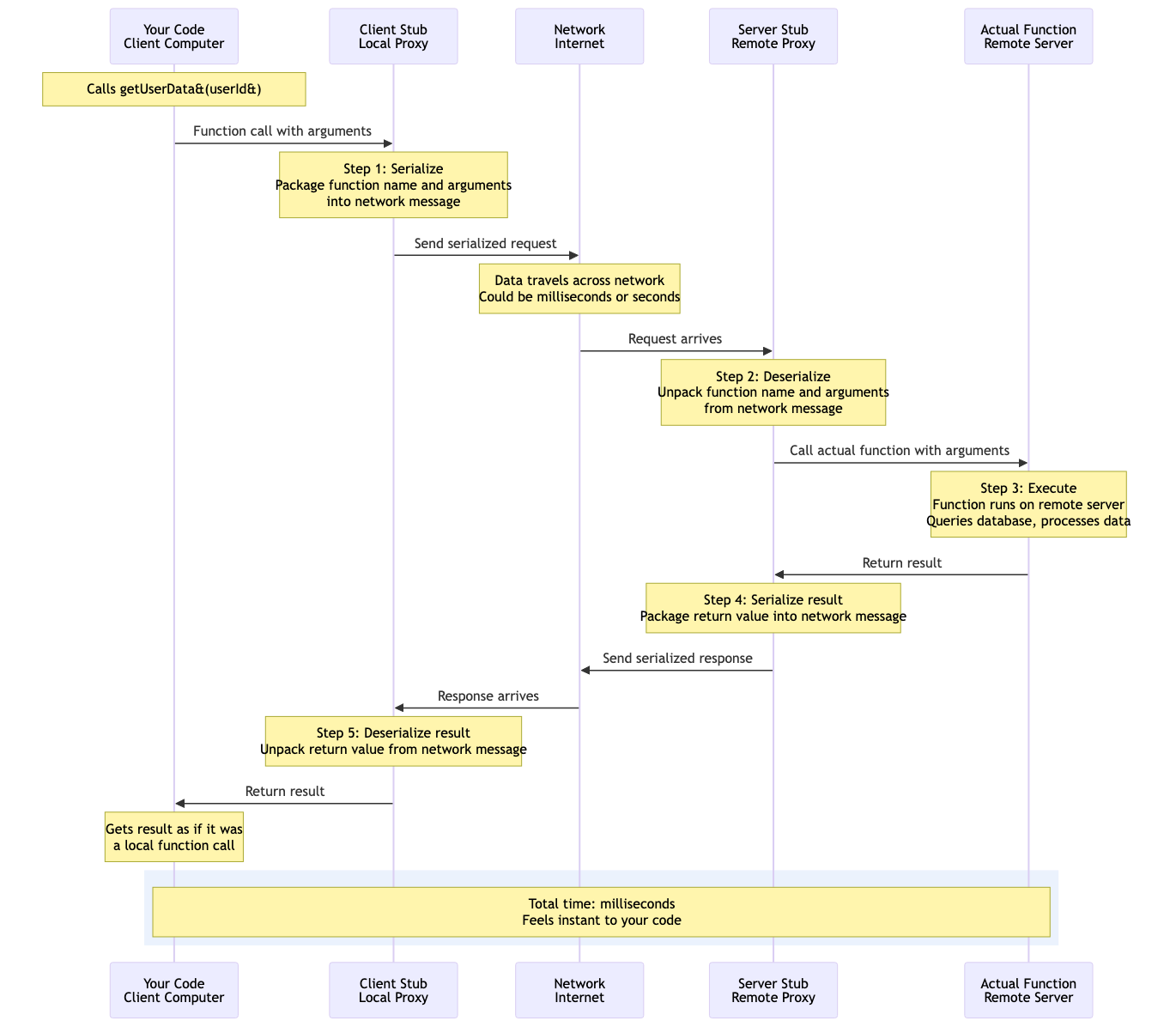
Diagram 3
All of this happens in milliseconds. To your code, it looks like a simple function call. Behind the scenes, data traveled across networks, got serialized and deserialized, and a function executed on a completely different machine.
Why Modern Apps Rely on RPC
Walk into any tech company and their systems use RPC extensively, even if they do not call it that. Here is why:
When you search on Google, your query does not go to one giant computer. It goes to thousands of computers working together. These computers need to talk to each other constantly. How does the search frontend ask the indexing service for results? RPC. How does one service ask another for user preferences? RPC. How do microservices coordinate? RPC.
Netflix uses RPC to coordinate between its recommendation service, video streaming service, user authentication, and hundreds of other services. When you click play on a show, that simple action triggers dozens of RPC calls between different services, all happening in the background.
Your banking app uses RPC to securely communicate with backend servers to check your balance, process transfers, and verify transactions. That instant balance update you see? RPC made it feel instant even though your phone just talked to a server potentially thousands of miles away.
Different Flavors of RPC
RPC is not one specific technology. It is a concept, and different implementations exist for different needs.
Traditional RPC systems like Sun RPC have been around since the 1980s. They work but feel dated by modern standards.
SOAP was popular in the 2000s, using XML to structure messages. It is powerful but verbose and complex. Many developers found it cumbersome.
REST APIs are not technically RPC, but they serve a similar purpose. Instead of calling functions directly, you make HTTP requests to URLs. It is simpler in some ways but requires more manual work to use.
gRPC is a modern RPC framework created by Google. It is fast, efficient, and widely used today. It uses Protocol Buffers to serialize data, making it compact and quick. Many companies have switched to gRPC for internal service communication.
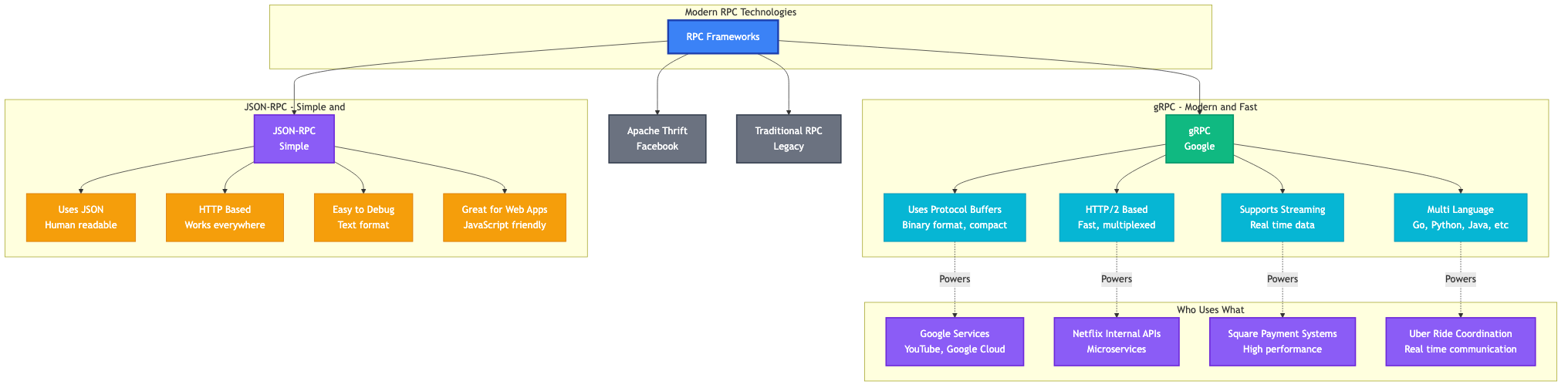
Diagram 4
JSON-RPC is another modern approach, using JSON for messages. It is simpler than gRPC but less efficient. It works great for web applications where simplicity matters more than peak performance.
The choice depends on your needs. Building a high performance microservices system? gRPC. Building a simple web app? JSON-RPC or even REST might be easier.
The Challenges RPC Solves and Creates
RPC makes distributed systems easier to build, but it introduces challenges too. When you call a local function, it either works or crashes immediately. When you call a remote function via RPC, the network might fail. The remote server might be down. The call might timeout.
Good RPC frameworks help you handle these failures gracefully. They provide retry mechanisms, timeout controls, and error handling. But you still need to think about failure in ways you do not with local function calls.
There is also the performance question. A local function call takes nanoseconds. An RPC call takes milliseconds at best. That is a million times slower. For one call, no big deal. For thousands of calls in a tight loop, it adds up fast.
This is why smart developers batch RPC calls when possible. Instead of calling
getUser(id) a thousand times, they call getUsers(listOfIds) once. Same result, but far fewer network round trips.What This Means for You
If you build any modern application, you will encounter RPC whether you realize it or not. Every time you use a cloud service, you are using RPC. Every time you call a third party API from your code, you are essentially doing RPC.
Understanding RPC helps you make better architectural decisions. Should you put this function on a remote server or keep it local? How should your services communicate? What happens when the network fails?
It also helps you debug problems. When your application seems slow, checking how many RPC calls you are making can reveal the bottleneck. When things break mysteriously, understanding RPC helps you realize the network might be the culprit.
Most importantly, RPC is the foundation of distributed systems. Everything from Google Search to your food delivery app relies on different computers working together seamlessly. RPC is the invisible glue making that coordination possible.
The Future of Remote Calls
RPC continues to evolve. Modern frameworks like gRPC support streaming, where data flows continuously instead of in single request response pairs. They support bidirectional communication where both client and server can initiate calls. They integrate with service meshes that automatically handle routing, security, and monitoring.
The trend is clear: making remote calls feel even more like local calls while adding capabilities impossible with local functions. You can call a function that runs on a different computer, in a different language, on a different operating system, and it just works.
Next time your app instantly loads data from a server, remember it is not magic. It is RPC, decades of engineering making the complex feel simple. Your code called a function. That function happened to run on a computer far away. The result came back. And you never had to think about how the networking actually worked.
That is the quiet brilliance of RPC. It makes distance irrelevant and lets you focus on building great software instead of wrangling network protocols.