Go Interfaces: The Complete Deep Dive
Why Go Interfaces Are Different (And Better)
If you come from Java or C#, Go interfaces will feel strange at first. In those languages, you explicitly declare that a class implements an interface:
java// Java - Explicit implementation
public class Dog implements Animal {
    // Must declare "implements"
}
In Go, implementation is implicit. If your type has the right methods, it implements the interface. No declaration needed:
go// Go - Implicit implementation
type Dog struct{}

func (d Dog) Speak() string {
    return "Woof!"
}

// Dog now implements any interface requiring Speak() string
// No "implements" keyword needed!
This seemingly small difference has profound implications for how Go code is designed.
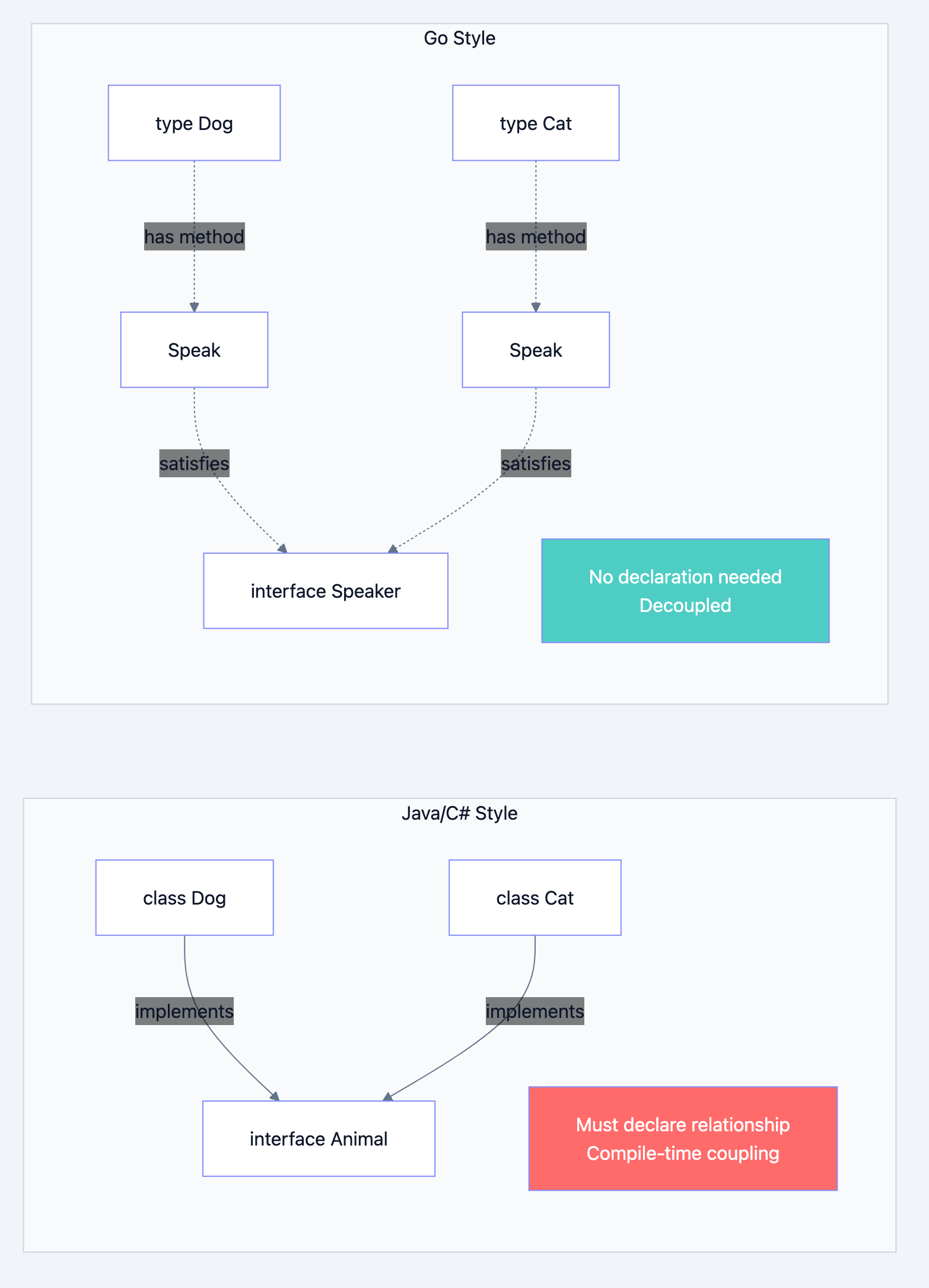
Design principles diagram 1
The USB Port Analogy (Revisited for Go)
Think of a Go interface as a USB port, but with a twist:
Traditional interfaces are like proprietary connectors. The cable manufacturer must explicitly license and implement the connector spec. They declare "this cable is USB-C compatible."
Go interfaces are like a universal scanner. Any device that happens to have the right electrical contacts will work. The device doesn't need to know about the scanner - it just needs to have the right shape.
This means:
- Third-party types can satisfy your interfaces without modification
- You can create interfaces for types you don't own
- Interfaces can be defined where they're used, not where types are defined
Interface Basics: The Foundation
Defining Interfaces
An interface is a collection of method signatures:
go// Filename: interface_basics.go
package main

import (
    "fmt"
    "math"
)

// =============================================================================
// INTERFACE DEFINITION
// =============================================================================

// Shape defines what all shapes must do
// Why: An interface is just method signatures
// Why: No fields, no implementation, just the contract
type Shape interface {
    Area() float64
    Perimeter() float64
}

// Namer is a simple single-method interface
type Namer interface {
    Name() string
}

// ShapeWithName composes two interfaces
type ShapeWithName interface {
    Shape
    Namer
}

// =============================================================================
// IMPLEMENTATIONS
// =============================================================================

// Rectangle implements Shape
type Rectangle struct {
    Width  float64
    Height float64
}

// Area implements Shape.Area
func (r Rectangle) Area() float64 {
    return r.Width * r.Height
}

// Perimeter implements Shape.Perimeter
func (r Rectangle) Perimeter() float64 {
    return 2 * (r.Width + r.Height)
}

// Name implements Namer
func (r Rectangle) Name() string {
    return "Rectangle"
}

// Circle implements Shape
type Circle struct {
    Radius float64
}

func (c Circle) Area() float64 {
    return math.Pi * c.Radius * c.Radius
}

func (c Circle) Perimeter() float64 {
    return 2 * math.Pi * c.Radius
}

func (c Circle) Name() string {
    return "Circle"
}

// Triangle implements Shape
type Triangle struct {
    Base   float64
    Height float64
    SideA  float64
    SideB  float64
    SideC  float64
}

func (t Triangle) Area() float64 {
    return 0.5 * t.Base * t.Height
}

func (t Triangle) Perimeter() float64 {
    return t.SideA + t.SideB + t.SideC
}

func (t Triangle) Name() string {
    return "Triangle"
}

// =============================================================================
// FUNCTIONS THAT USE INTERFACES
// =============================================================================

// PrintShapeInfo works with ANY Shape
// Why: The function doesn't care about the concrete type
func PrintShapeInfo(s Shape) {
    fmt.Printf("Area: %.2f, Perimeter: %.2f\n", s.Area(), s.Perimeter())
}

// PrintWithName works with anything that has both Shape and Namer methods
func PrintWithName(s ShapeWithName) {
    fmt.Printf("%s - Area: %.2f, Perimeter: %.2f\n",
        s.Name(), s.Area(), s.Perimeter())
}

// TotalArea calculates total area of any shapes
func TotalArea(shapes []Shape) float64 {
    var total float64
    for _, shape := range shapes {
        total += shape.Area()
    }
    return total
}

func main() {
    fmt.Println("╔══════════════════════════════════════════════════════════╗")
    fmt.Println("║              GO INTERFACES: BASICS                        ║")
    fmt.Println("╚══════════════════════════════════════════════════════════╝")

    // Create shapes
    rect := Rectangle{Width: 10, Height: 5}
    circle := Circle{Radius: 7}
    triangle := Triangle{
        Base: 6, Height: 4,
        SideA: 5, SideB: 5, SideC: 6,
    }

    // All shapes work with the same function
    fmt.Println("\n📐 Individual shapes:")
    fmt.Print("Rectangle: ")
    PrintShapeInfo(rect)
    fmt.Print("Circle: ")
    PrintShapeInfo(circle)
    fmt.Print("Triangle: ")
    PrintShapeInfo(triangle)

    // Using composed interface
    fmt.Println("\n📐 With names (composed interface):")
    PrintWithName(rect)
    PrintWithName(circle)
    PrintWithName(triangle)

    // Slice of interfaces
    fmt.Println("\n📐 Total area calculation:")
    shapes := []Shape{rect, circle, triangle}
    fmt.Printf("Total area of all shapes: %.2f\n", TotalArea(shapes))
}
Expected Output:
╔══════════════════════════════════════════════════════════╗
║              GO INTERFACES: BASICS                        ║
╚══════════════════════════════════════════════════════════╝

📐 Individual shapes:
Rectangle: Area: 50.00, Perimeter: 30.00
Circle: Area: 153.94, Perimeter: 43.98
Triangle: Area: 12.00, Perimeter: 16.00

📐 With names (composed interface):
Rectangle - Area: 50.00, Perimeter: 30.00
Circle - Area: 153.94, Perimeter: 43.98
Triangle - Area: 12.00, Perimeter: 16.00

📐 Total area calculation:
Total area of all shapes: 215.94
The Empty Interface: any
The empty interface
interface{} (aliased as any in Go 1.18+) has zero methods. Since every type has at least zero methods, every type implements the empty interface.go// Filename: empty_interface.go package main import "fmt" // Container can hold anything type Container struct { items []any // any == interface{} } func (c *Container) Add(item any) { c.items = append(c.items, item) } func (c *Container) Get(index int) any { if index < 0 || index >= len(c.items) { return nil } return c.items[index] } func (c *Container) Print() { for i, item := range c.items { fmt.Printf("[%d] Type: %T, Value: %v\n", i, item, item) } } func main() { fmt.Println("╔══════════════════════════════════════════════════════════╗") fmt.Println("║ THE EMPTY INTERFACE (any) ║") fmt.Println("╚══════════════════════════════════════════════════════════╝") container := &Container{} // Can add any type! container.Add(42) container.Add("hello") container.Add(3.14) container.Add([]int{1, 2, 3}) container.Add(struct{ Name string }{"Alice"}) fmt.Println("\nContainer contents:") container.Print() // But you lose type safety! fmt.Println("\n⚠️ Warning: You lose type information") item := container.Get(0) // item is 'any' - you need type assertion to use it // num := item + 1 // ERROR: cannot add if num, ok := item.(int); ok { fmt.Printf("Got int: %d, doubled: %d\n", num, num*2) } }
When to use
any:- JSON parsing with unknown structure
- Generic containers (before Go 1.18 generics)
- Plugin systems
- Reflection-based code
When NOT to use
any:- When you know the types (use proper types!)
- When type safety matters (use specific interfaces)
- When performance is critical (type assertions have overhead)
Type Assertions and Type Switches
When you have an interface value, sometimes you need to get the concrete type back.
go// Filename: type_assertions.go
package main

import "fmt"

// Animal interface
type Animal interface {
    Speak() string
}

// Dog implementation
type Dog struct {
    Name string
}

func (d Dog) Speak() string {
    return "Woof!"
}

func (d Dog) Fetch() string {
    return fmt.Sprintf("%s fetches the ball!", d.Name)
}

// Cat implementation
type Cat struct {
    Name string
}

func (c Cat) Speak() string {
    return "Meow!"
}

func (c Cat) Scratch() string {
    return fmt.Sprintf("%s scratches the furniture!", c.Name)
}

// Bird implementation
type Bird struct {
    Name string
}

func (b Bird) Speak() string {
    return "Tweet!"
}

func (b Bird) Fly() string {
    return fmt.Sprintf("%s flies away!", b.Name)
}

// =============================================================================
// TYPE ASSERTIONS
// =============================================================================

// ProcessAnimal demonstrates type assertions
func ProcessAnimal(a Animal) {
    fmt.Printf("Animal says: %s\n", a.Speak())

    // Type assertion with comma-ok idiom
    // Why: Safe way to check if animal is a specific type
    if dog, ok := a.(Dog); ok {
        fmt.Printf("  It's a dog named %s!\n", dog.Name)
        fmt.Printf("  %s\n", dog.Fetch())
        return
    }

    if cat, ok := a.(Cat); ok {
        fmt.Printf("  It's a cat named %s!\n", cat.Name)
        fmt.Printf("  %s\n", cat.Scratch())
        return
    }

    fmt.Println("  It's some other animal")
}

// =============================================================================
// TYPE SWITCH
// =============================================================================

// DescribeAnimal uses type switch for cleaner multiple type handling
func DescribeAnimal(a Animal) string {
    // Type switch: like a switch statement, but on types
    switch v := a.(type) {
    case Dog:
        return fmt.Sprintf("Dog named %s who can fetch", v.Name)
    case Cat:
        return fmt.Sprintf("Cat named %s who likes to scratch", v.Name)
    case Bird:
        return fmt.Sprintf("Bird named %s who can fly", v.Name)
    default:
        return fmt.Sprintf("Unknown animal: %T", v)
    }
}

// ProcessAny handles any type
func ProcessAny(v any) string {
    switch x := v.(type) {
    case string:
        return fmt.Sprintf("String of length %d: %q", len(x), x)
    case int:
        return fmt.Sprintf("Integer: %d (doubled: %d)", x, x*2)
    case float64:
        return fmt.Sprintf("Float: %.2f", x)
    case bool:
        return fmt.Sprintf("Boolean: %t", x)
    case []int:
        return fmt.Sprintf("Int slice with %d elements: %v", len(x), x)
    case nil:
        return "Nil value"
    default:
        return fmt.Sprintf("Unknown type: %T", x)
    }
}

func main() {
    fmt.Println("╔══════════════════════════════════════════════════════════╗")
    fmt.Println("║         TYPE ASSERTIONS AND TYPE SWITCHES                 ║")
    fmt.Println("╚══════════════════════════════════════════════════════════╝")

    animals := []Animal{
        Dog{Name: "Buddy"},
        Cat{Name: "Whiskers"},
        Bird{Name: "Tweety"},
    }

    fmt.Println("\n📋 Type Assertions (comma-ok idiom):")
    fmt.Println("─"*50)
    for _, animal := range animals {
        ProcessAnimal(animal)
        fmt.Println()
    }

    fmt.Println("📋 Type Switch:")
    fmt.Println("─"*50)
    for _, animal := range animals {
        fmt.Println(DescribeAnimal(animal))
    }

    fmt.Println("\n📋 Processing Any Type:")
    fmt.Println("─"*50)
    values := []any{
        "hello",
        42,
        3.14,
        true,
        []int{1, 2, 3},
        nil,
        struct{ X int }{42},
    }

    for _, v := range values {
        fmt.Println(ProcessAny(v))
    }
}
Interface Composition: Building Bigger Interfaces
Go encourages small, focused interfaces. Combine them when needed.
go// Filename: interface_composition.go
package main

import (
    "fmt"
    "io"
    "strings"
)

// =============================================================================
// SMALL, FOCUSED INTERFACES (Like Go's standard library)
// =============================================================================

// Reader reads data
type Reader interface {
    Read(p []byte) (n int, err error)
}

// Writer writes data
type Writer interface {
    Write(p []byte) (n int, err error)
}

// Closer closes a resource
type Closer interface {
    Close() error
}

// Seeker seeks to a position
type Seeker interface {
    Seek(offset int64, whence int) (int64, error)
}

// =============================================================================
// COMPOSED INTERFACES
// =============================================================================

// ReadWriter combines Reader and Writer
type ReadWriter interface {
    Reader
    Writer
}

// ReadWriteCloser combines Reader, Writer, and Closer
type ReadWriteCloser interface {
    Reader
    Writer
    Closer
}

// ReadWriteSeeker combines Reader, Writer, and Seeker
type ReadWriteSeeker interface {
    Reader
    Writer
    Seeker
}

// =============================================================================
// IMPLEMENTATION
// =============================================================================

// Buffer implements multiple interfaces
type Buffer struct {
    data   []byte
    pos    int
    closed bool
}

func NewBuffer() *Buffer {
    return &Buffer{data: make([]byte, 0)}
}

// Read implements Reader
func (b *Buffer) Read(p []byte) (int, error) {
    if b.closed {
        return 0, fmt.Errorf("buffer is closed")
    }
    if b.pos >= len(b.data) {
        return 0, io.EOF
    }
    n := copy(p, b.data[b.pos:])
    b.pos += n
    return n, nil
}

// Write implements Writer
func (b *Buffer) Write(p []byte) (int, error) {
    if b.closed {
        return 0, fmt.Errorf("buffer is closed")
    }
    b.data = append(b.data, p...)
    return len(p), nil
}

// Close implements Closer
func (b *Buffer) Close() error {
    b.closed = true
    return nil
}

// Seek implements Seeker
func (b *Buffer) Seek(offset int64, whence int) (int64, error) {
    var newPos int64
    switch whence {
    case io.SeekStart:
        newPos = offset
    case io.SeekCurrent:
        newPos = int64(b.pos) + offset
    case io.SeekEnd:
        newPos = int64(len(b.data)) + offset
    }
    if newPos < 0 {
        return 0, fmt.Errorf("negative position")
    }
    b.pos = int(newPos)
    return newPos, nil
}

// String returns buffer contents as string
func (b *Buffer) String() string {
    return string(b.data)
}

// =============================================================================
// FUNCTIONS USING COMPOSED INTERFACES
// =============================================================================

// Copy reads from Reader and writes to Writer
// Why: Works with any Reader and Writer, not specific types
func Copy(dst Writer, src Reader) (int64, error) {
    buf := make([]byte, 32*1024) // 32KB buffer
    var total int64

    for {
        n, readErr := src.Read(buf)
        if n > 0 {
            written, writeErr := dst.Write(buf[:n])
            total += int64(written)
            if writeErr != nil {
                return total, writeErr
            }
        }
        if readErr == io.EOF {
            return total, nil
        }
        if readErr != nil {
            return total, readErr
        }
    }
}

// ProcessAndClose reads all data and closes the source
func ProcessAndClose(rc io.ReadCloser) (string, error) {
    defer rc.Close()

    var builder strings.Builder
    buf := make([]byte, 1024)

    for {
        n, err := rc.Read(buf)
        if n > 0 {
            builder.Write(buf[:n])
        }
        if err == io.EOF {
            break
        }
        if err != nil {
            return "", err
        }
    }

    return builder.String(), nil
}

func main() {
    fmt.Println("╔══════════════════════════════════════════════════════════╗")
    fmt.Println("║            INTERFACE COMPOSITION                          ║")
    fmt.Println("╚══════════════════════════════════════════════════════════╝")

    // Create buffer
    buf := NewBuffer()

    // Use as Writer
    fmt.Println("\n✍️ Writing to buffer (as Writer):")
    buf.Write([]byte("Hello, "))
    buf.Write([]byte("Interface "))
    buf.Write([]byte("Composition!"))
    fmt.Printf("   Buffer contents: %q\n", buf.String())

    // Use as Seeker
    fmt.Println("\n🔍 Seeking to start (as Seeker):")
    buf.Seek(0, io.SeekStart)

    // Use as Reader
    fmt.Println("\n📖 Reading from buffer (as Reader):")
    readBuf := make([]byte, 7)
    buf.Read(readBuf)
    fmt.Printf("   Read: %q\n", string(readBuf))

    // Copy between buffers
    fmt.Println("\n📋 Copying between buffers (Reader -> Writer):")
    src := NewBuffer()
    src.Write([]byte("This is the source data!"))
    src.Seek(0, io.SeekStart)

    dst := NewBuffer()
    copied, _ := Copy(dst, src)
    fmt.Printf("   Copied %d bytes\n", copied)
    fmt.Printf("   Destination: %q\n", dst.String())

    // Demonstrate interface satisfaction
    fmt.Println("\n📊 Interface Satisfaction:")
    fmt.Println("─"*50)

    var _ Reader = buf           // ✓ Buffer satisfies Reader
    var _ Writer = buf           // ✓ Buffer satisfies Writer
    var _ Closer = buf           // ✓ Buffer satisfies Closer
    var _ Seeker = buf           // ✓ Buffer satisfies Seeker
    var _ ReadWriter = buf       // ✓ Buffer satisfies ReadWriter
    var _ ReadWriteCloser = buf  // ✓ Buffer satisfies ReadWriteCloser
    var _ ReadWriteSeeker = buf  // ✓ Buffer satisfies ReadWriteSeeker

    fmt.Println("   Buffer satisfies all composed interfaces!")

    fmt.Println("\n" + "═"*60)
    fmt.Println("COMPOSITION BENEFITS:")
    fmt.Println("  ✓ Small interfaces are easy to implement")
    fmt.Println("  ✓ Functions request only what they need")
    fmt.Println("  ✓ New compositions without new code")
    fmt.Println("  ✓ Maximum flexibility, minimum coupling")
    fmt.Println("═"*60)
}
Interface Best Practices
1. Keep Interfaces Small
go// BAD: Large interface
type UserManager interface {
    Create(user User) error
    Read(id int) (User, error)
    Update(user User) error
    Delete(id int) error
    List() ([]User, error)
    Search(query string) ([]User, error)
    Validate(user User) error
    Hash(password string) string
    SendEmail(user User, template string) error
    GenerateReport(users []User) Report
}

// GOOD: Small, focused interfaces
type UserCreator interface {
    Create(user User) error
}

type UserReader interface {
    Read(id int) (User, error)
}

type UserUpdater interface {
    Update(user User) error
}

type UserDeleter interface {
    Delete(id int) error
}

// Compose when needed
type UserReadWriter interface {
    UserReader
    UserUpdater
}
2. Accept Interfaces, Return Structs
go// BAD: Returning interface
func NewLogger() Logger {
    return &FileLogger{} // Returns interface
}

// GOOD: Return concrete type
func NewFileLogger(path string) *FileLogger {
    return &FileLogger{path: path}
}

// BAD: Accepting concrete type
func ProcessUser(repo *PostgresUserRepo, id int) error {
    // Tightly coupled to Postgres
}

// GOOD: Accept interface
func ProcessUser(repo UserReader, id int) error {
    // Works with any UserReader implementation
}
3. Define Interfaces Where They're Used
go// BAD: Defining interface in the implementation package
// file: database/user_repo.go
package database

type UserRepository interface {
    Find(id int) (User, error)
}

type PostgresUserRepo struct{}

func (p *PostgresUserRepo) Find(id int) (User, error) { ... }

// GOOD: Define interface in the consumer package
// file: handlers/user_handler.go
package handlers

// Interface defined where it's USED, not where it's implemented
type UserFinder interface {
    Find(id int) (User, error)
}

type UserHandler struct {
    finder UserFinder // Can use any implementation
}
4. Don't Export Interfaces for Types You Own
go// BAD: Exporting interface when you only have one implementation
type Validator interface {
    Validate(data interface{}) error
}

type DefaultValidator struct{}

// GOOD: Just export the concrete type
// Add interface later when you actually need polymorphism
type Validator struct{}

func (v *Validator) Validate(data interface{}) error { ... }
Real World Pattern: Dependency Injection with Interfaces
go// Filename: dependency_injection.go
package main

import (
    "fmt"
    "time"
)

// =============================================================================
// INTERFACES: Define contracts
// =============================================================================

type UserRepository interface {
    FindByID(id int) (*User, error)
    Save(user *User) error
}

type EmailService interface {
    Send(to, subject, body string) error
}

type Logger interface {
    Info(msg string)
    Error(msg string)
}

type Clock interface {
    Now() time.Time
}

// =============================================================================
// DOMAIN
// =============================================================================

type User struct {
    ID        int
    Email     string
    Name      string
    LastLogin time.Time
}

// =============================================================================
// SERVICE: Depends on interfaces, not implementations
// =============================================================================

type UserService struct {
    repo   UserRepository
    email  EmailService
    logger Logger
    clock  Clock
}

func NewUserService(
    repo UserRepository,
    email EmailService,
    logger Logger,
    clock Clock,
) *UserService {
    return &UserService{
        repo:   repo,
        email:  email,
        logger: logger,
        clock:  clock,
    }
}

func (s *UserService) Login(userID int) error {
    s.logger.Info(fmt.Sprintf("User %d attempting login", userID))

    user, err := s.repo.FindByID(userID)
    if err != nil {
        s.logger.Error(fmt.Sprintf("User %d not found: %v", userID, err))
        return err
    }

    user.LastLogin = s.clock.Now()
    if err := s.repo.Save(user); err != nil {
        s.logger.Error(fmt.Sprintf("Failed to update user: %v", err))
        return err
    }

    s.logger.Info(fmt.Sprintf("User %s logged in successfully", user.Name))
    return nil
}

func (s *UserService) SendWelcome(userID int) error {
    user, err := s.repo.FindByID(userID)
    if err != nil {
        return err
    }

    return s.email.Send(
        user.Email,
        "Welcome!",
        fmt.Sprintf("Hello %s, welcome to our platform!", user.Name),
    )
}

// =============================================================================
// PRODUCTION IMPLEMENTATIONS
// =============================================================================

type PostgresUserRepo struct{}

func (p *PostgresUserRepo) FindByID(id int) (*User, error) {
    fmt.Printf("[POSTGRES] Finding user %d\n", id)
    return &User{ID: id, Name: "Alice", Email: "alice@example.com"}, nil
}

func (p *PostgresUserRepo) Save(user *User) error {
    fmt.Printf("[POSTGRES] Saving user %d\n", user.ID)
    return nil
}

type SMTPEmailService struct{}

func (s *SMTPEmailService) Send(to, subject, body string) error {
    fmt.Printf("[SMTP] Sending to %s: %s\n", to, subject)
    return nil
}

type ConsoleLogger struct{}

func (c *ConsoleLogger) Info(msg string) {
    fmt.Printf("[INFO] %s\n", msg)
}

func (c *ConsoleLogger) Error(msg string) {
    fmt.Printf("[ERROR] %s\n", msg)
}

type RealClock struct{}

func (r *RealClock) Now() time.Time {
    return time.Now()
}

// =============================================================================
// TEST IMPLEMENTATIONS (Mocks)
// =============================================================================

type MockUserRepo struct {
    users     map[int]*User
    SaveCalls int
}

func NewMockUserRepo() *MockUserRepo {
    return &MockUserRepo{
        users: map[int]*User{
            1: {ID: 1, Name: "Test User", Email: "test@test.com"},
        },
    }
}

func (m *MockUserRepo) FindByID(id int) (*User, error) {
    if user, ok := m.users[id]; ok {
        return user, nil
    }
    return nil, fmt.Errorf("user not found")
}

func (m *MockUserRepo) Save(user *User) error {
    m.SaveCalls++
    m.users[user.ID] = user
    return nil
}

type MockEmailService struct {
    SentEmails []struct {
        To, Subject, Body string
    }
}

func (m *MockEmailService) Send(to, subject, body string) error {
    m.SentEmails = append(m.SentEmails, struct {
        To, Subject, Body string
    }{to, subject, body})
    return nil
}

type MockLogger struct {
    Messages []string
}

func (m *MockLogger) Info(msg string) {
    m.Messages = append(m.Messages, "[INFO] "+msg)
}

func (m *MockLogger) Error(msg string) {
    m.Messages = append(m.Messages, "[ERROR] "+msg)
}

type MockClock struct {
    Time time.Time
}

func (m *MockClock) Now() time.Time {
    return m.Time
}

// =============================================================================
// DEMONSTRATION
// =============================================================================

func main() {
    fmt.Println("╔══════════════════════════════════════════════════════════╗")
    fmt.Println("║        DEPENDENCY INJECTION WITH INTERFACES               ║")
    fmt.Println("╚══════════════════════════════════════════════════════════╝")

    // Production setup
    fmt.Println("\n🏭 PRODUCTION MODE:")
    fmt.Println("─"*50)

    prodService := NewUserService(
        &PostgresUserRepo{},
        &SMTPEmailService{},
        &ConsoleLogger{},
        &RealClock{},
    )

    prodService.Login(1)
    prodService.SendWelcome(1)

    // Test setup
    fmt.Println("\n🧪 TEST MODE:")
    fmt.Println("─"*50)

    mockRepo := NewMockUserRepo()
    mockEmail := &MockEmailService{}
    mockLogger := &MockLogger{}
    mockClock := &MockClock{Time: time.Date(2024, 2, 13, 10, 0, 0, 0, time.UTC)}

    testService := NewUserService(mockRepo, mockEmail, mockLogger, mockClock)

    testService.Login(1)
    testService.SendWelcome(1)

    // Verify behavior
    fmt.Println("\n✅ TEST ASSERTIONS:")
    fmt.Printf("   Save called: %d times\n", mockRepo.SaveCalls)
    fmt.Printf("   Emails sent: %d\n", len(mockEmail.SentEmails))
    fmt.Printf("   Log messages: %d\n", len(mockLogger.Messages))
    fmt.Printf("   User last login: %s\n", mockRepo.users[1].LastLogin.Format(time.RFC3339))

    fmt.Println("\n" + "═"*60)
    fmt.Println("DEPENDENCY INJECTION BENEFITS:")
    fmt.Println("  ✓ Same service code, different implementations")
    fmt.Println("  ✓ Easy to test with mocks")
    fmt.Println("  ✓ Easy to swap implementations (Postgres → MySQL)")
    fmt.Println("  ✓ Loose coupling, high cohesion")
    fmt.Println("═"*60)
}
Common Interface Mistakes
Mistake 1: Nil Interface vs Nil Concrete Value
go// Filename: nil_interface_gotcha.go
package main

import "fmt"

type Printer interface {
    Print()
}

type ConsolePrinter struct {
    prefix string
}

func (c *ConsolePrinter) Print() {
    fmt.Println(c.prefix + "Hello!")
}

func GetPrinter(enabled bool) Printer {
    var printer *ConsolePrinter // nil pointer

    if enabled {
        printer = &ConsolePrinter{prefix: "> "}
    }

    return printer // DANGER: Returns interface with nil value!
}

func main() {
    fmt.Println("╔══════════════════════════════════════════════════════════╗")
    fmt.Println("║              NIL INTERFACE GOTCHA                         ║")
    fmt.Println("╚══════════════════════════════════════════════════════════╝")

    // Get disabled printer
    printer := GetPrinter(false)

    // This is surprising!
    fmt.Printf("printer == nil: %v\n", printer == nil)
    fmt.Printf("printer type: %T\n", printer)

    // The interface has:
    // - Type: *ConsolePrinter
    // - Value: nil
    // So interface != nil (it has a type!)

    // This will panic!
    // printer.Print() // PANIC: nil pointer dereference

    fmt.Println("\n⚠️ SOLUTION: Return nil explicitly")

    printer2 := GetPrinterFixed(false)
    fmt.Printf("printer2 == nil: %v\n", printer2 == nil)
}

func GetPrinterFixed(enabled bool) Printer {
    if !enabled {
        return nil // Return nil interface, not nil-valued interface
    }
    return &ConsolePrinter{prefix: "> "}
}
Mistake 2: Pointer vs Value Receivers
go// Filename: receiver_types.go
package main

import "fmt"

type Counter interface {
    Increment()
    Value() int
}

// ValueCounter uses value receiver
type ValueCounter struct {
    count int
}

func (v ValueCounter) Increment() {
    v.count++ // This modifies a COPY!
}

func (v ValueCounter) Value() int {
    return v.count
}

// PointerCounter uses pointer receiver
type PointerCounter struct {
    count int
}

func (p *PointerCounter) Increment() {
    p.count++ // This modifies the original
}

func (p *PointerCounter) Value() int {
    return p.count
}

func main() {
    fmt.Println("╔══════════════════════════════════════════════════════════╗")
    fmt.Println("║          POINTER VS VALUE RECEIVERS                       ║")
    fmt.Println("╚══════════════════════════════════════════════════════════╝")

    // Value receiver - Increment doesn't work!
    fmt.Println("\n📋 Value Receiver:")
    var c1 Counter = ValueCounter{count: 0}
    c1.Increment()
    c1.Increment()
    c1.Increment()
    fmt.Printf("After 3 increments: %d (Expected: 3, Got: 0!)\n", c1.Value())

    // Pointer receiver - Works correctly
    fmt.Println("\n📋 Pointer Receiver:")
    var c2 Counter = &PointerCounter{count: 0}
    c2.Increment()
    c2.Increment()
    c2.Increment()
    fmt.Printf("After 3 increments: %d (Correct!)\n", c2.Value())

    // Note: Value receiver CAN be assigned to interface
    // But pointer receiver MUST use pointer
    // var c3 Counter = PointerCounter{} // ERROR!
    var c4 Counter = &PointerCounter{} // OK
    _ = c4
}
Summary: Go Interfaces Mastery
Key Concepts
| Concept | Description |
|---|---|
| Implicit Implementation | No "implements" keyword needed |
| Interface Composition | Combine small interfaces |
Empty Interface (any) | Accepts any type |
| Type Assertions | Get concrete type from interface |
| Type Switches | Handle multiple types cleanly |
| Pointer Receivers | Use when methods modify state |
Best Practices Checklist
| Practice | Benefit |
|---|---|
| Keep interfaces small | Easy to implement, compose |
| Accept interfaces, return structs | Flexible inputs, concrete outputs |
| Define interfaces at usage site | Decoupled design |
| Use composition over large interfaces | Better abstraction |
| Return nil explicitly | Avoid nil interface gotcha |
| Use pointer receivers for mutations | Correct behavior |
Your Next Steps
- Review your existing interfaces - are they too large?
- Define interfaces where they're used, not where types are defined
- Write tests using mock implementations
- Practice type assertions and switches
- Study the standard library interfaces (io.Reader, io.Writer, etc.)
"The bigger the interface, the weaker the abstraction." - Rob Pike
Go interfaces are your most powerful tool for building flexible, maintainable, and testable software. Master them, and you'll write Go code that stands the test of time.