YAGNI Principle: Stop Building What You Don't Need
The Feature Nobody Used
I once worked on a team that spent three months building a sophisticated reporting system. It had:
- Custom report builder with drag-and-drop
- 47 different chart types
- Scheduled email delivery
- Export to 12 different formats
- Real-time collaborative editing
- AI-powered insights
We were proud of our engineering. It was beautiful, flexible, and powerful.
One year later, we checked the analytics:
- Total users of the feature: 3
- Reports created: 7
- Most used export format: PDF (one of the original 2 formats)
- Chart types used: Bar and Line (2 out of 47)
We had spent three months building something almost nobody wanted. That time could have been spent on features users were actually requesting.
This is what happens when you ignore YAGNI.
What is YAGNI?
YAGNI stands for "You Aren't Gonna Need It."
It's a principle from Extreme Programming (XP) that states:
"Always implement things when you actually need them, never when you just foresee that you need them."
In other words: Don't build features for imaginary future requirements.
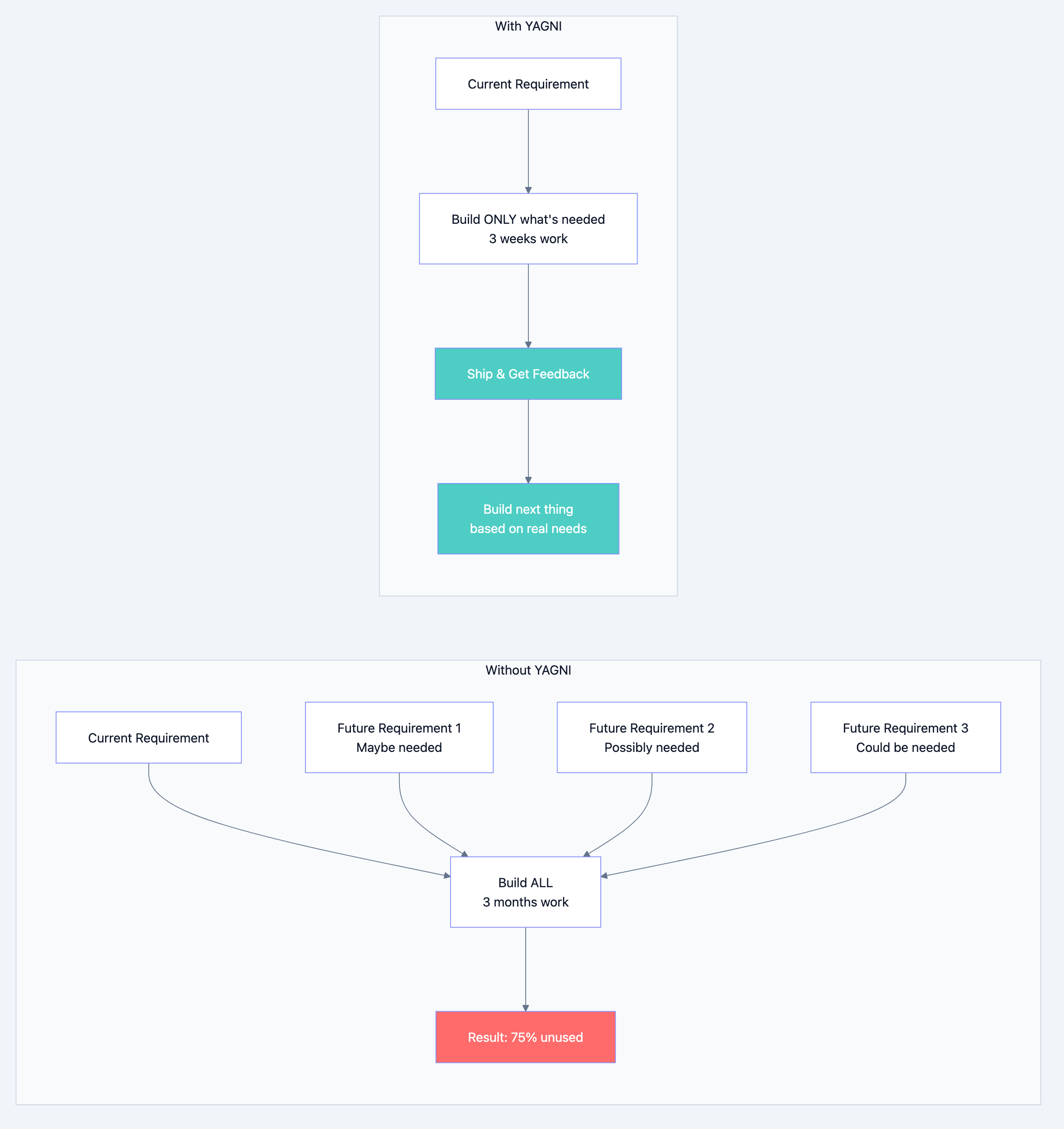
Design principles diagram 1
Why We Over-Engineer
Before we dive into solutions, let's understand why we violate YAGNI so often:
1. The Fear of Future Changes
"What if we need to support multiple databases later?"
So we build an abstract database layer with pluggable adapters, factory patterns, and configuration systems... for an app that will only ever use PostgreSQL.
2. The Resume-Driven Development
"This would be a great opportunity to use Kubernetes, microservices, and event sourcing!"
So we architect a distributed system for an app with 100 users that could run perfectly on a single $5 server.
3. The "Just In Case" Mentality
"Just in case we need to scale to millions of users..."
So we build for scale before we have 100 users, wasting months on problems we may never have.
4. The Perfectionist Trap
"The code should be beautiful and handle every edge case..."
So we spend weeks polishing features instead of shipping and learning from real users.

Design principles diagram 2
Real Examples of YAGNI Violations
Example 1: The Premature Plugin System
go// Filename: bad_plugin_system.go
// YAGNI VIOLATION: Building a plugin system for one implementation

package main

import (
    "fmt"
    "reflect"
)

// ============================================================================
// This is MASSIVE over-engineering for a simple notification need!
// ============================================================================

// PluginMetadata describes a plugin
type PluginMetadata struct {
    Name        string
    Version     string
    Author      string
    Description string
    Hooks       []string
}

// Plugin is the interface all plugins must implement
type Plugin interface {
    GetMetadata() PluginMetadata
    Initialize(config map[string]interface{}) error
    Execute(context PluginContext) (PluginResult, error)
    Cleanup() error
}

// PluginContext provides context to plugins
type PluginContext struct {
    RequestID  string
    UserID     string
    Data       map[string]interface{}
    Extensions map[string]Plugin
}

// PluginResult contains the result of plugin execution
type PluginResult struct {
    Success bool
    Data    interface{}
    Errors  []error
}

// PluginRegistry manages plugin registration and lifecycle
type PluginRegistry struct {
    plugins    map[string]Plugin
    hooks      map[string][]Plugin
    order      []string
    middleware []PluginMiddleware
}

// PluginMiddleware wraps plugin execution
type PluginMiddleware func(Plugin, PluginContext) PluginResult

// PluginLoader loads plugins dynamically
type PluginLoader struct {
    searchPaths []string
    cache       map[string]Plugin
}

// ... 500 more lines of plugin infrastructure ...

// EmailNotificationPlugin is our ONE notification type!
// All this infrastructure for ONE plugin!
type EmailNotificationPlugin struct{}

func (e *EmailNotificationPlugin) GetMetadata() PluginMetadata {
    return PluginMetadata{
        Name:    "email",
        Version: "1.0.0",
    }
}

func (e *EmailNotificationPlugin) Initialize(config map[string]interface{}) error {
    return nil
}

func (e *EmailNotificationPlugin) Execute(ctx PluginContext) (PluginResult, error) {
    // Finally, the actual work - send an email
    fmt.Println("Sending email...")
    return PluginResult{Success: true}, nil
}

func (e *EmailNotificationPlugin) Cleanup() error {
    return nil
}

// All we needed was to send an email!
Here's the YAGNI-compliant version:
go// Filename: good_simple_notification.go
// YAGNI COMPLIANT: Build only what you need now

package main

import (
    "fmt"
    "net/smtp"
)

// =============================================================================
// SIMPLE SOLUTION: Just send the email!
// =============================================================================

// EmailConfig holds email configuration
type EmailConfig struct {
    SMTPHost string
    SMTPPort string
    From     string
    Password string
}

// SendEmail sends an email
// Why: This is ALL we need right now
// Why: If we need SMS later, we add it THEN, not now
func SendEmail(config EmailConfig, to, subject, body string) error {
    auth := smtp.PlainAuth("", config.From, config.Password, config.SMTPHost)

    msg := fmt.Sprintf("Subject: %s\r\n\r\n%s", subject, body)

    addr := fmt.Sprintf("%s:%s", config.SMTPHost, config.SMTPPort)
    return smtp.SendMail(addr, auth, config.From, []string{to}, []byte(msg))
}

// NotifyUser sends a notification email to a user
func NotifyUser(config EmailConfig, userEmail, message string) error {
    return SendEmail(config, userEmail, "Notification", message)
}

func main() {
    config := EmailConfig{
        SMTPHost: "smtp.example.com",
        SMTPPort: "587",
        From:     "noreply@example.com",
        Password: "secret",
    }

    // Simple and direct!
    err := NotifyUser(config, "user@example.com", "Your order has shipped!")
    if err != nil {
        fmt.Printf("Failed to send: %v\n", err)
    } else {
        fmt.Println("Notification sent!")
    }

    // Total lines of code: ~30
    // vs Plugin System: ~500+
    // Time to implement: 30 minutes vs 2 days
}
Example 2: The Premature Abstraction
go// Filename: bad_premature_abstraction.go
// YAGNI VIOLATION: Abstracting before you have multiple implementations

package main

// IUserRepository defines user data operations
type IUserRepository interface {
    Save(user User) error
    FindByID(id int) (User, error)
    FindByEmail(email string) (User, error)
    FindAll() ([]User, error)
    Update(user User) error
    Delete(id int) error
}

// IUserService defines user business logic
type IUserService interface {
    Register(name, email, password string) (User, error)
    Authenticate(email, password string) (User, error)
    UpdateProfile(id int, name string) error
    ChangePassword(id int, oldPass, newPass string) error
}

// IPasswordHasher defines password hashing
type IPasswordHasher interface {
    Hash(password string) (string, error)
    Verify(hash, password string) bool
}

// IEmailValidator defines email validation
type IEmailValidator interface {
    Validate(email string) error
}

// IUserFactory creates users
type IUserFactory interface {
    CreateUser(name, email, password string) User
}

// UserRepositoryImpl is the ONLY implementation
type UserRepositoryImpl struct {
    // We only use PostgreSQL, we only WILL use PostgreSQL
}

// UserServiceImpl is the ONLY implementation
type UserServiceImpl struct {
    repo     IUserRepository
    hasher   IPasswordHasher
    validate IEmailValidator
    factory  IUserFactory
}

// We have 5 interfaces but only ONE implementation of each!
// All this ceremony for nothing!
The YAGNI version:
go// Filename: good_simple_user.go
// YAGNI COMPLIANT: Concrete implementation, interface when needed

package main

import (
    "crypto/sha256"
    "encoding/hex"
    "fmt"
    "regexp"
    "sync"
)

// =============================================================================
// SIMPLE SOLUTION: Concrete types, add interfaces ONLY when you need them
// =============================================================================

// User represents a user
type User struct {
    ID           int
    Name         string
    Email        string
    PasswordHash string
}

// UserStore manages users (concrete implementation)
// Why: We only have one storage backend (in-memory for this example)
// Why: If we need PostgreSQL, we refactor THEN
type UserStore struct {
    users  map[int]User
    nextID int
    mu     sync.RWMutex
}

// NewUserStore creates a new user store
func NewUserStore() *UserStore {
    return &UserStore{
        users:  make(map[int]User),
        nextID: 1,
    }
}

// Save saves a user
func (s *UserStore) Save(user *User) error {
    s.mu.Lock()
    defer s.mu.Unlock()

    user.ID = s.nextID
    s.users[user.ID] = *user
    s.nextID++
    return nil
}

// FindByID finds a user by ID
func (s *UserStore) FindByID(id int) (User, bool) {
    s.mu.RLock()
    defer s.mu.RUnlock()

    user, exists := s.users[id]
    return user, exists
}

// FindByEmail finds a user by email
func (s *UserStore) FindByEmail(email string) (User, bool) {
    s.mu.RLock()
    defer s.mu.RUnlock()

    for _, user := range s.users {
        if user.Email == email {
            return user, true
        }
    }
    return User{}, false
}

// hashPassword hashes a password (simple, just a function)
// Why: No interface needed - we only have one way to hash passwords
func hashPassword(password string) string {
    hash := sha256.Sum256([]byte(password))
    return hex.EncodeToString(hash[:])
}

// validateEmail validates an email (simple, just a function)
// Why: No interface needed - email validation doesn't need polymorphism
func validateEmail(email string) error {
    pattern := `^[a-zA-Z0-9._%+-]+@[a-zA-Z0-9.-]+\.[a-zA-Z]{2,}$`
    if matched, _ := regexp.MatchString(pattern, email); !matched {
        return fmt.Errorf("invalid email format")
    }
    return nil
}

// RegisterUser registers a new user
// Why: Simple function, not a "service" with injected dependencies
func RegisterUser(store *UserStore, name, email, password string) (*User, error) {
    // Validate
    if err := validateEmail(email); err != nil {
        return nil, err
    }

    // Check if exists
    if _, exists := store.FindByEmail(email); exists {
        return nil, fmt.Errorf("email already registered")
    }

    // Create user
    user := &User{
        Name:         name,
        Email:        email,
        PasswordHash: hashPassword(password),
    }

    // Save
    if err := store.Save(user); err != nil {
        return nil, err
    }

    return user, nil
}

// AuthenticateUser authenticates a user
func AuthenticateUser(store *UserStore, email, password string) (*User, error) {
    user, exists := store.FindByEmail(email)
    if !exists {
        return nil, fmt.Errorf("user not found")
    }

    if user.PasswordHash != hashPassword(password) {
        return nil, fmt.Errorf("invalid password")
    }

    return &user, nil
}

func main() {
    fmt.Println("╔══════════════════════════════════════════════════════════╗")
    fmt.Println("║            YAGNI: Simple User Management                 ║")
    fmt.Println("╚══════════════════════════════════════════════════════════╝")

    store := NewUserStore()

    // Register users
    fmt.Println("\n👤 Registering users:")
    fmt.Println("─"*50)

    user1, err := RegisterUser(store, "Alice", "alice@example.com", "password123")
    if err != nil {
        fmt.Printf("❌ Failed: %v\n", err)
    } else {
        fmt.Printf("✅ Registered: %s (ID: %d)\n", user1.Name, user1.ID)
    }

    user2, err := RegisterUser(store, "Bob", "bob@example.com", "secret456")
    if err != nil {
        fmt.Printf("❌ Failed: %v\n", err)
    } else {
        fmt.Printf("✅ Registered: %s (ID: %d)\n", user2.Name, user2.ID)
    }

    // Try duplicate email
    _, err = RegisterUser(store, "Alice2", "alice@example.com", "pass")
    if err != nil {
        fmt.Printf("✅ Correctly rejected duplicate: %v\n", err)
    }

    // Authenticate
    fmt.Println("\n🔐 Authenticating:")
    fmt.Println("─"*50)

    authed, err := AuthenticateUser(store, "alice@example.com", "password123")
    if err != nil {
        fmt.Printf("❌ Auth failed: %v\n", err)
    } else {
        fmt.Printf("✅ Authenticated: %s\n", authed.Name)
    }

    // Wrong password
    _, err = AuthenticateUser(store, "alice@example.com", "wrongpassword")
    if err != nil {
        fmt.Printf("✅ Correctly rejected bad password: %v\n", err)
    }

    fmt.Println("\n" + "═"*60)
    fmt.Println("Lines of code: ~100 vs ~300+ with unnecessary interfaces")
    fmt.Println("Time to implement: 1 hour vs 4 hours")
    fmt.Println("Flexibility: Add interfaces WHEN you need them")
    fmt.Println("═"*60)
}
Expected Output:
╔══════════════════════════════════════════════════════════╗
║            YAGNI: Simple User Management                 ║
╚══════════════════════════════════════════════════════════╝

👤 Registering users:
──────────────────────────────────────────────────
✅ Registered: Alice (ID: 1)
✅ Registered: Bob (ID: 2)
✅ Correctly rejected duplicate: email already registered

🔐 Authenticating:
──────────────────────────────────────────────────
✅ Authenticated: Alice
✅ Correctly rejected bad password: invalid password

════════════════════════════════════════════════════════════
Lines of code: ~100 vs ~300+ with unnecessary interfaces
Time to implement: 1 hour vs 4 hours
Flexibility: Add interfaces WHEN you need them
════════════════════════════════════════════════════════════
Example 3: The Configurable Everything
go// Filename: bad_over_configurable.go
// YAGNI VIOLATION: Making everything configurable "just in case"

package main

import (
    "encoding/json"
    "time"
)

// ServerConfig with EVERY possible option
type ServerConfig struct {
    // Basic settings
    Host    string `json:"host"`
    Port    int    `json:"port"`
    Timeout int    `json:"timeout"`

    // SSL settings (we don't use SSL yet)
    SSLEnabled   bool   `json:"ssl_enabled"`
    SSLCertPath  string `json:"ssl_cert_path"`
    SSLKeyPath   string `json:"ssl_key_path"`
    SSLMinVersion string `json:"ssl_min_version"`

    // Rate limiting (we don't rate limit yet)
    RateLimitEnabled    bool `json:"rate_limit_enabled"`
    RateLimitRequests   int  `json:"rate_limit_requests"`
    RateLimitWindow     int  `json:"rate_limit_window"`
    RateLimitBurstSize  int  `json:"rate_limit_burst_size"`

    // Circuit breaker (we don't use this yet)
    CircuitBreakerEnabled    bool `json:"circuit_breaker_enabled"`
    CircuitBreakerThreshold  int  `json:"circuit_breaker_threshold"`
    CircuitBreakerTimeout    int  `json:"circuit_breaker_timeout"`

    // Caching (we don't cache yet)
    CacheEnabled      bool   `json:"cache_enabled"`
    CacheType         string `json:"cache_type"` // memory, redis, memcached
    CacheHost         string `json:"cache_host"`
    CachePort         int    `json:"cache_port"`
    CachePassword     string `json:"cache_password"`
    CacheTTL          int    `json:"cache_ttl"`
    CacheMaxItems     int    `json:"cache_max_items"`

    // Logging (we use console logging)
    LogLevel          string `json:"log_level"`
    LogFormat         string `json:"log_format"` // json, text
    LogOutput         string `json:"log_output"` // stdout, file, syslog
    LogFilePath       string `json:"log_file_path"`
    LogMaxSize        int    `json:"log_max_size"`
    LogMaxBackups     int    `json:"log_max_backups"`
    LogMaxAge         int    `json:"log_max_age"`
    LogCompress       bool   `json:"log_compress"`

    // Metrics (we don't collect metrics yet)
    MetricsEnabled    bool   `json:"metrics_enabled"`
    MetricsType       string `json:"metrics_type"` // prometheus, statsd
    MetricsHost       string `json:"metrics_host"`
    MetricsPort       int    `json:"metrics_port"`
    MetricsPrefix     string `json:"metrics_prefix"`

    // Tracing (we don't trace yet)
    TracingEnabled    bool    `json:"tracing_enabled"`
    TracingType       string  `json:"tracing_type"` // jaeger, zipkin
    TracingHost       string  `json:"tracing_host"`
    TracingSampleRate float64 `json:"tracing_sample_rate"`

    // Health checks (overly configurable)
    HealthCheckEnabled  bool   `json:"health_check_enabled"`
    HealthCheckPath     string `json:"health_check_path"`
    HealthCheckInterval int    `json:"health_check_interval"`

    // ... 50 more options nobody asked for
}

// 90% of these options will NEVER be used!
// Configuration file becomes a nightmare to maintain
// Every option is another thing to document, test, and support
The YAGNI version:
go// Filename: good_simple_config.go
// YAGNI COMPLIANT: Only configure what you actually use

package main

import (
    "encoding/json"
    "fmt"
    "os"
)

// =============================================================================
// SIMPLE SOLUTION: Configure only what you need TODAY
// =============================================================================

// Config holds the configuration we actually use
type Config struct {
    Port    int    `json:"port"`
    Debug   bool   `json:"debug"`
    DBHost  string `json:"db_host"`
    DBName  string `json:"db_name"`
}

// DefaultConfig returns sensible defaults
func DefaultConfig() Config {
    return Config{
        Port:   8080,
        Debug:  false,
        DBHost: "localhost:5432",
        DBName: "myapp",
    }
}

// LoadConfig loads configuration
// Why: Simple, handles the common cases
// Why: Easy to extend WHEN we need more options
func LoadConfig(filename string) (Config, error) {
    config := DefaultConfig()

    // Environment variables override file (12-factor app style)
    if port := os.Getenv("PORT"); port != "" {
        fmt.Sscanf(port, "%d", &config.Port)
    }

    if dbHost := os.Getenv("DB_HOST"); dbHost != "" {
        config.DBHost = dbHost
    }

    if os.Getenv("DEBUG") == "true" {
        config.Debug = true
    }

    // Load from file if exists
    file, err := os.Open(filename)
    if err == nil {
        defer file.Close()
        json.NewDecoder(file).Decode(&config)
    }

    return config, nil
}

func main() {
    config, _ := LoadConfig("config.json")

    fmt.Println("Configuration loaded:")
    fmt.Printf("  Port: %d\n", config.Port)
    fmt.Printf("  Debug: %v\n", config.Debug)
    fmt.Printf("  Database: %s/%s\n", config.DBHost, config.DBName)

    // That's it! Simple, clear, and sufficient.
    // When we need SSL, we add SSL config.
    // When we need caching, we add cache config.
    // NOT BEFORE!
}
The YAGNI Decision Framework
Before building any feature, ask yourself:
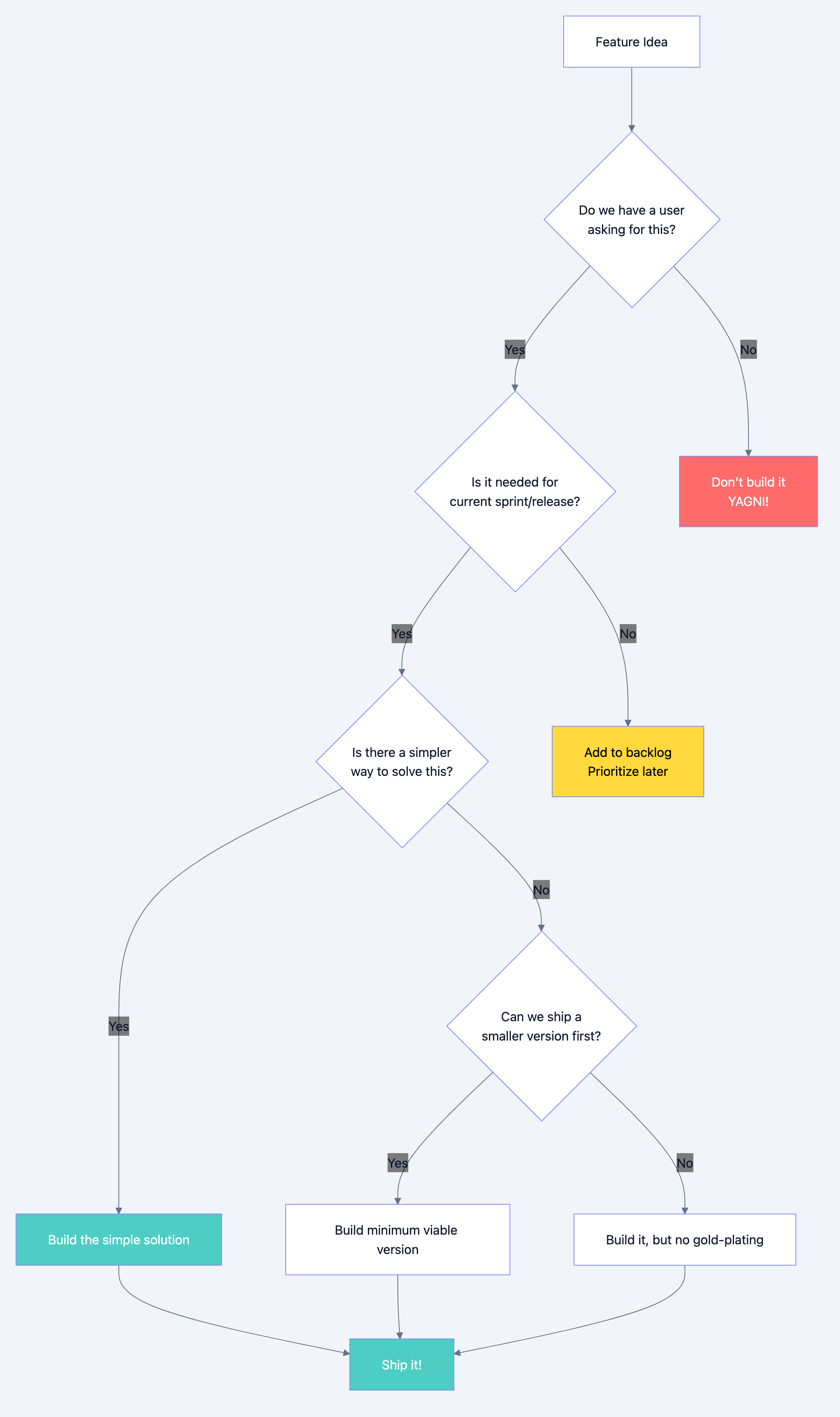
Design principles diagram 3
Questions to Ask Before Every Feature
| Question | If "No"... |
|---|---|
| Is a real user asking for this? | Don't build it |
| Do we need it this sprint? | Add to backlog |
| Is this the simplest solution? | Simplify first |
| Can we ship something smaller? | Ship the MVP |
| Will we use this in the next month? | Delay building it |
When "Future-Proofing" Makes Sense
YAGNI doesn't mean never thinking ahead. Some things ARE worth considering:
Worth Considering Now
| Concern | Why |
|---|---|
| Security | Hard to add later, costly to get wrong |
| Data model | Migrations are expensive |
| API contracts | Breaking changes hurt users |
| Core architecture | Foundation is hard to change |
Not Worth Building Now
| Concern | Why Wait |
|---|---|
| Multiple database support | You'll probably never switch |
| Plugin systems | Build when you have multiple plugins |
| Configurable everything | Most configs never change |
| Scale for millions | You don't have millions yet |
go// Filename: yagni_decision_example.go
// Demonstrating what to think about vs what to build

package main

import "fmt"

// =============================================================================
// THINK ABOUT NOW (Design Decisions)
// =============================================================================

// User has a good data model (think about this!)
type User struct {
    ID        int
    Email     string // Unique, indexed
    Name      string
    CreatedAt int64  // Unix timestamp - easy to work with
    // We THOUGHT about future fields but didn't add them:
    // - PreferredLanguage (add when needed)
    // - AvatarURL (add when needed)
    // - PhoneNumber (add when needed)
}

// API uses versioning (think about this!)
const APIVersion = "v1"

// Endpoint: /api/v1/users
// Why: If we need v2, we can add it without breaking v1

// =============================================================================
// DON'T BUILD NOW (Features)
// =============================================================================

// DON'T: Build multi-tenancy until you have multiple tenants
// DON'T: Build caching until you have performance problems
// DON'T: Build rate limiting until you have abuse
// DON'T: Build webhooks until someone asks
// DON'T: Build import/export until someone needs it

// =============================================================================
// BUILD ONLY WHAT'S NEEDED
// =============================================================================

// CreateUser creates a user - simple and direct
func CreateUser(email, name string) (*User, error) {
    user := &User{
        ID:    1, // Would come from database
        Email: email,
        Name:  name,
    }
    return user, nil
}

func main() {
    fmt.Println("YAGNI Example")
    fmt.Println("=============")
    fmt.Println()
    fmt.Println("We THOUGHT about:")
    fmt.Println("  ✓ Data model (User struct is clean)")
    fmt.Println("  ✓ API versioning (easy to add v2 later)")
    fmt.Println("  ✓ Timestamps (Unix for simplicity)")
    fmt.Println()
    fmt.Println("We DIDN'T build:")
    fmt.Println("  ✗ Multi-tenancy (no tenants yet)")
    fmt.Println("  ✗ Caching layer (no performance issues)")
    fmt.Println("  ✗ Plugin system (no plugins)")
    fmt.Println("  ✗ Configurable everything (defaults work)")
}
YAGNI and Technical Debt
A common argument against YAGNI: "Won't this create technical debt?"
The answer is nuanced:
Speculative Code IS Technical Debt
Code you wrote for imaginary requirements:
- Costs time to write
- Costs time to maintain
- Costs time to understand
- Costs time to test
- May never be used
That's negative ROI - worse than technical debt.
Missing Code is NOT Technical Debt
Not building a caching layer isn't debt. You don't owe anyone a caching layer. When you need it, you build it. Until then, you have a simpler system.
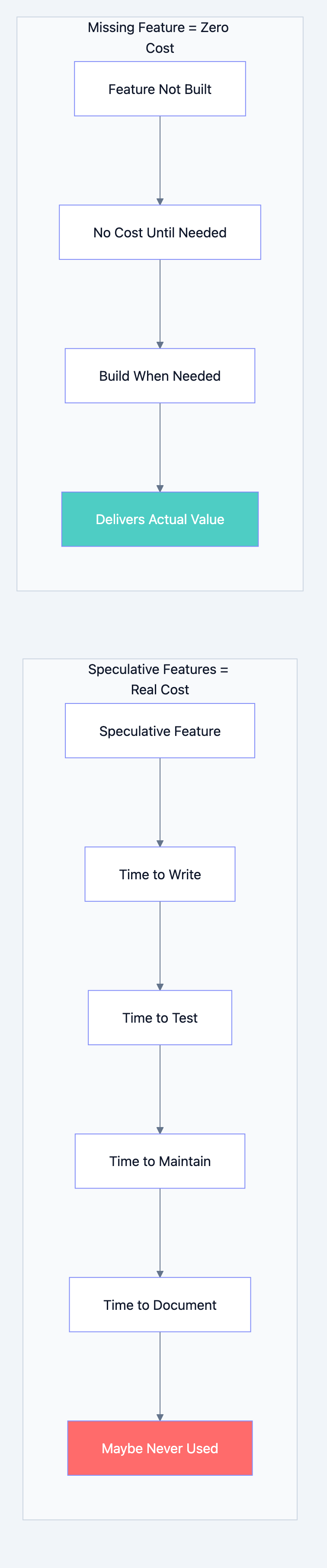
Design principles diagram 4
YAGNI Checklist
Before writing any code, verify:
| Check | Question |
|---|---|
| ✅ | Is there a real user story for this? |
| ✅ | Is this in the current sprint? |
| ✅ | Have I written the simplest possible solution? |
| ✅ | Am I avoiding "what if" features? |
| ✅ | Can I ship this in days, not weeks? |
| ✅ | Am I solving today's problem, not tomorrow's? |
Summary: The YAGNI Manifesto
Do Build
- Features users are asking for NOW
- The simplest solution that works
- Clean, maintainable code
- Good foundations (data model, API design)
Don't Build
- Features for imaginary users
- Features for "someday"
- Configurable everything
- Abstractions without multiple implementations
- Scale for users you don't have
Key Takeaways
- Real users > Imaginary users - Build for people who exist
- Now > Later - Focus on current requirements
- Simple > Flexible - Simplicity enables change
- Ship > Perfect - Get feedback, iterate
- Delete > Keep - Remove speculative code
Your Next Steps
- Audit: Find features built for "someday" that never came
- Delete: Remove code that's never used
- Question: For every new feature, ask "who is asking for this?"
- Read Next: OOP Principles
"The best code is no code at all." - Jeff Atwood
Remember: Every line of code is a liability. Write only what you need, when you need it.