DRY Principle: Eliminating Repetition for Maintainable Code
The Copy-Paste Horror Story
It was 2 AM. The production server was on fire. A critical bug had brought down the entire payment system. Sarah, the on-call engineer, was frantically searching through the codebase.
The bug was simple: a date formatting issue that caused transactions to be recorded in the wrong timezone. The fix was also simple: change
time.Now() to time.Now().UTC().But here's where the horror began.
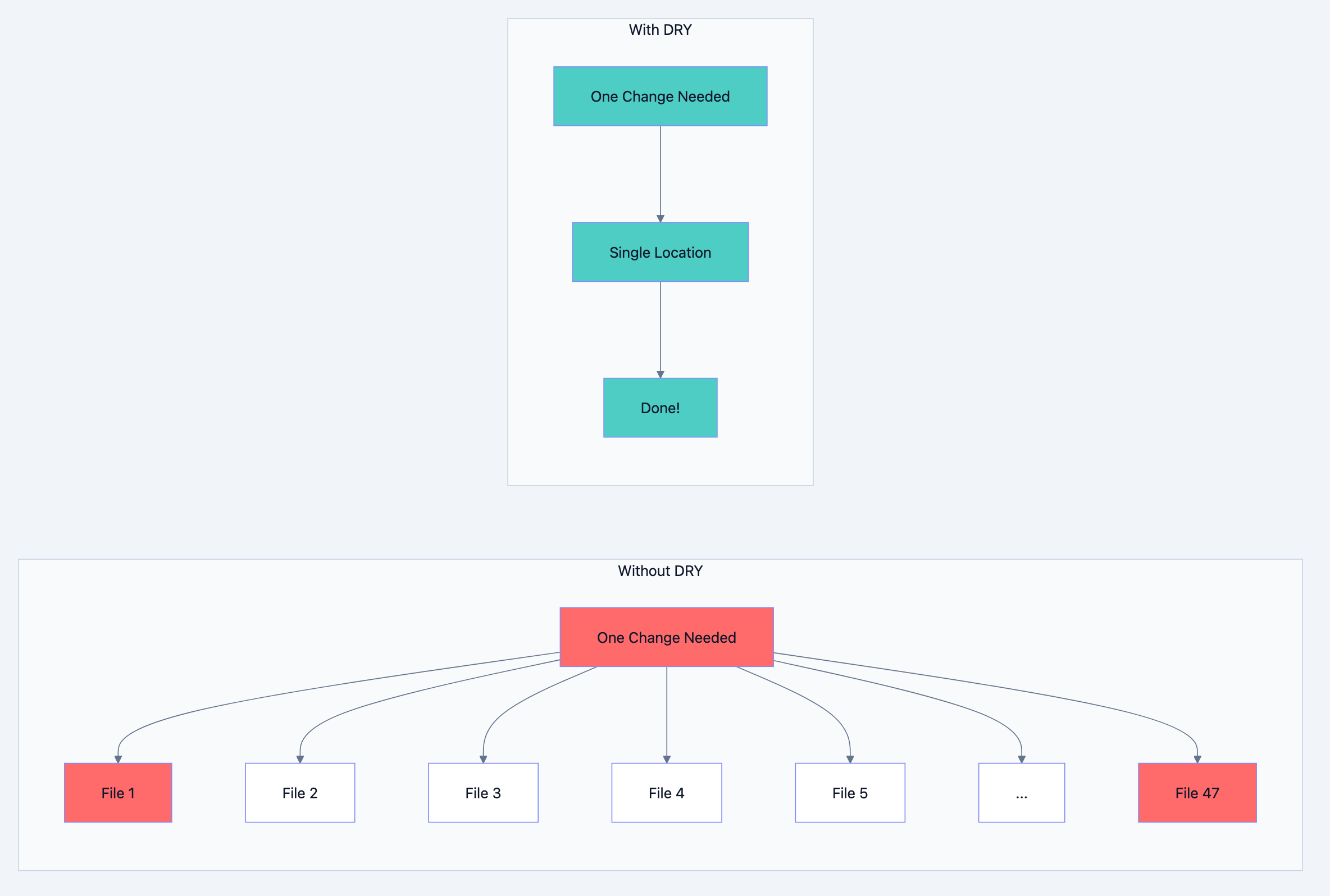
That date formatting logic was copied into 47 different files. Sarah had to find and fix every single copy. Miss one? Another timezone bug waiting to happen. Make a typo in one fix? Another bug.
What should have been a 2-minute fix became a 4-hour ordeal.
This is what happens when you violate DRY.
What is DRY?
DRY stands for "Don't Repeat Yourself."
The principle was formulated by Andy Hunt and Dave Thomas in their book "The Pragmatic Programmer":
"Every piece of knowledge must have a single, unambiguous, authoritative representation within a system."
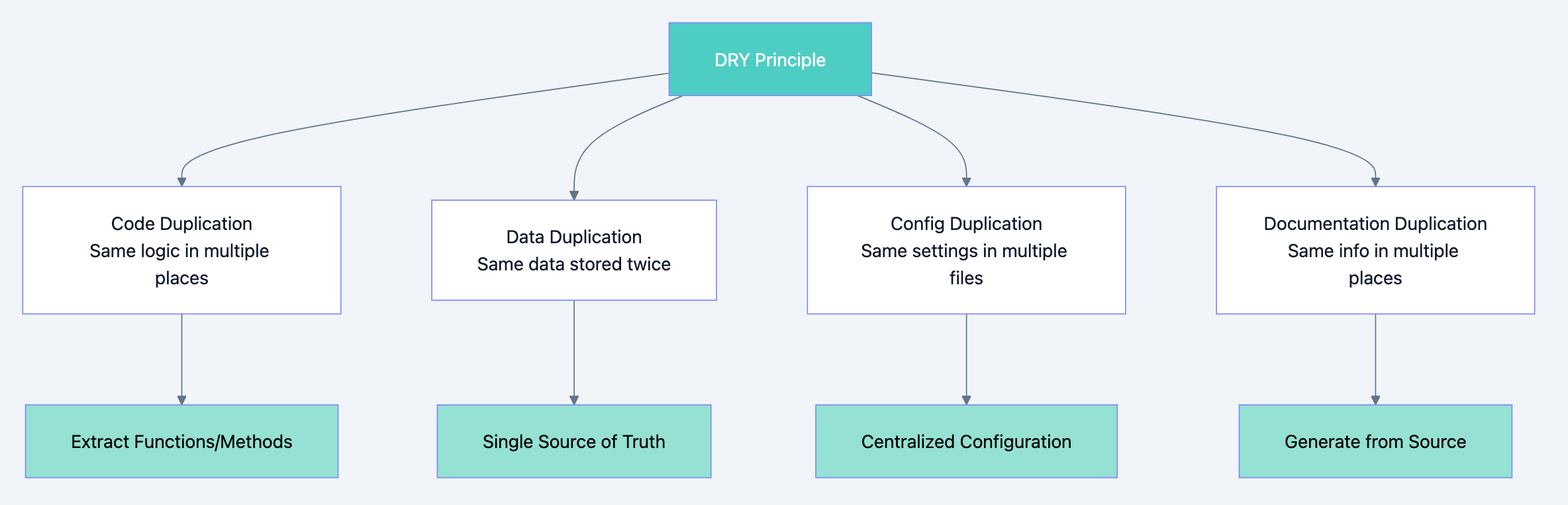
Notice it says "knowledge," not just "code." DRY applies to:
- Code: Functions, classes, algorithms
- Data: Database schemas, constants
- Configuration: Environment settings, feature flags
- Documentation: Comments, README files
- Test logic: Setup code, assertions
Design principles diagram 1
Why Repetition is Poison
The Shotgun Surgery Anti-Pattern
When the same logic exists in multiple places, any change requires "shotgun surgery" - making the same change in many places at once.
Design principles diagram 2
The Real Costs of Duplication
| Problem | Impact |
|---|---|
| Inconsistent updates | Some copies get updated, others don't |
| Bug multiplication | Fix one bug, miss 46 identical bugs |
| Wasted effort | Developers write the same code repeatedly |
| Larger codebase | More code = more to maintain, test, understand |
| Knowledge silos | "Which version is correct?" |
| Merge conflicts | Multiple people updating similar code |
Types of Duplication
Type 1: Exact Copy-Paste
The most obvious violation. Identical code in multiple places.
go// Filename: bad_exact_duplication.go
// DRY VIOLATION: Exact same code in multiple places

package main

import (
    "fmt"
    "regexp"
    "strings"
)

// In user_handler.go
func validateUserEmail(email string) bool {
    if email == "" {
        return false
    }
    if len(email) > 254 {
        return false
    }
    pattern := `^[a-zA-Z0-9._%+-]+@[a-zA-Z0-9.-]+\.[a-zA-Z]{2,}$`
    matched, _ := regexp.MatchString(pattern, email)
    return matched
}

// In order_handler.go - EXACT SAME CODE!
func validateOrderEmail(email string) bool {
    if email == "" {
        return false
    }
    if len(email) > 254 {
        return false
    }
    pattern := `^[a-zA-Z0-9._%+-]+@[a-zA-Z0-9.-]+\.[a-zA-Z]{2,}$`
    matched, _ := regexp.MatchString(pattern, email)
    return matched
}

// In newsletter_handler.go - AGAIN!
func validateSubscriberEmail(email string) bool {
    if email == "" {
        return false
    }
    if len(email) > 254 {
        return false
    }
    pattern := `^[a-zA-Z0-9._%+-]+@[a-zA-Z0-9.-]+\.[a-zA-Z]{2,}$`
    matched, _ := regexp.MatchString(pattern, email)
    return matched
}

// What happens when the email regex needs to change?
// What if we need to support new TLDs?
// 3 places to update, 3 chances to make mistakes!
Type 2: Structural Duplication
Same structure with different details.
go// Filename: bad_structural_duplication.go
// DRY VIOLATION: Same structure, different details

package main

import (
    "database/sql"
    "fmt"
)

// User CRUD operations
func CreateUser(db *sql.DB, name, email string) error {
    query := "INSERT INTO users (name, email) VALUES (?, ?)"
    _, err := db.Exec(query, name, email)
    if err != nil {
        return fmt.Errorf("failed to create user: %w", err)
    }
    return nil
}

func GetUser(db *sql.DB, id int) (*User, error) {
    query := "SELECT id, name, email FROM users WHERE id = ?"
    row := db.QueryRow(query, id)
    user := &User{}
    err := row.Scan(&user.ID, &user.Name, &user.Email)
    if err != nil {
        return nil, fmt.Errorf("failed to get user: %w", err)
    }
    return user, nil
}

// Product CRUD operations - SAME STRUCTURE!
func CreateProduct(db *sql.DB, name string, price float64) error {
    query := "INSERT INTO products (name, price) VALUES (?, ?)"
    _, err := db.Exec(query, name, price)
    if err != nil {
        return fmt.Errorf("failed to create product: %w", err)
    }
    return nil
}

func GetProduct(db *sql.DB, id int) (*Product, error) {
    query := "SELECT id, name, price FROM products WHERE id = ?"
    row := db.QueryRow(query, id)
    product := &Product{}
    err := row.Scan(&product.ID, &product.Name, &product.Price)
    if err != nil {
        return nil, fmt.Errorf("failed to get product: %w", err)
    }
    return product, nil
}

// Order CRUD operations - SAME STRUCTURE AGAIN!
func CreateOrder(db *sql.DB, userID, productID int) error {
    query := "INSERT INTO orders (user_id, product_id) VALUES (?, ?)"
    _, err := db.Exec(query, userID, productID)
    if err != nil {
        return fmt.Errorf("failed to create order: %w", err)
    }
    return nil
}

// ... and so on for every entity in the system
Type 3: Logic Duplication
Same business logic expressed differently.
go// Filename: bad_logic_duplication.go
// DRY VIOLATION: Same logic, different expressions

package main

// In pricing_service.go
func CalculateDiscount(price float64, customerType string) float64 {
    switch customerType {
    case "premium":
        return price * 0.20 // 20% discount
    case "gold":
        return price * 0.15 // 15% discount
    case "silver":
        return price * 0.10 // 10% discount
    default:
        return 0
    }
}

// In invoice_service.go - SAME LOGIC, DIFFERENT IMPLEMENTATION!
func GetDiscountRate(customer Customer) float64 {
    if customer.IsPremium {
        return 0.20
    }
    if customer.Tier == "gold" {
        return 0.15
    }
    if customer.Tier == "silver" {
        return 0.10
    }
    return 0
}

// In checkout_service.go - AGAIN!
var discountRates = map[string]float64{
    "premium": 0.20,
    "gold":    0.15,
    "silver":  0.10,
}

func ApplyDiscount(price float64, tier string) float64 {
    if rate, ok := discountRates[tier]; ok {
        return price - (price * rate)
    }
    return price
}

// What happens when we add a "platinum" tier?
// What if premium discount changes to 25%?
// 3 places with the same knowledge about discount rates!
Eliminating Duplication: Patterns and Techniques
Pattern 1: Extract Function
The simplest and most common technique.
go// Filename: dry_extract_function.go
// DRY SOLUTION: Extract common code into a function

package main

import (
    "fmt"
    "regexp"
)

// =============================================================================
// SHARED VALIDATION PACKAGE
// =============================================================================

// emailRegex is compiled once and reused
var emailRegex = regexp.MustCompile(`^[a-zA-Z0-9._%+-]+@[a-zA-Z0-9.-]+\.[a-zA-Z]{2,}$`)

// ValidateEmail validates an email address
// Why: Single source of truth for email validation
// Why: Changes here automatically apply everywhere
func ValidateEmail(email string) error {
    if email == "" {
        return fmt.Errorf("email is required")
    }

    if len(email) > 254 {
        return fmt.Errorf("email is too long (max 254 characters)")
    }

    if !emailRegex.MatchString(email) {
        return fmt.Errorf("email format is invalid")
    }

    return nil
}

// =============================================================================
// CONSUMERS - All use the same validation
// =============================================================================

// User represents a user in the system
type User struct {
    ID    int
    Name  string
    Email string
}

// NewUser creates a new user with validation
func NewUser(name, email string) (*User, error) {
    // Use the shared validation
    if err := ValidateEmail(email); err != nil {
        return nil, fmt.Errorf("invalid user email: %w", err)
    }

    return &User{Name: name, Email: email}, nil
}

// Order represents an order
type Order struct {
    ID          int
    UserEmail   string
    BillingEmail string
}

// NewOrder creates a new order with validation
func NewOrder(userEmail, billingEmail string) (*Order, error) {
    // Use the same shared validation
    if err := ValidateEmail(userEmail); err != nil {
        return nil, fmt.Errorf("invalid user email: %w", err)
    }

    if err := ValidateEmail(billingEmail); err != nil {
        return nil, fmt.Errorf("invalid billing email: %w", err)
    }

    return &Order{UserEmail: userEmail, BillingEmail: billingEmail}, nil
}

// NewsletterSubscription represents a subscription
type NewsletterSubscription struct {
    Email string
}

// Subscribe creates a newsletter subscription
func Subscribe(email string) (*NewsletterSubscription, error) {
    // Same validation, no duplication!
    if err := ValidateEmail(email); err != nil {
        return nil, fmt.Errorf("invalid subscription email: %w", err)
    }

    return &NewsletterSubscription{Email: email}, nil
}

func main() {
    fmt.Println("╔══════════════════════════════════════════════════════════╗")
    fmt.Println("║            DRY: Extract Function Pattern                  ║")
    fmt.Println("╚══════════════════════════════════════════════════════════╝")

    // Test valid email
    user, err := NewUser("Alice", "alice@example.com")
    if err != nil {
        fmt.Printf("❌ User creation failed: %v\n", err)
    } else {
        fmt.Printf("✅ User created: %s (%s)\n", user.Name, user.Email)
    }

    // Test invalid email
    _, err = NewUser("Bob", "invalid-email")
    if err != nil {
        fmt.Printf("❌ User creation failed (expected): %v\n", err)
    }

    // Test order with valid emails
    order, err := NewOrder("customer@shop.com", "billing@shop.com")
    if err != nil {
        fmt.Printf("❌ Order creation failed: %v\n", err)
    } else {
        fmt.Printf("✅ Order created with emails: %s, %s\n",
            order.UserEmail, order.BillingEmail)
    }

    // Test subscription
    sub, err := Subscribe("newsletter@reader.com")
    if err != nil {
        fmt.Printf("❌ Subscription failed: %v\n", err)
    } else {
        fmt.Printf("✅ Subscribed: %s\n", sub.Email)
    }

    fmt.Println("\n" + "═"*60)
    fmt.Println("BENEFIT: Email validation logic exists in ONE place.")
    fmt.Println("Change the regex? One file. Add a new check? One file.")
    fmt.Println("═"*60)
}
Expected Output:
╔══════════════════════════════════════════════════════════╗
║            DRY: Extract Function Pattern                  ║
╚══════════════════════════════════════════════════════════╝
✅ User created: Alice (alice@example.com)
❌ User creation failed (expected): invalid user email: email format is invalid
✅ Order created with emails: customer@shop.com, billing@shop.com
✅ Subscribed: newsletter@reader.com

════════════════════════════════════════════════════════════
BENEFIT: Email validation logic exists in ONE place.
Change the regex? One file. Add a new check? One file.
════════════════════════════════════════════════════════════
Pattern 2: Use Constants and Configuration
go// Filename: dry_constants.go
// DRY SOLUTION: Centralize magic numbers and configuration

package main

import (
    "fmt"
    "time"
)

// =============================================================================
// CENTRALIZED CONSTANTS
// =============================================================================

// DiscountTier represents customer discount levels
type DiscountTier string

const (
    TierPlatinum DiscountTier = "platinum"
    TierPremium  DiscountTier = "premium"
    TierGold     DiscountTier = "gold"
    TierSilver   DiscountTier = "silver"
    TierBronze   DiscountTier = "bronze"
    TierStandard DiscountTier = "standard"
)

// DiscountRates is the single source of truth for all discount rates
// Why: Adding or changing a discount requires changing only this map
var DiscountRates = map[DiscountTier]float64{
    TierPlatinum: 0.30, // 30% discount
    TierPremium:  0.25, // 25% discount
    TierGold:     0.20, // 20% discount
    TierSilver:   0.15, // 15% discount
    TierBronze:   0.10, // 10% discount
    TierStandard: 0.00, // No discount
}

// Application-wide constants
const (
    MaxLoginAttempts     = 5
    SessionTimeoutHours  = 24
    PasswordMinLength    = 12
    PasswordMaxLength    = 128
    UsernameMinLength    = 3
    UsernameMaxLength    = 30
    MaxUploadSizeMB      = 10
    DefaultPageSize      = 20
    MaxPageSize          = 100
    TokenExpiryMinutes   = 15
    RefreshTokenDays     = 30
)

// Timeouts and durations
var (
    HTTPTimeout        = 30 * time.Second
    DatabaseTimeout    = 10 * time.Second
    CacheExpiry        = 5 * time.Minute
    SessionTimeout     = SessionTimeoutHours * time.Hour
    TokenExpiry        = TokenExpiryMinutes * time.Minute
    RefreshTokenExpiry = RefreshTokenDays * 24 * time.Hour
)

// =============================================================================
// USING THE CENTRALIZED VALUES
// =============================================================================

// CalculateDiscount uses the centralized discount rates
func CalculateDiscount(price float64, tier DiscountTier) float64 {
    rate, exists := DiscountRates[tier]
    if !exists {
        rate = DiscountRates[TierStandard]
    }
    return price * rate
}

// ValidatePassword uses centralized password rules
func ValidatePassword(password string) error {
    if len(password) < PasswordMinLength {
        return fmt.Errorf("password must be at least %d characters", PasswordMinLength)
    }
    if len(password) > PasswordMaxLength {
        return fmt.Errorf("password cannot exceed %d characters", PasswordMaxLength)
    }
    return nil
}

// ValidateUsername uses centralized username rules
func ValidateUsername(username string) error {
    if len(username) < UsernameMinLength {
        return fmt.Errorf("username must be at least %d characters", UsernameMinLength)
    }
    if len(username) > UsernameMaxLength {
        return fmt.Errorf("username cannot exceed %d characters", UsernameMaxLength)
    }
    return nil
}

// CreateSession uses centralized session settings
func CreateSession() Session {
    return Session{
        CreatedAt: time.Now(),
        ExpiresAt: time.Now().Add(SessionTimeout),
    }
}

// Session represents a user session
type Session struct {
    CreatedAt time.Time
    ExpiresAt time.Time
}

func main() {
    fmt.Println("╔══════════════════════════════════════════════════════════╗")
    fmt.Println("║          DRY: Centralized Constants Pattern              ║")
    fmt.Println("╚══════════════════════════════════════════════════════════╝")

    // Using discount rates
    fmt.Println("\n📊 Discount Calculations (price: $100):")
    fmt.Println("─"*50)
    tiers := []DiscountTier{TierPlatinum, TierPremium, TierGold, TierSilver, TierBronze}
    for _, tier := range tiers {
        discount := CalculateDiscount(100, tier)
        fmt.Printf("  %-10s: $%.2f off (%.0f%%)\n", tier, discount, DiscountRates[tier]*100)
    }

    // Using validation constants
    fmt.Println("\n🔐 Validation Rules:")
    fmt.Println("─"*50)
    fmt.Printf("  Password: %d-%d characters\n", PasswordMinLength, PasswordMaxLength)
    fmt.Printf("  Username: %d-%d characters\n", UsernameMinLength, UsernameMaxLength)
    fmt.Printf("  Max upload: %d MB\n", MaxUploadSizeMB)

    // Using timeout constants
    fmt.Println("\n⏱️ Timeout Settings:")
    fmt.Println("─"*50)
    fmt.Printf("  HTTP timeout: %v\n", HTTPTimeout)
    fmt.Printf("  Database timeout: %v\n", DatabaseTimeout)
    fmt.Printf("  Session timeout: %v\n", SessionTimeout)
    fmt.Printf("  Token expiry: %v\n", TokenExpiry)

    fmt.Println("\n" + "═"*60)
    fmt.Println("BENEFIT: All magic numbers in ONE place.")
    fmt.Println("Need to change password requirements? One file.")
    fmt.Println("Need to update discount rates? One file.")
    fmt.Println("═"*60)
}
Pattern 3: Template Method with Interfaces
go// Filename: dry_template_method.go
// DRY SOLUTION: Use interfaces for structural duplication

package main

import (
    "fmt"
)

// =============================================================================
// GENERIC REPOSITORY PATTERN
// =============================================================================

// Entity is the interface all entities must implement
type Entity interface {
    TableName() string
    ID() int
    SetID(id int)
}

// Repository provides generic CRUD operations
// Why: Same database logic for all entities
type Repository[T Entity] struct {
    db map[int]T // Simulated database
    nextID int
}

// NewRepository creates a new repository
func NewRepository[T Entity]() *Repository[T] {
    return &Repository[T]{
        db: make(map[int]T),
        nextID: 1,
    }
}

// Create inserts a new entity
func (r *Repository[T]) Create(entity T) (T, error) {
    entity.SetID(r.nextID)
    r.db[r.nextID] = entity
    r.nextID++

    fmt.Printf("[%s] Created with ID %d\n", entity.TableName(), entity.ID())
    return entity, nil
}

// FindByID retrieves an entity by ID
func (r *Repository[T]) FindByID(id int) (T, bool) {
    entity, exists := r.db[id]
    if exists {
        fmt.Printf("[%s] Found ID %d\n", entity.TableName(), id)
    }
    return entity, exists
}

// FindAll retrieves all entities
func (r *Repository[T]) FindAll() []T {
    result := make([]T, 0, len(r.db))
    for _, entity := range r.db {
        result = append(result, entity)
    }
    return result
}

// Update updates an existing entity
func (r *Repository[T]) Update(entity T) error {
    if _, exists := r.db[entity.ID()]; !exists {
        return fmt.Errorf("entity with ID %d not found", entity.ID())
    }
    r.db[entity.ID()] = entity
    fmt.Printf("[%s] Updated ID %d\n", entity.TableName(), entity.ID())
    return nil
}

// Delete removes an entity
func (r *Repository[T]) Delete(id int) error {
    if _, exists := r.db[id]; !exists {
        return fmt.Errorf("entity with ID %d not found", id)
    }
    delete(r.db, id)
    fmt.Printf("[%s] Deleted ID %d\n", r.db[id].TableName(), id)
    return nil
}

// Count returns the number of entities
func (r *Repository[T]) Count() int {
    return len(r.db)
}

// =============================================================================
// ENTITIES - Each only needs to implement the Entity interface
// =============================================================================

// User entity
type User struct {
    id    int
    Name  string
    Email string
}

func (u *User) TableName() string { return "users" }
func (u *User) ID() int          { return u.id }
func (u *User) SetID(id int)     { u.id = id }

// Product entity
type Product struct {
    id    int
    Name  string
    Price float64
}

func (p *Product) TableName() string { return "products" }
func (p *Product) ID() int          { return p.id }
func (p *Product) SetID(id int)     { p.id = id }

// Order entity
type Order struct {
    id        int
    UserID    int
    ProductID int
    Quantity  int
}

func (o *Order) TableName() string { return "orders" }
func (o *Order) ID() int          { return o.id }
func (o *Order) SetID(id int)     { o.id = id }

// =============================================================================
// DEMONSTRATION
// =============================================================================

func main() {
    fmt.Println("╔══════════════════════════════════════════════════════════╗")
    fmt.Println("║        DRY: Generic Repository Pattern (Go 1.18+)        ║")
    fmt.Println("╚══════════════════════════════════════════════════════════╝")

    // User repository - NO duplicate CRUD code!
    userRepo := NewRepository[*User]()

    fmt.Println("\n👤 User Operations:")
    fmt.Println("─"*50)
    user1, _ := userRepo.Create(&User{Name: "Alice", Email: "alice@example.com"})
    user2, _ := userRepo.Create(&User{Name: "Bob", Email: "bob@example.com"})

    if found, exists := userRepo.FindByID(1); exists {
        fmt.Printf("  Found user: %s (%s)\n", found.Name, found.Email)
    }

    // Product repository - Same generic code!
    productRepo := NewRepository[*Product]()

    fmt.Println("\n📦 Product Operations:")
    fmt.Println("─"*50)
    product1, _ := productRepo.Create(&Product{Name: "Laptop", Price: 999.99})
    product2, _ := productRepo.Create(&Product{Name: "Mouse", Price: 29.99})

    if found, exists := productRepo.FindByID(1); exists {
        fmt.Printf("  Found product: %s ($%.2f)\n", found.Name, found.Price)
    }

    // Order repository - Still the same generic code!
    orderRepo := NewRepository[*Order]()

    fmt.Println("\n🛒 Order Operations:")
    fmt.Println("─"*50)
    orderRepo.Create(&Order{UserID: user1.ID(), ProductID: product1.ID(), Quantity: 1})
    orderRepo.Create(&Order{UserID: user2.ID(), ProductID: product2.ID(), Quantity: 3})

    // Stats
    fmt.Println("\n📊 Repository Statistics:")
    fmt.Println("─"*50)
    fmt.Printf("  Users: %d\n", userRepo.Count())
    fmt.Printf("  Products: %d\n", productRepo.Count())
    fmt.Printf("  Orders: %d\n", orderRepo.Count())

    fmt.Println("\n" + "═"*60)
    fmt.Println("BENEFIT: CRUD logic written ONCE, works for ALL entities!")
    fmt.Println("Add a new entity type? Just implement the Entity interface.")
    fmt.Println("Fix a bug in Create? Fixed for ALL repositories.")
    fmt.Println("═"*60)
}
Expected Output:
╔══════════════════════════════════════════════════════════╗
║        DRY: Generic Repository Pattern (Go 1.18+)        ║
╚══════════════════════════════════════════════════════════╝

👤 User Operations:
──────────────────────────────────────────────────
[users] Created with ID 1
[users] Created with ID 2
[users] Found ID 1
  Found user: Alice (alice@example.com)

📦 Product Operations:
──────────────────────────────────────────────────
[products] Created with ID 1
[products] Created with ID 2
[products] Found ID 1
  Found product: Laptop ($999.99)

🛒 Order Operations:
──────────────────────────────────────────────────
[orders] Created with ID 1
[orders] Created with ID 2

📊 Repository Statistics:
──────────────────────────────────────────────────
  Users: 2
  Products: 2
  Orders: 2

════════════════════════════════════════════════════════════
BENEFIT: CRUD logic written ONCE, works for ALL entities!
Add a new entity type? Just implement the Entity interface.
Fix a bug in Create? Fixed for ALL repositories.
════════════════════════════════════════════════════════════
Pattern 4: Middleware and Decorators
go// Filename: dry_middleware.go
// DRY SOLUTION: Use middleware to avoid repeated cross-cutting concerns

package main

import (
    "fmt"
    "time"
)

// =============================================================================
// MIDDLEWARE PATTERN FOR HTTP-LIKE HANDLERS
// =============================================================================

// Request represents an incoming request
type Request struct {
    Path   string
    Method string
    UserID string
    Body   string
}

// Response represents an outgoing response
type Response struct {
    StatusCode int
    Body       string
}

// Handler processes requests
type Handler func(Request) Response

// Middleware wraps a handler with additional behavior
type Middleware func(Handler) Handler

// =============================================================================
// REUSABLE MIDDLEWARE - Write once, use everywhere!
// =============================================================================

// LoggingMiddleware logs all requests
// Why: Instead of adding logging to every handler, wrap once
func LoggingMiddleware(next Handler) Handler {
    return func(req Request) Response {
        start := time.Now()
        fmt.Printf("📝 [LOG] %s %s started\n", req.Method, req.Path)

        response := next(req)

        duration := time.Since(start)
        fmt.Printf("📝 [LOG] %s %s completed in %v (status: %d)\n",
            req.Method, req.Path, duration, response.StatusCode)

        return response
    }
}

// AuthMiddleware checks authentication
// Why: Authentication logic in ONE place, applied to any handler
func AuthMiddleware(next Handler) Handler {
    return func(req Request) Response {
        if req.UserID == "" {
            fmt.Println("🔒 [AUTH] No user ID - unauthorized")
            return Response{StatusCode: 401, Body: "Unauthorized"}
        }

        fmt.Printf("🔒 [AUTH] User %s authenticated\n", req.UserID)
        return next(req)
    }
}

// TimingMiddleware measures execution time
func TimingMiddleware(next Handler) Handler {
    return func(req Request) Response {
        start := time.Now()
        response := next(req)
        duration := time.Since(start)

        fmt.Printf("⏱️ [TIMING] Request took %v\n", duration)
        return response
    }
}

// RecoveryMiddleware catches panics
func RecoveryMiddleware(next Handler) Handler {
    return func(req Request) Response {
        defer func() {
            if r := recover(); r != nil {
                fmt.Printf("💥 [RECOVERY] Caught panic: %v\n", r)
            }
        }()
        return next(req)
    }
}

// RateLimitMiddleware limits request rates (simplified)
func RateLimitMiddleware(maxRequests int) Middleware {
    requestCount := 0

    return func(next Handler) Handler {
        return func(req Request) Response {
            requestCount++
            if requestCount > maxRequests {
                fmt.Printf("🚫 [RATE] Rate limit exceeded (%d/%d)\n",
                    requestCount, maxRequests)
                return Response{StatusCode: 429, Body: "Too Many Requests"}
            }

            fmt.Printf("📊 [RATE] Request %d/%d\n", requestCount, maxRequests)
            return next(req)
        }
    }
}

// Chain applies multiple middleware to a handler
func Chain(handler Handler, middlewares ...Middleware) Handler {
    // Apply middleware in reverse order so first middleware is outermost
    for i := len(middlewares) - 1; i >= 0; i-- {
        handler = middlewares[i](handler)
    }
    return handler
}

// =============================================================================
// ACTUAL HANDLERS - Now clean and focused on business logic!
// =============================================================================

// GetUserHandler handles user retrieval
// Why: This handler only contains business logic, no logging/auth/timing
func GetUserHandler(req Request) Response {
    // Simulate some work
    time.Sleep(10 * time.Millisecond)

    return Response{
        StatusCode: 200,
        Body:       fmt.Sprintf("User data for request to %s", req.Path),
    }
}

// CreateOrderHandler handles order creation
func CreateOrderHandler(req Request) Response {
    time.Sleep(20 * time.Millisecond)

    return Response{
        StatusCode: 201,
        Body:       "Order created successfully",
    }
}

// DeleteProductHandler handles product deletion
func DeleteProductHandler(req Request) Response {
    time.Sleep(15 * time.Millisecond)

    return Response{
        StatusCode: 204,
        Body:       "",
    }
}

// =============================================================================
// DEMONSTRATION
// =============================================================================

func main() {
    fmt.Println("╔══════════════════════════════════════════════════════════╗")
    fmt.Println("║             DRY: Middleware Pattern                       ║")
    fmt.Println("╚══════════════════════════════════════════════════════════╝")

    // Apply middleware once, use everywhere
    standardMiddleware := []Middleware{
        RecoveryMiddleware,
        LoggingMiddleware,
        TimingMiddleware,
        AuthMiddleware,
    }

    // Wrap handlers with middleware
    getUserWrapped := Chain(GetUserHandler, standardMiddleware...)
    createOrderWrapped := Chain(CreateOrderHandler, standardMiddleware...)

    // Test 1: Authenticated request
    fmt.Println("\n📤 Test 1: Authenticated GET /users/123")
    fmt.Println("─"*50)
    req1 := Request{
        Path:   "/users/123",
        Method: "GET",
        UserID: "user_42",
    }
    resp1 := getUserWrapped(req1)
    fmt.Printf("📥 Response: %d - %s\n", resp1.StatusCode, resp1.Body)

    // Test 2: Unauthenticated request
    fmt.Println("\n📤 Test 2: Unauthenticated POST /orders")
    fmt.Println("─"*50)
    req2 := Request{
        Path:   "/orders",
        Method: "POST",
        UserID: "", // No user ID
    }
    resp2 := createOrderWrapped(req2)
    fmt.Printf("📥 Response: %d - %s\n", resp2.StatusCode, resp2.Body)

    // Test 3: Rate limited handler
    fmt.Println("\n📤 Test 3: Rate Limited Endpoint")
    fmt.Println("─"*50)
    rateLimitedHandler := Chain(
        GetUserHandler,
        LoggingMiddleware,
        RateLimitMiddleware(3),
    )

    for i := 1; i <= 5; i++ {
        req := Request{Path: fmt.Sprintf("/api/data/%d", i), Method: "GET"}
        resp := rateLimitedHandler(req)
        fmt.Printf("  Request %d: Status %d\n", i, resp.StatusCode)
    }

    fmt.Println("\n" + "═"*60)
    fmt.Println("BENEFIT: Logging, auth, timing written ONCE as middleware.")
    fmt.Println("Every handler automatically gets these behaviors.")
    fmt.Println("Change logging format? One place. Add metrics? One place.")
    fmt.Println("═"*60)
}
The WET Exception: When Duplication is Okay
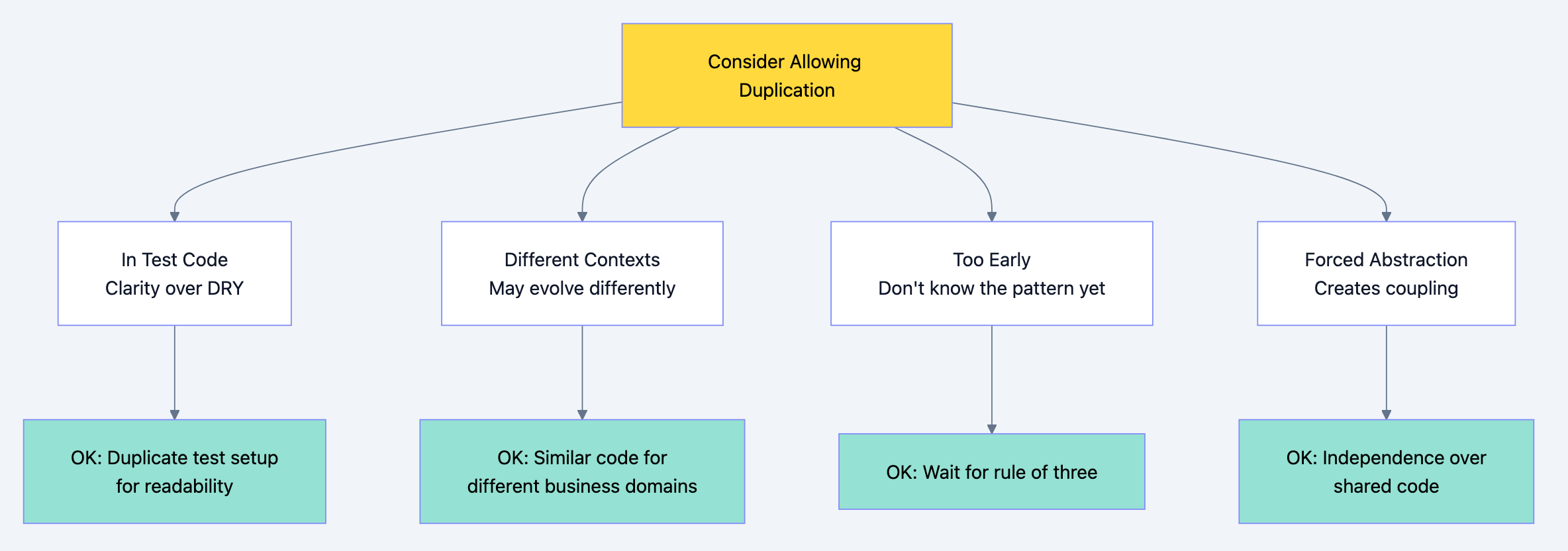
DRY has an opposite: WET (Write Everything Twice) or more generously, "Write Explicit Tests".
Sometimes a little duplication is better than the wrong abstraction.
The Rule of Three
"Three strikes and you refactor."
- First time: Just write it
- Second time: Note the duplication, but maybe duplicate
- Third time: Now refactor and extract
Why? Because you need enough examples to understand the true abstraction.
go// First implementation - just write it
func FormatUserName(user User) string {
    return fmt.Sprintf("%s %s", user.FirstName, user.LastName)
}

// Second implementation - similar but different context
func FormatOrderCustomerName(order Order) string {
    return fmt.Sprintf("%s %s", order.CustomerFirstName, order.CustomerLastName)
}

// Third implementation - NOW we see the pattern
func FormatEmployeeName(employee Employee) string {
    return fmt.Sprintf("%s %s", employee.FirstName, employee.LastName)
}

// NOW extract because we understand the abstraction:
type Namer interface {
    FirstName() string
    LastName() string
}

func FormatFullName(n Namer) string {
    return fmt.Sprintf("%s %s", n.FirstName(), n.LastName())
}
When Duplication is the Right Choice
Design principles diagram 3
Test Code Example
go// In tests, duplication often HELPS readability

// OVER-DRY: Hard to understand what's being tested
func TestUserCreation(t *testing.T) {
    user := createTestUser(t, withEmail("test@test.com"), withName("Test"))
    // What does createTestUser actually create?
    // Need to check helper to understand test
}

// APPROPRIATELY WET: Clear what's being tested
func TestUserCreation_ValidEmail(t *testing.T) {
    user := User{
        Name:  "Alice",
        Email: "alice@example.com",
    }

    err := user.Validate()

    if err != nil {
        t.Errorf("expected valid user, got error: %v", err)
    }
}

func TestUserCreation_InvalidEmail(t *testing.T) {
    user := User{
        Name:  "Bob",
        Email: "invalid-email", // Clearly shows what makes it invalid
    }

    err := user.Validate()

    if err == nil {
        t.Error("expected error for invalid email")
    }
}
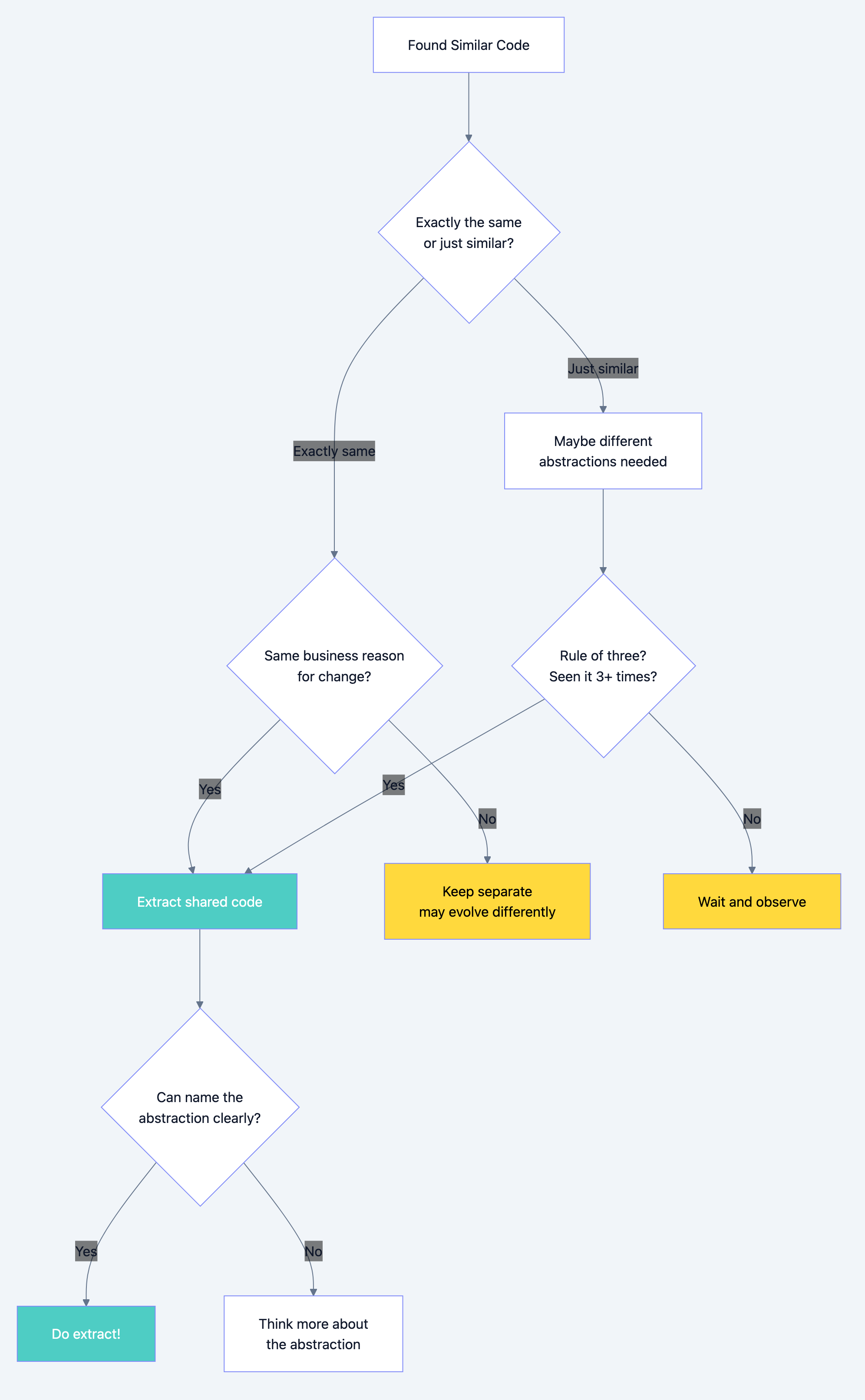
The DRY Decision Framework
Design principles diagram 4
Summary: The DRY Essentials
When to Apply DRY
| Situation | Action |
|---|---|
| Same code copied 3+ times | Extract to function |
| Same magic numbers everywhere | Create named constants |
| Same structure, different details | Consider generics or interfaces |
| Same cross-cutting concerns | Use middleware/decorators |
| Same configuration in multiple places | Centralize configuration |
When NOT to Apply DRY
| Situation | Why Keep Duplication |
|---|---|
| Test setup code | Clarity is more important |
| Two similar things that may diverge | Premature abstraction hurts |
| Can't name the abstraction clearly | You don't understand it yet |
| Duplication is in different bounded contexts | They may need to evolve independently |
| Only two occurrences | Rule of three not met |
Key Takeaways
- DRY is about knowledge, not just code - Same business rule shouldn't exist in multiple places
- One change = One place to edit - That's the goal
- Rule of three - Don't extract too early
- Wrong abstraction is worse than duplication - Be patient
- Test code can be WET - Clarity matters more there
Your Next Steps
- Audit: Find repeated code in your project
- Evaluate: Does it represent the same knowledge?
- Extract: If rule of three is met and abstraction is clear
- Read Next: YAGNI Principle
"Duplication is far cheaper than the wrong abstraction." - Sandi Metz
Remember: DRY is a guideline, not a law. The goal is maintainable code, not zero duplication at all costs.