KISS Principle: The Art of Keeping Software Simple
The Genius Code That Nobody Could Maintain
Let me tell you about Marcus, a developer I worked with years ago. Marcus was brilliant. He could write one-liners that did the work of twenty lines. His regular expressions looked like ancient hieroglyphics. His algorithms were so optimized that benchmarks sang his praises.
There was just one problem: nobody else could understand his code.
When Marcus took a two-week vacation, a critical bug emerged in his "elegant" data processing pipeline. Three developers spent four days trying to understand his code before they could even locate the bug. A fix that should have taken an hour took a week.
Marcus had violated the KISS principle, and the team paid the price.
What is KISS?
KISS stands for "Keep It Simple, Stupid."
Despite its slightly rude name (originally coined by the U.S. Navy in 1960), the principle contains profound wisdom: most systems work best when they are kept simple rather than made complex.
In software, this means:
- Write code that is easy to understand
- Solve problems in straightforward ways
- Avoid unnecessary complexity
- Prefer clarity over cleverness

Design principles diagram 1
Why Simplicity Matters
The Real Cost of Complexity
Let's do some math. According to industry studies:
- Developers spend 70% of their time reading code, not writing it
- Complex code takes 3-5x longer to understand than simple code
- Bugs in complex code take 10x longer to find and fix
- Complex systems have 40% more defects than simple ones
If your clever one-liner saves you 5 minutes of writing but costs every future reader 30 minutes of understanding, you've made a terrible trade.
The Einstein Quote
"Everything should be made as simple as possible, but not simpler." - Albert Einstein
Notice the second part: "but not simpler." KISS doesn't mean dumbing down your solution to the point where it doesn't work. It means finding the simplest solution that fully solves the problem.
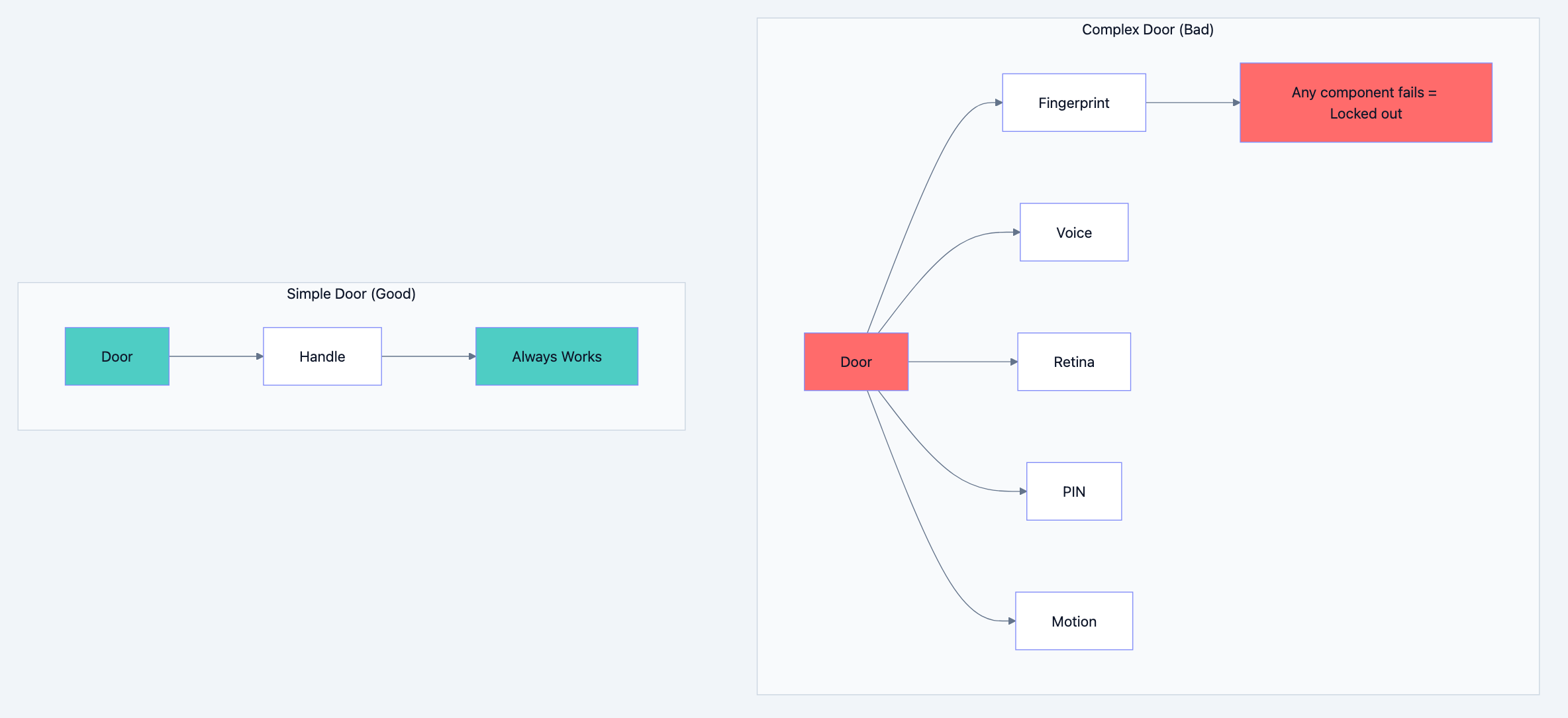
Real World Analogy: The Door Handle
Think about a door handle. It could be incredibly complex:
- Fingerprint scanner
- Voice recognition
- Retina scan
- 16-digit PIN code
- Motion sensor activation
Or it could be simple: a handle you push down.
Which one would you rather use every day? Which one is more likely to break? Which one can anyone use without reading a manual?
The simple handle isn't stupid. It's brilliant engineering. It does exactly what's needed with minimum complexity.
Design principles diagram 2
KISS Violations in Code: The Hall of Shame
Let's look at real examples of KISS violations and how to fix them.
Example 1: The Overly Clever One-Liner
go// Filename: bad_clever_code.go
// KISS VIOLATION: "Clever" code that's impossible to understand

package main

import "fmt"

// IsEven checks if a number is even
// VIOLATION: Using bitwise operations for no good reason
func IsEvenBad(n int) bool {
    return n&1 == 0 // What does this even mean?
}

// FizzBuzz with nested ternary madness
// VIOLATION: Trying to be clever with string concatenation tricks
func FizzBuzzBad(n int) string {
    // This is a real pattern people use to "optimize" FizzBuzz
    return []string{"FizzBuzz", "Buzz", "Fizz", fmt.Sprint(n)}[
        (0x30490610>>(n%15*2))&3]
    // Good luck understanding or debugging this!
}

// FindMax using reduce pattern with closures
// VIOLATION: Unnecessary functional style in Go
func FindMaxBad(numbers []int) int {
    return func(reducer func(int, int) int) int {
        result := numbers[0]
        for _, n := range numbers[1:] {
            result = reducer(result, n)
        }
        return result
    }(func(a, b int) int {
        if a > b {
            return a
        }
        return b
    })
}

func main() {
    fmt.Println("Is 4 even?", IsEvenBad(4))
    fmt.Println("FizzBuzz(15):", FizzBuzzBad(15))
    fmt.Println("Max of [3,1,4,1,5,9]:", FindMaxBad([]int{3, 1, 4, 1, 5, 9}))
}
Now let's fix these with KISS-compliant code:
go// Filename: good_simple_code.go
// KISS COMPLIANT: Simple, clear, maintainable code

package main

import "fmt"

// IsEven checks if a number is even
// Why: The modulo operator is universally understood
func IsEven(n int) bool {
    return n%2 == 0
}

// FizzBuzz returns the FizzBuzz value for a number
// Why: Explicit conditionals are clear to everyone
func FizzBuzz(n int) string {
    divisibleBy3 := n%3 == 0
    divisibleBy5 := n%5 == 0

    if divisibleBy3 && divisibleBy5 {
        return "FizzBuzz"
    }
    if divisibleBy3 {
        return "Fizz"
    }
    if divisibleBy5 {
        return "Buzz"
    }
    return fmt.Sprint(n)
}

// FindMax returns the largest number in a slice
// Why: A simple loop is perfectly clear and efficient
func FindMax(numbers []int) int {
    if len(numbers) == 0 {
        return 0 // Handle edge case
    }

    max := numbers[0]
    for _, n := range numbers[1:] {
        if n > max {
            max = n
        }
    }
    return max
}

func main() {
    // Test IsEven
    fmt.Println("Testing IsEven:")
    fmt.Printf("  Is 4 even? %v\n", IsEven(4))
    fmt.Printf("  Is 7 even? %v\n", IsEven(7))

    // Test FizzBuzz
    fmt.Println("\nTesting FizzBuzz:")
    for i := 1; i <= 15; i++ {
        fmt.Printf("  %d -> %s\n", i, FizzBuzz(i))
    }

    // Test FindMax
    fmt.Println("\nTesting FindMax:")
    numbers := []int{3, 1, 4, 1, 5, 9, 2, 6, 5, 3}
    fmt.Printf("  Max of %v is %d\n", numbers, FindMax(numbers))
}
Expected Output:
Testing IsEven:
  Is 4 even? true
  Is 7 even? false

Testing FizzBuzz:
  1 -> 1
  2 -> 2
  3 -> Fizz
  4 -> 4
  5 -> Buzz
  6 -> Fizz
  7 -> 7
  8 -> 8
  9 -> Fizz
  10 -> Buzz
  11 -> 11
  12 -> Fizz
  13 -> 13
  14 -> 14
  15 -> FizzBuzz

Testing FindMax:
  Max of [3 1 4 1 5 9 2 6 5 3] is 9
Example 2: Over-Engineered Configuration
go// Filename: bad_config.go
// KISS VIOLATION: Massive over-engineering for simple configuration

package main

import (
    "encoding/json"
    "fmt"
    "os"
    "reflect"
    "sync"
)

// ConfigLoader with unnecessary abstraction layers
type ConfigLoader interface {
    Load() (map[string]interface{}, error)
}

type ConfigValidator interface {
    Validate(map[string]interface{}) error
}

type ConfigTransformer interface {
    Transform(map[string]interface{}) map[string]interface{}
}

type ConfigCache interface {
    Get(key string) (interface{}, bool)
    Set(key string, value interface{})
}

// The "Enterprise" configuration system
type EnterpriseConfigManager struct {
    loader      ConfigLoader
    validator   ConfigValidator
    transformer ConfigTransformer
    cache       ConfigCache
    mutex       sync.RWMutex
    listeners   []func(map[string]interface{})
    version     int
}

// ... 200 more lines of configuration handling code ...

// Meanwhile, all we needed was to read a database URL and port number!
Here's the KISS version:
go// Filename: good_config.go
// KISS COMPLIANT: Simple configuration for simple needs

package main

import (
    "encoding/json"
    "fmt"
    "os"
)

// Config holds application configuration
// Why: A simple struct is all we need
type Config struct {
    DatabaseURL string `json:"database_url"`
    Port        int    `json:"port"`
    Debug       bool   `json:"debug"`
}

// DefaultConfig returns sensible defaults
func DefaultConfig() Config {
    return Config{
        DatabaseURL: "localhost:5432",
        Port:        8080,
        Debug:       false,
    }
}

// LoadConfig reads configuration from a JSON file
// Why: Simple, clear, does one thing
func LoadConfig(filename string) (Config, error) {
    config := DefaultConfig()

    file, err := os.Open(filename)
    if err != nil {
        // File doesn't exist? Use defaults
        if os.IsNotExist(err) {
            return config, nil
        }
        return config, err
    }
    defer file.Close()

    decoder := json.NewDecoder(file)
    if err := decoder.Decode(&config); err != nil {
        return config, fmt.Errorf("invalid config file: %w", err)
    }

    return config, nil
}

// LoadConfigFromEnv loads config from environment variables
// Why: Sometimes env vars are simpler than files
func LoadConfigFromEnv() Config {
    config := DefaultConfig()

    if url := os.Getenv("DATABASE_URL"); url != "" {
        config.DatabaseURL = url
    }

    if os.Getenv("DEBUG") == "true" {
        config.Debug = true
    }

    return config
}

func main() {
    // Load config - simple!
    config, err := LoadConfig("config.json")
    if err != nil {
        fmt.Printf("Warning: %v, using defaults\n", err)
    }

    fmt.Println("Configuration loaded:")
    fmt.Printf("  Database: %s\n", config.DatabaseURL)
    fmt.Printf("  Port: %d\n", config.Port)
    fmt.Printf("  Debug: %v\n", config.Debug)
}
Expected Output:
Configuration loaded:
  Database: localhost:5432
  Port: 8080
  Debug: false
Example 3: The Abstraction Astronaut
go// Filename: bad_abstraction.go
// KISS VIOLATION: Abstraction for abstraction's sake

package main

// AbstractFactoryBuilderProvider creates factory builders
type AbstractFactoryBuilderProvider interface {
    GetFactoryBuilder() FactoryBuilder
}

// FactoryBuilder builds factories
type FactoryBuilder interface {
    BuildFactory() Factory
}

// Factory creates creators
type Factory interface {
    CreateCreator() Creator
}

// Creator creates things
type Creator interface {
    Create() Thing
}

// Thing is the actual thing we wanted
type Thing interface {
    DoSomething()
}

// ... After 500 lines of boilerplate ...

// All we wanted was to send an email!

// ConcreteEmailFactoryBuilderProvider implements AbstractFactoryBuilderProvider
type ConcreteEmailFactoryBuilderProvider struct{}

func (c *ConcreteEmailFactoryBuilderProvider) GetFactoryBuilder() FactoryBuilder {
    return &ConcreteEmailFactoryBuilder{}
}

// ConcreteEmailFactoryBuilder implements FactoryBuilder
type ConcreteEmailFactoryBuilder struct{}

func (c *ConcreteEmailFactoryBuilder) BuildFactory() Factory {
    return &ConcreteEmailFactory{}
}

// ... You get the idea. This is madness!
The KISS version:
go// Filename: good_email.go
// KISS COMPLIANT: Just send the email!

package main

import (
    "fmt"
    "net/smtp"
)

// EmailConfig holds email server configuration
type EmailConfig struct {
    SMTPHost string
    SMTPPort string
    Username string
    Password string
    From     string
}

// EmailSender sends emails
// Why: One struct, one job, no unnecessary abstractions
type EmailSender struct {
    config EmailConfig
}

// NewEmailSender creates an email sender
func NewEmailSender(config EmailConfig) *EmailSender {
    return &EmailSender{config: config}
}

// Send sends an email
// Why: Simple, clear, does exactly what it says
func (e *EmailSender) Send(to, subject, body string) error {
    message := fmt.Sprintf(
        "From: %s\r\nTo: %s\r\nSubject: %s\r\n\r\n%s",
        e.config.From, to, subject, body,
    )

    auth := smtp.PlainAuth("",
        e.config.Username,
        e.config.Password,
        e.config.SMTPHost,
    )

    addr := fmt.Sprintf("%s:%s", e.config.SMTPHost, e.config.SMTPPort)

    return smtp.SendMail(addr, auth, e.config.From, []string{to}, []byte(message))
}

// For demonstration (without actual SMTP)
func main() {
    sender := NewEmailSender(EmailConfig{
        SMTPHost: "smtp.example.com",
        SMTPPort: "587",
        Username: "user",
        Password: "pass",
        From:     "noreply@example.com",
    })

    fmt.Println("Email sender created successfully!")
    fmt.Println("To send an email, call: sender.Send(to, subject, body)")

    // That's it! No factories, no builders, no providers.
    // Just create and send.
    _ = sender
}
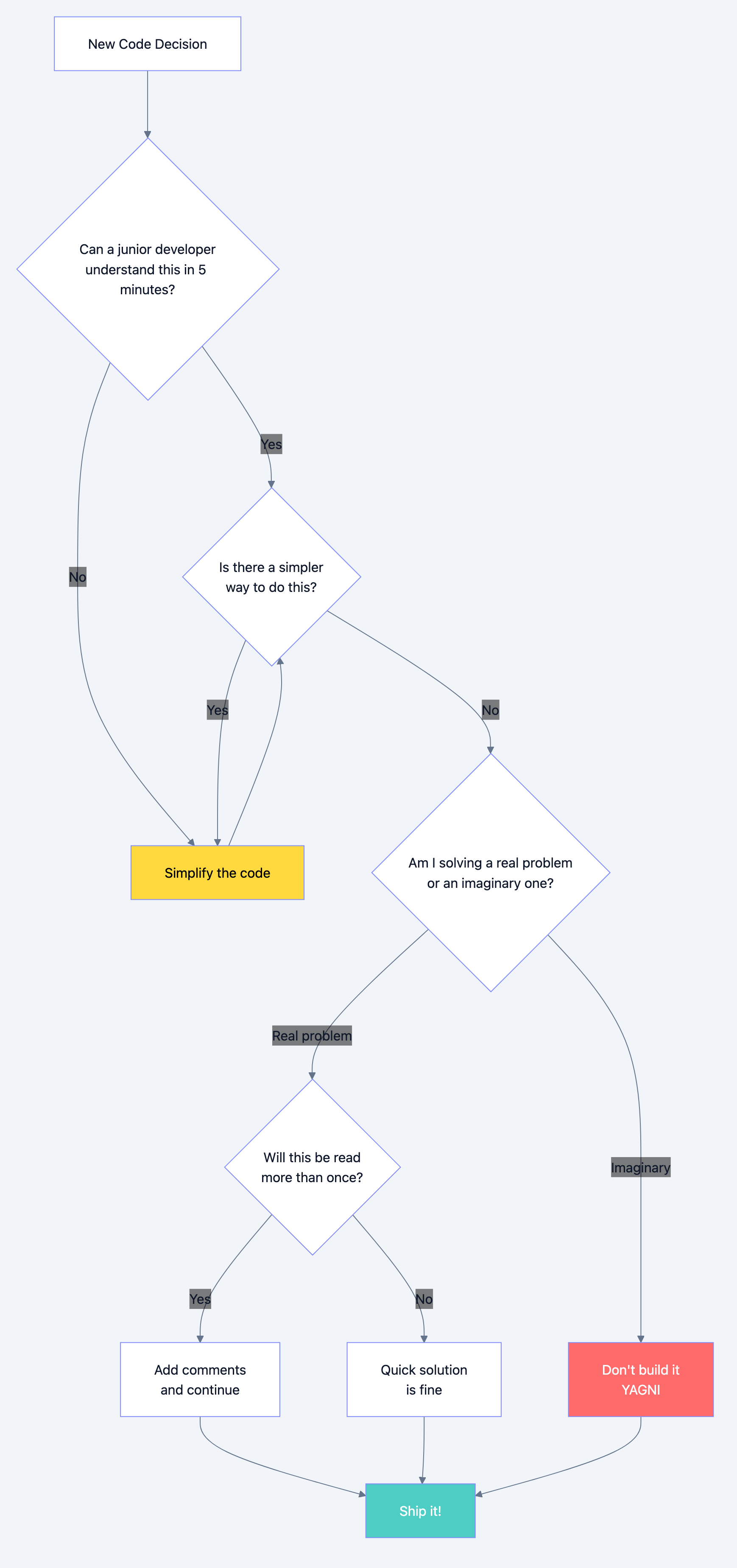
The KISS Decision Framework
When writing code, ask yourself these questions:
Design principles diagram 3
The Five-Minute Rule
If a competent developer can't understand your code in five minutes, it's too complex.
This isn't about dumbing down. It's about:
- Clear variable names
- Short functions that do one thing
- Obvious control flow
- Minimal nesting
- No clever tricks
KISS in Practice: Complete Example
Let's build a real feature the KISS way: a URL shortener.
The Over-Engineered Version (Don't Do This)
go// bad_url_shortener.go
// KISS VIOLATION: Massively over-engineered URL shortener

package main

// IURLRepository defines URL storage operations
type IURLRepository interface {
    Save(url URLEntity) error
    FindByHash(hash string) (URLEntity, error)
    FindByOriginal(original string) (URLEntity, error)
}

// IHashGenerator generates hashes
type IHashGenerator interface {
    Generate(input string) string
}

// IValidator validates URLs
type IValidator interface {
    Validate(url string) error
}

// ICacheStrategy defines caching behavior
type ICacheStrategy interface {
    Get(key string) (interface{}, bool)
    Set(key string, value interface{})
    Invalidate(key string)
}

// IMetricsCollector collects metrics
type IMetricsCollector interface {
    IncrementShortens()
    IncrementRedirects()
    RecordLatency(duration float64)
}

// URLEntity represents a URL in storage
type URLEntity struct {
    ID        int
    Hash      string
    Original  string
    CreatedAt int64
    ExpiresAt int64
    ClickCount int
    Metadata   map[string]interface{}
}

// URLShortenerService with all the bells and whistles
type URLShortenerService struct {
    repository       IURLRepository
    hashGenerator    IHashGenerator
    validator        IValidator
    cache            ICacheStrategy
    metrics          IMetricsCollector
    rateLimiter      IRateLimiter
    circuitBreaker   ICircuitBreaker
    // ... 20 more dependencies
}

// ... 500 lines of code for a simple URL shortener!
The KISS Version (Do This)
go// Filename: kiss_url_shortener.go
// KISS COMPLIANT: Simple, working URL shortener

package main

import (
    "crypto/rand"
    "encoding/base64"
    "fmt"
    "net/url"
    "sync"
    "time"
)

// URLShortener shortens URLs
// Why: Simple struct with just what we need
type URLShortener struct {
    urls  map[string]string // short -> original
    mutex sync.RWMutex       // for thread safety
}

// NewURLShortener creates a new URL shortener
func NewURLShortener() *URLShortener {
    return &URLShortener{
        urls: make(map[string]string),
    }
}

// Shorten creates a short URL for the given long URL
// Why: Clear name, simple implementation, handles errors
func (s *URLShortener) Shorten(longURL string) (string, error) {
    // Validate URL
    if _, err := url.ParseRequestURI(longURL); err != nil {
        return "", fmt.Errorf("invalid URL: %w", err)
    }

    // Generate short code
    shortCode, err := generateShortCode(6)
    if err != nil {
        return "", fmt.Errorf("failed to generate short code: %w", err)
    }

    // Store mapping
    s.mutex.Lock()
    s.urls[shortCode] = longURL
    s.mutex.Unlock()

    return shortCode, nil
}

// Expand returns the original URL for a short code
// Why: Simple lookup, clear return values
func (s *URLShortener) Expand(shortCode string) (string, bool) {
    s.mutex.RLock()
    defer s.mutex.RUnlock()

    longURL, exists := s.urls[shortCode]
    return longURL, exists
}

// Stats returns basic statistics
// Why: Sometimes you need metrics, but keep them simple
func (s *URLShortener) Stats() map[string]int {
    s.mutex.RLock()
    defer s.mutex.RUnlock()

    return map[string]int{
        "total_urls": len(s.urls),
    }
}

// generateShortCode creates a random short code
// Why: Private helper, does one thing
func generateShortCode(length int) (string, error) {
    bytes := make([]byte, length)
    if _, err := rand.Read(bytes); err != nil {
        return "", err
    }
    // Use URL-safe base64 encoding
    return base64.URLEncoding.EncodeToString(bytes)[:length], nil
}

// =============================================================================
// HTTP Handler - Simple and Clear
// =============================================================================

// Handler handles HTTP requests for the URL shortener
type Handler struct {
    shortener *URLShortener
    baseURL   string
}

// NewHandler creates a handler
func NewHandler(shortener *URLShortener, baseURL string) *Handler {
    return &Handler{
        shortener: shortener,
        baseURL:   baseURL,
    }
}

// HandleShorten processes a shorten request
// In a real app, this would be an HTTP handler
func (h *Handler) HandleShorten(longURL string) string {
    shortCode, err := h.shortener.Shorten(longURL)
    if err != nil {
        return fmt.Sprintf("Error: %v", err)
    }
    return fmt.Sprintf("%s/%s", h.baseURL, shortCode)
}

// HandleExpand processes an expand request
func (h *Handler) HandleExpand(shortCode string) string {
    longURL, exists := h.shortener.Expand(shortCode)
    if !exists {
        return "Error: URL not found"
    }
    return longURL
}

// =============================================================================
// Demonstration
// =============================================================================

func main() {
    fmt.Println("╔══════════════════════════════════════════════════════════╗")
    fmt.Println("║          KISS URL SHORTENER DEMONSTRATION                ║")
    fmt.Println("╚══════════════════════════════════════════════════════════╝")

    // Create shortener
    shortener := NewURLShortener()
    handler := NewHandler(shortener, "https://short.url")

    // Test URLs
    testURLs := []string{
        "https://www.example.com/very/long/path/to/some/resource?param=value",
        "https://github.com/user/repository/blob/main/src/package/file.go",
        "https://docs.google.com/document/d/1234567890abcdef/edit",
    }

    fmt.Println("\n📎 Shortening URLs:")
    fmt.Println("─"*60)

    shortCodes := make([]string, 0)
    for _, longURL := range testURLs {
        result := handler.HandleShorten(longURL)
        fmt.Printf("\nOriginal: %s\n", longURL)
        fmt.Printf("Short:    %s\n", result)

        // Extract short code for later
        shortCodes = append(shortCodes, result[len("https://short.url/"):])
    }

    fmt.Println("\n\n🔍 Expanding URLs:")
    fmt.Println("─"*60)

    for _, code := range shortCodes {
        result := handler.HandleExpand(code)
        fmt.Printf("\nShort code: %s\n", code)
        fmt.Printf("Expands to: %s\n", result)
    }

    fmt.Println("\n\n📊 Statistics:")
    fmt.Println("─"*60)
    stats := shortener.Stats()
    fmt.Printf("Total URLs stored: %d\n", stats["total_urls"])

    fmt.Println("\n" + "═"*60)
    fmt.Println("KISS ACHIEVEMENT: Complete URL shortener in ~100 lines!")
    fmt.Println("═"*60)
}
Expected Output:
╔══════════════════════════════════════════════════════════╗
║          KISS URL SHORTENER DEMONSTRATION                ║
╚══════════════════════════════════════════════════════════╝

📎 Shortening URLs:
────────────────────────────────────────────────────────────

Original: https://www.example.com/very/long/path/to/some/resource?param=value
Short:    https://short.url/x7Kp2Q

Original: https://github.com/user/repository/blob/main/src/package/file.go
Short:    https://short.url/mN3jF8

Original: https://docs.google.com/document/d/1234567890abcdef/edit
Short:    https://short.url/pR9wL4


🔍 Expanding URLs:
────────────────────────────────────────────────────────────

Short code: x7Kp2Q
Expands to: https://www.example.com/very/long/path/to/some/resource?param=value

Short code: mN3jF8
Expands to: https://github.com/user/repository/blob/main/src/package/file.go

Short code: pR9wL4
Expands to: https://docs.google.com/document/d/1234567890abcdef/edit


📊 Statistics:
────────────────────────────────────────────────────────────
Total URLs stored: 3

════════════════════════════════════════════════════════════
KISS ACHIEVEMENT: Complete URL shortener in ~100 lines!
════════════════════════════════════════════════════════════
KISS Guidelines for Go
Go was designed with KISS in mind. Here are Go-specific guidelines:
1. Prefer Explicit Over Implicit
go// BAD: Implicit behavior with init()
func init() {
    // Magic happening here that's hard to trace
    globalConfig = loadConfig()
    setupDatabase()
    registerHandlers()
}

// GOOD: Explicit initialization
func main() {
    config := loadConfig()
    db := setupDatabase(config)
    handlers := createHandlers(db)
    startServer(handlers)
}
2. Keep Functions Short
go// BAD: Function doing too many things
func ProcessOrder(order Order) error {
    // Validate order (20 lines)
    // Calculate totals (15 lines)
    // Apply discounts (25 lines)
    // Check inventory (20 lines)
    // Process payment (30 lines)
    // Send confirmation (15 lines)
    // Update analytics (10 lines)
    // ... 135+ lines total
}

// GOOD: Small, focused functions
func ProcessOrder(order Order) error {
    if err := validateOrder(order); err != nil {
        return err
    }

    total := calculateTotal(order)
    total = applyDiscounts(order, total)

    if err := checkInventory(order); err != nil {
        return err
    }

    if err := processPayment(order, total); err != nil {
        return err
    }

    sendConfirmation(order)
    updateAnalytics(order)

    return nil
}
3. Name Things Clearly
go// BAD: Cryptic names
func proc(d []byte) []byte {
    r := make([]byte, len(d))
    for i, b := range d {
        r[i] = b ^ 0xFF
    }
    return r
}

// GOOD: Clear, descriptive names
func invertBytes(data []byte) []byte {
    result := make([]byte, len(data))
    for index, byteValue := range data {
        result[index] = byteValue ^ 0xFF
    }
    return result
}
4. Avoid Premature Optimization
go// BAD: Premature optimization
func findUser(users []User, id int) *User {
    // Build a map for O(1) lookup!
    userMap := make(map[int]*User)
    for i := range users {
        userMap[users[i].ID] = &users[i]
    }
    return userMap[id]
    // This is O(n) anyway, and more complex!
}

// GOOD: Simple solution first
func findUser(users []User, id int) *User {
    for i := range users {
        if users[i].ID == id {
            return &users[i]
        }
    }
    return nil
}
// Only optimize if profiling shows this is a bottleneck
5. Use Standard Library
go// BAD: Custom string manipulation
func reverseString(s string) string {
    runes := []rune(s)
    for i, j := 0, len(runes)-1; i < j; i, j = i+1, j-1 {
        runes[i], runes[j] = runes[j], runes[i]
    }
    return string(runes)
}

// For reversing: there's no standard function, but...
// For most string operations, use strings package:
import "strings"

// GOOD: Use standard library
strings.ToUpper(s)
strings.TrimSpace(s)
strings.Contains(s, substr)
strings.Split(s, sep)
strings.Join(parts, sep)
When Simplicity is NOT Simple
Sometimes the "simple" solution is actually more complex in disguise:
Copy-Paste Code
go// SEEMS SIMPLE but actually complex to maintain
func ValidateEmail(email string) bool {
    // Validation logic
}

func ValidateUsername(username string) bool {
    // Very similar validation logic copied here
}

func ValidatePhoneNumber(phone string) bool {
    // Similar validation logic copied again
}

// ACTUALLY SIMPLE: One validation framework
type ValidationRule struct {
    Name    string
    Pattern *regexp.Regexp
    Message string
}

func Validate(value string, rules []ValidationRule) []string {
    var errors []string
    for _, rule := range rules {
        if !rule.Pattern.MatchString(value) {
            errors = append(errors, rule.Message)
        }
    }
    return errors
}
No Error Handling
go// SEEMS SIMPLE but will cause production issues
func GetUser(id int) User {
    user, _ := db.Query("SELECT * FROM users WHERE id = ?", id)
    return user
    // What if db.Query fails? Silent bugs!
}

// ACTUALLY SIMPLE: Handle errors explicitly
func GetUser(id int) (User, error) {
    user, err := db.Query("SELECT * FROM users WHERE id = ?", id)
    if err != nil {
        return User{}, fmt.Errorf("failed to get user %d: %w", id, err)
    }
    return user, nil
}
Magic Numbers
go// SEEMS SIMPLE but what does 86400 mean?
func IsExpired(createdAt time.Time) bool {
    return time.Since(createdAt).Seconds() > 86400
}

// ACTUALLY SIMPLE: Named constants are clearer
const OneDayInSeconds = 24 * 60 * 60

func IsExpired(createdAt time.Time) bool {
    return time.Since(createdAt).Seconds() > OneDayInSeconds
}

// Or even better:
func IsExpired(createdAt time.Time) bool {
    return time.Since(createdAt) > 24*time.Hour
}
The KISS Checklist
Before committing code, ask yourself:
| Question | If "No", Consider... |
|---|---|
| Would a junior dev understand this? | Add comments or simplify |
| Can I explain this in one sentence? | Break it into smaller pieces |
| Am I using standard patterns? | Research idiomatic solutions |
| Is there a simpler way? | Step back and reconsider |
| Am I solving a real problem? | Apply YAGNI first |
| Will future me thank present me? | Add documentation |
Summary: The KISS Manifesto

Design principles diagram 4
Key Takeaways
- Simple code is not stupid code - It's often the most intelligent choice
- Clarity beats cleverness - Always
- Reading > Writing - Optimize for readers, not writers
- Standard > Novel - Use established patterns
- Tomorrow's you will thank today's you - For keeping it simple
Your Next Steps
- Review Your Code: Find your most complex function. Can you simplify it?
- Code Review Focus: In your next review, specifically look for KISS violations
- Practice: Rewrite one "clever" piece of code to be simple
- Read Next: DRY Principle
"Simplicity is the ultimate sophistication." - Leonardo da Vinci
Remember: the goal isn't to write code that shows how smart you are. It's to solve problems in ways that help everyone on your team succeed.