Context and Cancellation Pattern in Go: Graceful Shutdowns and Timeouts
A user clicks "Cancel" on a long-running search. An API request takes too long. The server is shutting down. In all these cases, you need to stop ongoing work cleanly, without leaking goroutines or leaving resources in bad states.
Go's
context package is the standard way to handle cancellation, timeouts, and request-scoped values. It's so important that it's the first parameter in most Go APIs. Master this pattern, and you'll build robust, well-behaved applications.The Real World Parallel: A Restaurant Kitchen
Think of it like this: A customer orders a complex dish. The kitchen starts preparing multiple components simultaneously: one chef makes the sauce, another prepares the vegetables, a third handles the protein. Then the customer cancels their order. The kitchen needs to stop all related work immediately. Each chef checks periodically if the order is still active. When cancelled, they all stop, clean up their stations, and move to the next order. This is context cancellation.
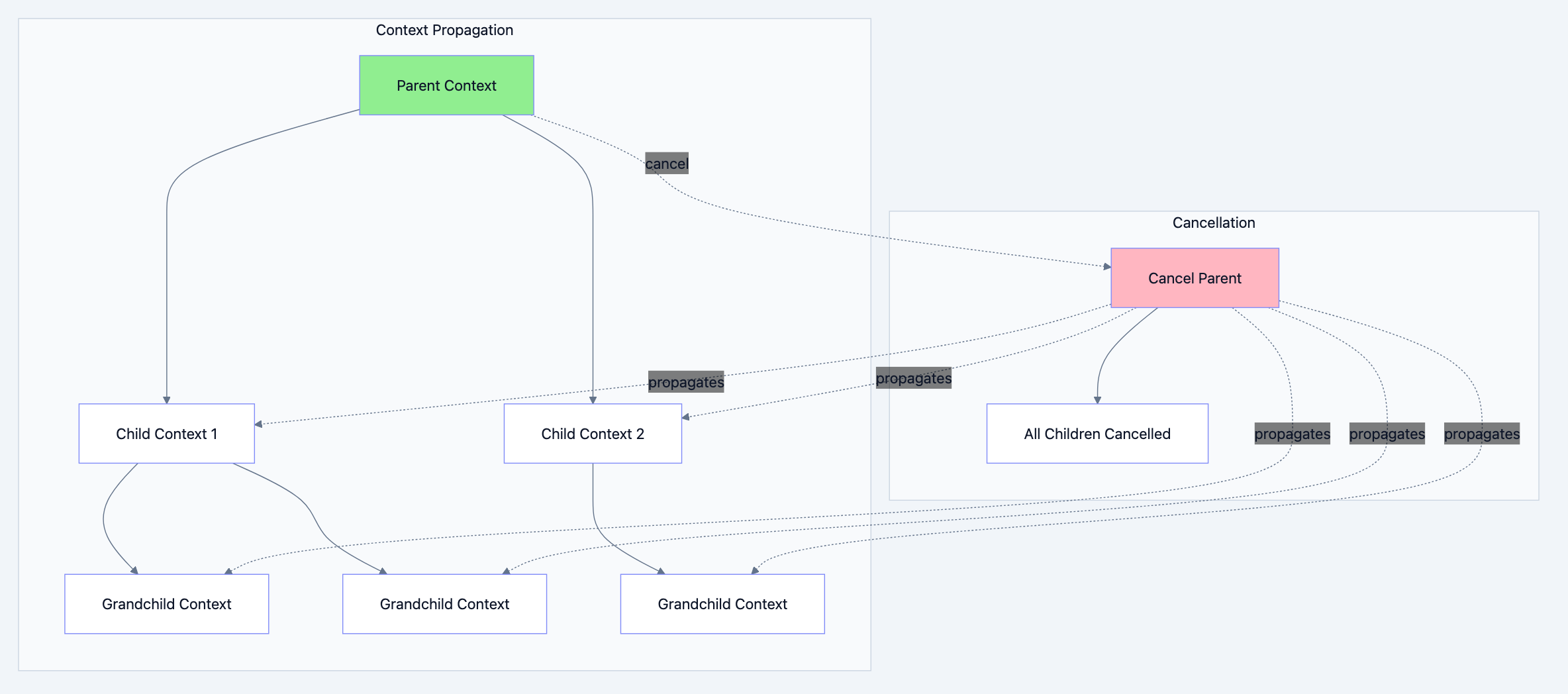
Concurrency pattern diagram 1
Why Context Matters
Without context, you can't:
- Stop a goroutine from outside
- Set timeouts on operations
- Cancel multiple goroutines at once
- Pass request-scoped data safely
go// Filename: why_context.go
package main

import (
    "context"
    "fmt"
    "time"
)

// WITHOUT context - cannot be cancelled!
func searchWithoutContext(query string) []string {
    time.Sleep(5 * time.Second) // User waiting...
    return []string{"result1", "result2"}
}

// WITH context - cancellable, with timeout
func searchWithContext(ctx context.Context, query string) ([]string, error) {
    resultCh := make(chan []string, 1)

    go func() {
        time.Sleep(5 * time.Second) // Simulate search
        resultCh <- []string{"result1", "result2"}
    }()

    select {
    case results := <-resultCh:
        return results, nil
    case <-ctx.Done():
        return nil, ctx.Err() // Cancelled or timed out!
    }
}

func main() {
    // With 2 second timeout - search will be cancelled
    ctx, cancel := context.WithTimeout(context.Background(), 2*time.Second)
    defer cancel()

    fmt.Println("Starting search with 2s timeout...")
    results, err := searchWithContext(ctx, "golang")

    if err != nil {
        fmt.Printf("Search cancelled: %v\n", err)
    } else {
        fmt.Printf("Results: %v\n", results)
    }
}
Expected Output:
Starting search with 2s timeout...
Search cancelled: context deadline exceeded
Context Types
go// Filename: context_types.go
package main

import (
    "context"
    "fmt"
    "time"
)

func main() {
    // 1. Background context - the root, never cancelled
    bg := context.Background()
    fmt.Println("1. Background context - root of all contexts")

    // 2. TODO context - placeholder when unsure what context to use
    todo := context.TODO()
    fmt.Println("2. TODO context - placeholder for future")

    // 3. WithCancel - manually cancellable
    ctxCancel, cancel := context.WithCancel(bg)
    fmt.Printf("3. WithCancel - cancellable: done=%v\n", ctxCancel.Err())
    cancel()
    fmt.Printf("   After cancel: done=%v\n", ctxCancel.Err())

    // 4. WithTimeout - auto-cancels after duration
    ctxTimeout, cancelTimeout := context.WithTimeout(bg, 100*time.Millisecond)
    defer cancelTimeout()
    fmt.Println("4. WithTimeout - cancels after 100ms")
    time.Sleep(150 * time.Millisecond)
    fmt.Printf("   After 150ms: done=%v\n", ctxTimeout.Err())

    // 5. WithDeadline - auto-cancels at specific time
    deadline := time.Now().Add(50 * time.Millisecond)
    ctxDeadline, cancelDeadline := context.WithDeadline(bg, deadline)
    defer cancelDeadline()
    fmt.Println("5. WithDeadline - cancels at specific time")
    time.Sleep(100 * time.Millisecond)
    fmt.Printf("   After deadline: done=%v\n", ctxDeadline.Err())

    // 6. WithValue - carries request-scoped data
    type keyType string
    const userKey keyType = "user"
    ctxValue := context.WithValue(bg, userKey, "alice")
    fmt.Printf("6. WithValue - carries data: user=%v\n", ctxValue.Value(userKey))
}
Real World Example 1: HTTP Server with Graceful Shutdown
go// Filename: graceful_shutdown.go
package main

import (
    "context"
    "fmt"
    "net/http"
    "os"
    "os/signal"
    "sync"
    "syscall"
    "time"
)

// Server with graceful shutdown
type Server struct {
    httpServer *http.Server
    wg         sync.WaitGroup
}

func NewServer(addr string) *Server {
    mux := http.NewServeMux()

    s := &Server{
        httpServer: &http.Server{
            Addr:    addr,
            Handler: mux,
        },
    }

    // Long-running endpoint
    mux.HandleFunc("/slow", func(w http.ResponseWriter, r *http.Request) {
        s.wg.Add(1)
        defer s.wg.Done()

        ctx := r.Context()

        // Simulate long work
        select {
        case <-time.After(10 * time.Second):
            fmt.Fprintln(w, "Work completed!")
        case <-ctx.Done():
            fmt.Printf("Request cancelled: %v\n", ctx.Err())
            http.Error(w, "Request cancelled", http.StatusServiceUnavailable)
        }
    })

    // Health check
    mux.HandleFunc("/health", func(w http.ResponseWriter, r *http.Request) {
        w.Write([]byte("OK"))
    })

    return s
}

func (s *Server) Start() error {
    fmt.Printf("Server starting on %s\n", s.httpServer.Addr)
    return s.httpServer.ListenAndServe()
}

func (s *Server) Shutdown(ctx context.Context) error {
    fmt.Println("Shutting down server...")

    // Stop accepting new connections
    if err := s.httpServer.Shutdown(ctx); err != nil {
        return err
    }

    // Wait for in-flight requests
    done := make(chan struct{})
    go func() {
        s.wg.Wait()
        close(done)
    }()

    select {
    case <-done:
        fmt.Println("All requests completed")
        return nil
    case <-ctx.Done():
        return ctx.Err()
    }
}

func main() {
    server := NewServer(":8080")

    // Start server in goroutine
    go func() {
        if err := server.Start(); err != http.ErrServerClosed {
            fmt.Printf("Server error: %v\n", err)
        }
    }()

    // Wait for shutdown signal
    quit := make(chan os.Signal, 1)
    signal.Notify(quit, syscall.SIGINT, syscall.SIGTERM)
    <-quit

    fmt.Println("\nReceived shutdown signal")

    // Graceful shutdown with 30 second timeout
    ctx, cancel := context.WithTimeout(context.Background(), 30*time.Second)
    defer cancel()

    if err := server.Shutdown(ctx); err != nil {
        fmt.Printf("Shutdown error: %v\n", err)
    }

    fmt.Println("Server stopped gracefully")
}
Real World Example 2: Database Operations with Timeout
go// Filename: db_with_context.go
package main

import (
    "context"
    "fmt"
    "math/rand"
    "time"
)

// User represents a database user
type User struct {
    ID    int
    Name  string
    Email string
}

// Database simulates a database connection
type Database struct{}

// QueryUser simulates a database query with context
func (db *Database) QueryUser(ctx context.Context, userID int) (*User, error) {
    // Simulate query with variable latency
    queryTime := time.Duration(100+rand.Intn(400)) * time.Millisecond

    select {
    case <-time.After(queryTime):
        // Query completed
        return &User{
            ID:    userID,
            Name:  fmt.Sprintf("User %d", userID),
            Email: fmt.Sprintf("user%d@example.com", userID),
        }, nil
    case <-ctx.Done():
        // Context cancelled or timed out
        return nil, fmt.Errorf("query cancelled: %w", ctx.Err())
    }
}

// QueryUsers simulates fetching multiple users
func (db *Database) QueryUsers(ctx context.Context, userIDs []int) ([]*User, error) {
    results := make([]*User, 0, len(userIDs))

    for _, id := range userIDs {
        // Check context before each query
        if ctx.Err() != nil {
            return results, fmt.Errorf("stopped after %d users: %w", len(results), ctx.Err())
        }

        user, err := db.QueryUser(ctx, id)
        if err != nil {
            return results, err
        }
        results = append(results, user)
    }

    return results, nil
}

// UserService provides user-related operations
type UserService struct {
    db *Database
}

// GetUserWithTimeout gets a user with a timeout
func (s *UserService) GetUserWithTimeout(userID int, timeout time.Duration) (*User, error) {
    ctx, cancel := context.WithTimeout(context.Background(), timeout)
    defer cancel()

    return s.db.QueryUser(ctx, userID)
}

// GetUsersWithDeadline gets users that must complete by deadline
func (s *UserService) GetUsersWithDeadline(userIDs []int, deadline time.Time) ([]*User, error) {
    ctx, cancel := context.WithDeadline(context.Background(), deadline)
    defer cancel()

    return s.db.QueryUsers(ctx, userIDs)
}

func main() {
    rand.Seed(time.Now().UnixNano())

    service := &UserService{db: &Database{}}

    fmt.Println("🗄️  Database Operations with Context")
    fmt.Println("=====================================\n")

    // Example 1: Single query with timeout
    fmt.Println("1. Single query with 200ms timeout:")
    for i := 0; i < 3; i++ {
        user, err := service.GetUserWithTimeout(1, 200*time.Millisecond)
        if err != nil {
            fmt.Printf("   Attempt %d: ❌ %v\n", i+1, err)
        } else {
            fmt.Printf("   Attempt %d: ✅ Got %s\n", i+1, user.Name)
        }
    }

    // Example 2: Multiple queries with deadline
    fmt.Println("\n2. Multiple queries with 500ms deadline:")
    deadline := time.Now().Add(500 * time.Millisecond)
    userIDs := []int{1, 2, 3, 4, 5, 6, 7, 8, 9, 10}

    users, err := service.GetUsersWithDeadline(userIDs, deadline)
    if err != nil {
        fmt.Printf("   ❌ Error: %v\n", err)
    }
    fmt.Printf("   ✅ Retrieved %d/%d users before deadline\n", len(users), len(userIDs))

    // Example 3: Cancellable query
    fmt.Println("\n3. Cancellable query:")
    ctx, cancel := context.WithCancel(context.Background())

    // Cancel after 100ms
    go func() {
        time.Sleep(100 * time.Millisecond)
        fmt.Println("   Cancelling query...")
        cancel()
    }()

    _, err = service.db.QueryUser(ctx, 1)
    if err != nil {
        fmt.Printf("   ❌ Query cancelled: %v\n", err)
    }
}
Real World Example 3: Parallel Operations with Shared Cancellation
go// Filename: parallel_with_cancellation.go
package main

import (
    "context"
    "fmt"
    "math/rand"
    "sync"
    "time"
)

// SearchResult from a single source
type SearchResult struct {
    Source  string
    Results []string
    Error   error
}

// searchSource simulates searching a single source
func searchSource(ctx context.Context, source string) SearchResult {
    latency := time.Duration(100+rand.Intn(300)) * time.Millisecond

    select {
    case <-time.After(latency):
        // Simulate some results
        return SearchResult{
            Source:  source,
            Results: []string{fmt.Sprintf("result from %s", source)},
        }
    case <-ctx.Done():
        return SearchResult{
            Source: source,
            Error:  ctx.Err(),
        }
    }
}

// SearchAll searches all sources in parallel with shared cancellation
func SearchAll(ctx context.Context, query string, sources []string) []SearchResult {
    results := make([]SearchResult, len(sources))
    var wg sync.WaitGroup

    for i, source := range sources {
        wg.Add(1)
        go func(index int, src string) {
            defer wg.Done()
            results[index] = searchSource(ctx, src)
        }(i, source)
    }

    wg.Wait()
    return results
}

// SearchFirst returns as soon as one source responds
func SearchFirst(ctx context.Context, query string, sources []string) (*SearchResult, error) {
    ctx, cancel := context.WithCancel(ctx)
    defer cancel() // Cancel remaining searches when we return

    resultCh := make(chan SearchResult, len(sources))

    for _, source := range sources {
        go func(src string) {
            result := searchSource(ctx, src)
            select {
            case resultCh <- result:
            case <-ctx.Done():
            }
        }(source)
    }

    // Return first successful result
    for i := 0; i < len(sources); i++ {
        result := <-resultCh
        if result.Error == nil {
            return &result, nil
        }
    }

    return nil, fmt.Errorf("all sources failed")
}

// SearchWithQuorum returns when N sources respond
func SearchWithQuorum(ctx context.Context, query string, sources []string, quorum int) ([]SearchResult, error) {
    ctx, cancel := context.WithCancel(ctx)
    defer cancel()

    resultCh := make(chan SearchResult, len(sources))

    for _, source := range sources {
        go func(src string) {
            result := searchSource(ctx, src)
            select {
            case resultCh <- result:
            case <-ctx.Done():
            }
        }(source)
    }

    var results []SearchResult
    for i := 0; i < len(sources) && len(results) < quorum; i++ {
        select {
        case result := <-resultCh:
            if result.Error == nil {
                results = append(results, result)
            }
        case <-ctx.Done():
            return results, ctx.Err()
        }
    }

    if len(results) < quorum {
        return results, fmt.Errorf("only got %d/%d results", len(results), quorum)
    }

    return results, nil
}

func main() {
    rand.Seed(time.Now().UnixNano())

    sources := []string{"Google", "Bing", "DuckDuckGo", "Yahoo", "Yandex"}

    fmt.Println("🔍 Parallel Search with Cancellation")
    fmt.Println("=====================================\n")

    // Example 1: Search all with timeout
    fmt.Println("1. Search all sources (500ms timeout):")
    ctx, cancel := context.WithTimeout(context.Background(), 500*time.Millisecond)
    results := SearchAll(ctx, "golang", sources)
    cancel()

    for _, r := range results {
        if r.Error != nil {
            fmt.Printf("   ❌ %s: %v\n", r.Source, r.Error)
        } else {
            fmt.Printf("   ✅ %s: %v\n", r.Source, r.Results)
        }
    }

    // Example 2: First response wins
    fmt.Println("\n2. First response wins:")
    ctx, cancel = context.WithTimeout(context.Background(), 1*time.Second)
    first, err := SearchFirst(ctx, "golang", sources)
    cancel()

    if err != nil {
        fmt.Printf("   ❌ Error: %v\n", err)
    } else {
        fmt.Printf("   ✅ First response from %s: %v\n", first.Source, first.Results)
    }

    // Example 3: Quorum (3 of 5)
    fmt.Println("\n3. Quorum search (need 3 of 5):")
    ctx, cancel = context.WithTimeout(context.Background(), 1*time.Second)
    quorumResults, err := SearchWithQuorum(ctx, "golang", sources, 3)
    cancel()

    if err != nil {
        fmt.Printf("   ❌ Error: %v\n", err)
    }
    fmt.Printf("   ✅ Got %d results:\n", len(quorumResults))
    for _, r := range quorumResults {
        fmt.Printf("      - %s\n", r.Source)
    }
}
Context Best Practices
go// Filename: context_best_practices.go
package main

import (
    "context"
    "fmt"
    "net/http"
)

// BEST PRACTICE 1: Context is the first parameter
// Why: Convention makes code predictable and easier to maintain

// Good
func ProcessData(ctx context.Context, data []byte) error {
    return nil
}

// Bad - context should be first
// func ProcessData(data []byte, ctx context.Context) error

// BEST PRACTICE 2: Don't store context in structs
// Why: Context is request-scoped, not instance-scoped

// Bad
type BadService struct {
    ctx context.Context // Don't do this!
}

// Good - pass context to methods
type GoodService struct{}

func (s *GoodService) DoWork(ctx context.Context) error {
    return nil
}

// BEST PRACTICE 3: Always call cancel
// Why: Releases resources even if context hasn't timed out

func goodCancelUsage() {
    ctx, cancel := context.WithTimeout(context.Background(), 0)
    defer cancel() // Always defer cancel!

    _ = ctx
}

// BEST PRACTICE 4: Use context.Value sparingly
// Why: Type safety is lost, makes dependencies implicit

type contextKey string

const (
    userIDKey    contextKey = "userID"
    requestIDKey contextKey = "requestID"
)

// Good - typed keys prevent collisions
func SetUserID(ctx context.Context, userID string) context.Context {
    return context.WithValue(ctx, userIDKey, userID)
}

func GetUserID(ctx context.Context) (string, bool) {
    userID, ok := ctx.Value(userIDKey).(string)
    return userID, ok
}

// BEST PRACTICE 5: Check ctx.Err() in loops
func processItems(ctx context.Context, items []int) error {
    for _, item := range items {
        // Check before expensive operation
        if ctx.Err() != nil {
            return ctx.Err()
        }

        // Process item...
        _ = item
    }
    return nil
}

// BEST PRACTICE 6: Use ctx.Done() in select statements
func longOperation(ctx context.Context) error {
    // Simulated long operation
    done := make(chan struct{})

    go func() {
        // Do work...
        close(done)
    }()

    select {
    case <-done:
        return nil
    case <-ctx.Done():
        return ctx.Err()
    }
}

// BEST PRACTICE 7: Middleware should pass context
func LoggingMiddleware(next http.Handler) http.Handler {
    return http.HandlerFunc(func(w http.ResponseWriter, r *http.Request) {
        // Add request ID to context
        ctx := context.WithValue(r.Context(), requestIDKey, "req-123")
        r = r.WithContext(ctx)

        next.ServeHTTP(w, r)
    })
}

func main() {
    fmt.Println("Context Best Practices - See code comments")
}
When to Use Context
Use Context For:
| Scenario | Why |
|---|---|
| HTTP handlers | Request-scoped cancellation |
| Database queries | Query timeouts |
| API calls | Request timeouts |
| Long-running operations | Graceful cancellation |
| Parallel operations | Shared cancellation |
Don't Use Context For:
| Scenario | Better Alternative |
|---|---|
| Passing required data | Function parameters |
| Optional dependencies | Options pattern |
| Global configuration | Package-level config |
| Storing large data | Dedicated request struct |
Summary
Context is Go's standard way to:
- Cancel operations (user cancellation, timeouts)
- Set deadlines (max operation duration)
- Pass request-scoped values (trace IDs, user info)
Key Takeaways:
- Context is first parameter: Convention, not just style
- Always cancel: Use
defer cancel()to free resources - Check ctx.Done(): In loops and select statements
- Don't store in structs: Context is request-scoped
- Use Value sparingly: For cross-cutting concerns only
Next Steps
- Practice: Add context to all your HTTP handlers
- Explore: OpenTelemetry for distributed tracing
- Read: Go blog post on context
- Build: Graceful shutdown for your services