Pub/Sub Pattern in Go: Building Event Driven Systems
You have a user registration event. Multiple systems need to react: send a welcome email, create analytics entry, notify the sales team, provision cloud resources. How do you connect them without creating a tangled mess of dependencies?
The Pub/Sub (Publish-Subscribe) pattern decouples event producers from event consumers. Publishers don't know who's listening. Subscribers don't know who's publishing. They communicate through a shared topic. This creates flexible, maintainable systems that can evolve independently.
The Real World Parallel: A Radio Station
Think of it like this: A radio station broadcasts music on a frequency. The station doesn't know who's listening. Listeners tune in to the frequency they want. When you buy a new radio, you can immediately listen without the station knowing. When the station plays a new song, all tuned-in radios receive it simultaneously. This is Pub/Sub.
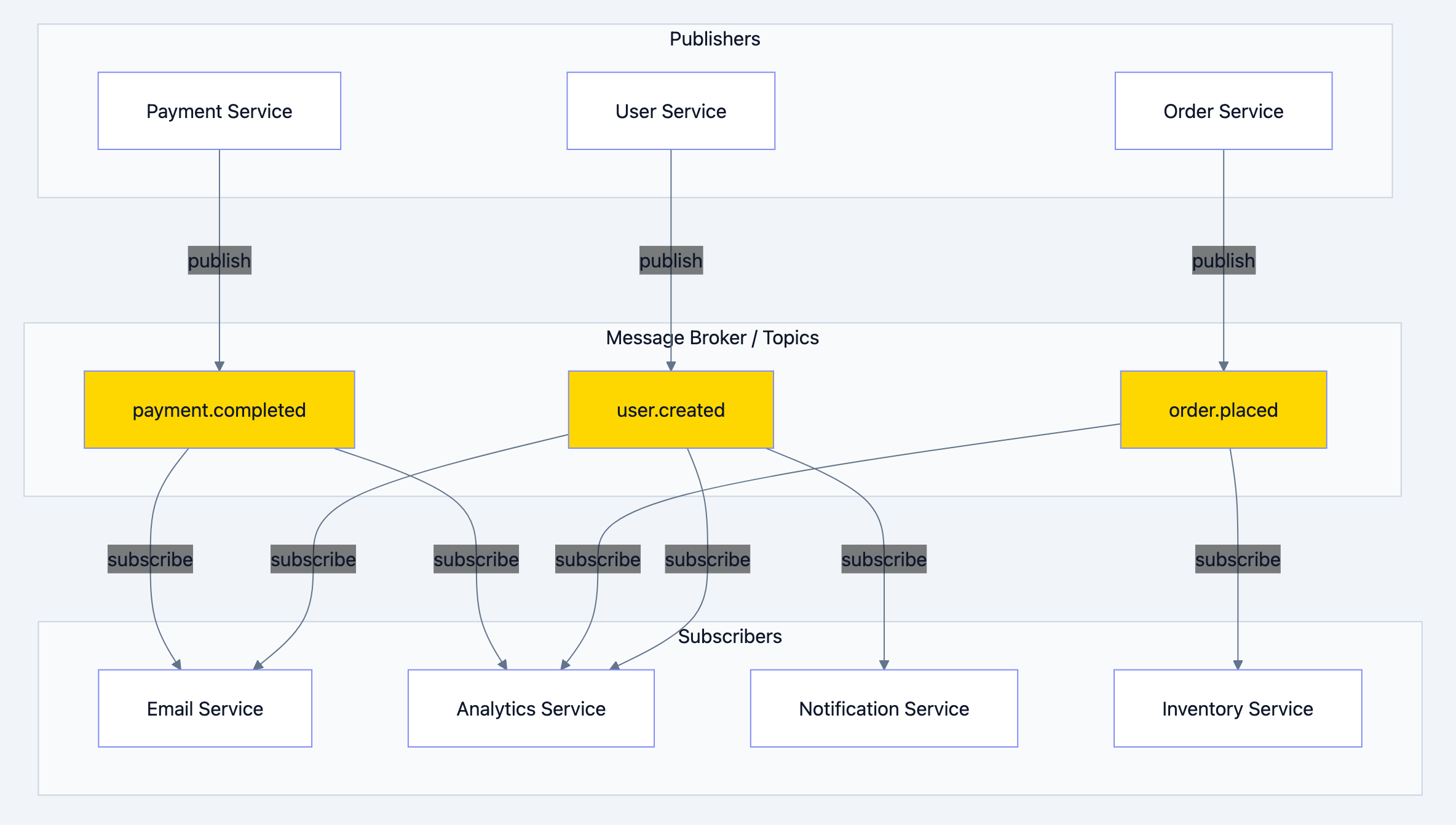
Concurrency pattern diagram 1
Why Pub/Sub?
Consider a monolithic approach vs Pub/Sub:
go// Monolithic approach - tight coupling
func RegisterUser(user User) error {
    // Save user
    if err := db.Save(user); err != nil {
        return err
    }

    // Direct calls to every dependent service
    emailService.SendWelcome(user)       // What if email is down?
    analyticsService.Track("signup", user) // What if analytics is slow?
    salesService.NotifyNewLead(user)      // What if we add more services?
    provisionService.CreateResources(user) // This grows forever...

    return nil
}

// Pub/Sub approach - loose coupling
func RegisterUser(user User) error {
    // Save user
    if err := db.Save(user); err != nil {
        return err
    }

    // Publish event - don't care who's listening
    eventBus.Publish("user.created", UserCreatedEvent{User: user})

    return nil
}

// Subscribers handle the rest independently
// Easy to add/remove without changing publisher
Benefits:
- Loose coupling: Publisher doesn't know subscribers
- Scalability: Add subscribers without changing publishers
- Resilience: Subscriber failures don't affect publishers
- Flexibility: Easy to add, remove, or modify subscribers
Basic Pub/Sub Implementation
go// Filename: pubsub_basic.go
package main

import (
    "fmt"
    "sync"
    "time"
)

// Event represents a published event
type Event struct {
    Topic     string
    Data      interface{}
    Timestamp time.Time
}

// Subscriber is a function that handles events
type Subscriber func(Event)

// PubSub is a simple publish-subscribe hub
type PubSub struct {
    mu          sync.RWMutex
    subscribers map[string][]chan Event
    closed      bool
}

// NewPubSub creates a new pub/sub hub
func NewPubSub() *PubSub {
    return &PubSub{
        subscribers: make(map[string][]chan Event),
    }
}

// Subscribe registers a subscriber for a topic
// Returns a channel that receives events
func (ps *PubSub) Subscribe(topic string, bufferSize int) <-chan Event {
    ps.mu.Lock()
    defer ps.mu.Unlock()

    ch := make(chan Event, bufferSize)
    ps.subscribers[topic] = append(ps.subscribers[topic], ch)

    return ch
}

// Publish sends an event to all subscribers of the topic
func (ps *PubSub) Publish(topic string, data interface{}) {
    ps.mu.RLock()
    defer ps.mu.RUnlock()

    if ps.closed {
        return
    }

    event := Event{
        Topic:     topic,
        Data:      data,
        Timestamp: time.Now(),
    }

    // Send to all subscribers (non-blocking)
    for _, ch := range ps.subscribers[topic] {
        select {
        case ch <- event:
        default:
            // Subscriber's buffer is full, skip
            fmt.Printf("Warning: subscriber buffer full for topic %s\n", topic)
        }
    }
}

// Close shuts down the pub/sub hub
func (ps *PubSub) Close() {
    ps.mu.Lock()
    defer ps.mu.Unlock()

    ps.closed = true

    for _, subs := range ps.subscribers {
        for _, ch := range subs {
            close(ch)
        }
    }
}

func main() {
    pubsub := NewPubSub()
    var wg sync.WaitGroup

    // Subscriber 1: Email Service
    emailCh := pubsub.Subscribe("user.created", 10)
    wg.Add(1)
    go func() {
        defer wg.Done()
        for event := range emailCh {
            user := event.Data.(string)
            fmt.Printf("📧 Email Service: Sending welcome email to %s\n", user)
            time.Sleep(50 * time.Millisecond)
        }
    }()

    // Subscriber 2: Analytics Service
    analyticsCh := pubsub.Subscribe("user.created", 10)
    wg.Add(1)
    go func() {
        defer wg.Done()
        for event := range analyticsCh {
            user := event.Data.(string)
            fmt.Printf("📊 Analytics: Recording signup for %s\n", user)
        }
    }()

    // Subscriber 3: Notification Service
    notifyCh := pubsub.Subscribe("user.created", 10)
    wg.Add(1)
    go func() {
        defer wg.Done()
        for event := range notifyCh {
            user := event.Data.(string)
            fmt.Printf("🔔 Notifications: Alerting team about new user %s\n", user)
        }
    }()

    // Publisher: User Service
    fmt.Println("Publishing user registration events...\n")
    users := []string{"alice@example.com", "bob@example.com", "charlie@example.com"}

    for _, user := range users {
        fmt.Printf("➡️  Publishing: user.created for %s\n", user)
        pubsub.Publish("user.created", user)
        time.Sleep(100 * time.Millisecond)
    }

    // Wait a bit for subscribers to process
    time.Sleep(500 * time.Millisecond)

    // Close and wait
    pubsub.Close()
    wg.Wait()

    fmt.Println("\nAll events processed!")
}
Expected Output:
Publishing user registration events...

➡️  Publishing: user.created for alice@example.com
📧 Email Service: Sending welcome email to alice@example.com
📊 Analytics: Recording signup for alice@example.com
🔔 Notifications: Alerting team about new user alice@example.com
➡️  Publishing: user.created for bob@example.com
📧 Email Service: Sending welcome email to bob@example.com
📊 Analytics: Recording signup for bob@example.com
🔔 Notifications: Alerting team about new user bob@example.com
➡️  Publishing: user.created for charlie@example.com
📧 Email Service: Sending welcome email to charlie@example.com
📊 Analytics: Recording signup for charlie@example.com
🔔 Notifications: Alerting team about new user charlie@example.com

All events processed!
Real World Example 1: E-Commerce Order System
go// Filename: ecommerce_pubsub.go
package main

import (
    "context"
    "encoding/json"
    "fmt"
    "math/rand"
    "sync"
    "time"
)

// Domain Events
type OrderCreatedEvent struct {
    OrderID    string
    CustomerID string
    Items      []OrderItem
    Total      float64
    CreatedAt  time.Time
}

type OrderItem struct {
    ProductID string
    Quantity  int
    Price     float64
}

type PaymentCompletedEvent struct {
    OrderID       string
    PaymentID     string
    Amount        float64
    Method        string
    TransactionID string
    CompletedAt   time.Time
}

type OrderShippedEvent struct {
    OrderID       string
    TrackingNumber string
    Carrier       string
    EstimatedDelivery time.Time
    ShippedAt     time.Time
}

// EventBus is a production-ready pub/sub implementation
type EventBus struct {
    mu          sync.RWMutex
    subscribers map[string][]Subscription
    closed      bool
}

type Subscription struct {
    ID       string
    Channel  chan []byte
    Handler  string
}

func NewEventBus() *EventBus {
    return &EventBus{
        subscribers: make(map[string][]Subscription),
    }
}

// Subscribe with a named handler for debugging
func (eb *EventBus) Subscribe(topic, handlerName string, bufferSize int) (<-chan []byte, string) {
    eb.mu.Lock()
    defer eb.mu.Unlock()

    subID := fmt.Sprintf("%s-%d", handlerName, time.Now().UnixNano())
    ch := make(chan []byte, bufferSize)

    sub := Subscription{
        ID:      subID,
        Channel: ch,
        Handler: handlerName,
    }

    eb.subscribers[topic] = append(eb.subscribers[topic], sub)
    return ch, subID
}

// Unsubscribe removes a subscription
func (eb *EventBus) Unsubscribe(topic, subID string) {
    eb.mu.Lock()
    defer eb.mu.Unlock()

    subs := eb.subscribers[topic]
    for i, sub := range subs {
        if sub.ID == subID {
            close(sub.Channel)
            eb.subscribers[topic] = append(subs[:i], subs[i+1:]...)
            break
        }
    }
}

// Publish serializes and sends an event
func (eb *EventBus) Publish(topic string, event interface{}) error {
    eb.mu.RLock()
    defer eb.mu.RUnlock()

    if eb.closed {
        return fmt.Errorf("event bus is closed")
    }

    data, err := json.Marshal(event)
    if err != nil {
        return fmt.Errorf("failed to marshal event: %w", err)
    }

    delivered := 0
    for _, sub := range eb.subscribers[topic] {
        select {
        case sub.Channel <- data:
            delivered++
        default:
            fmt.Printf("⚠️  Buffer full for %s on topic %s\n", sub.Handler, topic)
        }
    }

    fmt.Printf("📤 Published to %s: delivered to %d subscribers\n", topic, delivered)
    return nil
}

// Close shuts down the event bus
func (eb *EventBus) Close() {
    eb.mu.Lock()
    defer eb.mu.Unlock()

    eb.closed = true
    for _, subs := range eb.subscribers {
        for _, sub := range subs {
            close(sub.Channel)
        }
    }
}

// Services
type EmailService struct {
    eventBus *EventBus
}

func (s *EmailService) Start(ctx context.Context) {
    // Subscribe to multiple topics
    orderCreatedCh, _ := s.eventBus.Subscribe("order.created", "email-service", 100)
    paymentCompletedCh, _ := s.eventBus.Subscribe("payment.completed", "email-service", 100)
    orderShippedCh, _ := s.eventBus.Subscribe("order.shipped", "email-service", 100)

    go func() {
        for {
            select {
            case <-ctx.Done():
                return
            case data, ok := <-orderCreatedCh:
                if !ok {
                    return
                }
                var event OrderCreatedEvent
                json.Unmarshal(data, &event)
                fmt.Printf("📧 Email: Sending order confirmation for #%s\n", event.OrderID)

            case data, ok := <-paymentCompletedCh:
                if !ok {
                    return
                }
                var event PaymentCompletedEvent
                json.Unmarshal(data, &event)
                fmt.Printf("📧 Email: Sending payment receipt for order #%s\n", event.OrderID)

            case data, ok := <-orderShippedCh:
                if !ok {
                    return
                }
                var event OrderShippedEvent
                json.Unmarshal(data, &event)
                fmt.Printf("📧 Email: Sending shipping notification for #%s (tracking: %s)\n",
                    event.OrderID, event.TrackingNumber)
            }
        }
    }()
}

type InventoryService struct {
    eventBus *EventBus
}

func (s *InventoryService) Start(ctx context.Context) {
    orderCreatedCh, _ := s.eventBus.Subscribe("order.created", "inventory-service", 100)

    go func() {
        for {
            select {
            case <-ctx.Done():
                return
            case data, ok := <-orderCreatedCh:
                if !ok {
                    return
                }
                var event OrderCreatedEvent
                json.Unmarshal(data, &event)
                for _, item := range event.Items {
                    fmt.Printf("📦 Inventory: Reserving %d units of product %s\n",
                        item.Quantity, item.ProductID)
                }
            }
        }
    }()
}

type AnalyticsService struct {
    eventBus *EventBus
}

func (s *AnalyticsService) Start(ctx context.Context) {
    orderCreatedCh, _ := s.eventBus.Subscribe("order.created", "analytics-service", 100)
    paymentCompletedCh, _ := s.eventBus.Subscribe("payment.completed", "analytics-service", 100)

    go func() {
        for {
            select {
            case <-ctx.Done():
                return
            case data, ok := <-orderCreatedCh:
                if !ok {
                    return
                }
                var event OrderCreatedEvent
                json.Unmarshal(data, &event)
                fmt.Printf("📊 Analytics: Recording order #%s (total: $%.2f)\n",
                    event.OrderID, event.Total)

            case data, ok := <-paymentCompletedCh:
                if !ok {
                    return
                }
                var event PaymentCompletedEvent
                json.Unmarshal(data, &event)
                fmt.Printf("📊 Analytics: Recording payment via %s ($%.2f)\n",
                    event.Method, event.Amount)
            }
        }
    }()
}

type NotificationService struct {
    eventBus *EventBus
}

func (s *NotificationService) Start(ctx context.Context) {
    orderShippedCh, _ := s.eventBus.Subscribe("order.shipped", "notification-service", 100)

    go func() {
        for {
            select {
            case <-ctx.Done():
                return
            case data, ok := <-orderShippedCh:
                if !ok {
                    return
                }
                var event OrderShippedEvent
                json.Unmarshal(data, &event)
                fmt.Printf("📱 Push Notification: Your order #%s has been shipped!\n", event.OrderID)
            }
        }
    }()
}

func main() {
    rand.Seed(time.Now().UnixNano())

    eventBus := NewEventBus()
    ctx, cancel := context.WithCancel(context.Background())

    // Start services
    emailService := &EmailService{eventBus: eventBus}
    emailService.Start(ctx)

    inventoryService := &InventoryService{eventBus: eventBus}
    inventoryService.Start(ctx)

    analyticsService := &AnalyticsService{eventBus: eventBus}
    analyticsService.Start(ctx)

    notificationService := &NotificationService{eventBus: eventBus}
    notificationService.Start(ctx)

    // Let services initialize
    time.Sleep(100 * time.Millisecond)

    fmt.Println("🛒 E-Commerce Order Flow Simulation")
    fmt.Println("====================================\n")

    // Simulate order flow
    orderID := fmt.Sprintf("ORD-%06d", rand.Intn(1000000))

    // Step 1: Order Created
    fmt.Println("Step 1: Customer places order")
    eventBus.Publish("order.created", OrderCreatedEvent{
        OrderID:    orderID,
        CustomerID: "CUST-123",
        Items: []OrderItem{
            {ProductID: "PROD-A", Quantity: 2, Price: 29.99},
            {ProductID: "PROD-B", Quantity: 1, Price: 49.99},
        },
        Total:     109.97,
        CreatedAt: time.Now(),
    })

    time.Sleep(200 * time.Millisecond)

    // Step 2: Payment Completed
    fmt.Println("\nStep 2: Customer completes payment")
    eventBus.Publish("payment.completed", PaymentCompletedEvent{
        OrderID:       orderID,
        PaymentID:     "PAY-789",
        Amount:        109.97,
        Method:        "credit_card",
        TransactionID: "TXN-456789",
        CompletedAt:   time.Now(),
    })

    time.Sleep(200 * time.Millisecond)

    // Step 3: Order Shipped
    fmt.Println("\nStep 3: Warehouse ships order")
    eventBus.Publish("order.shipped", OrderShippedEvent{
        OrderID:          orderID,
        TrackingNumber:   "1Z999AA10123456784",
        Carrier:          "UPS",
        EstimatedDelivery: time.Now().Add(72 * time.Hour),
        ShippedAt:        time.Now(),
    })

    time.Sleep(300 * time.Millisecond)

    // Cleanup
    cancel()
    eventBus.Close()

    fmt.Println("\n✅ Order flow completed!")
}
Expected Output:
🛒 E-Commerce Order Flow Simulation
====================================

Step 1: Customer places order
📤 Published to order.created: delivered to 3 subscribers
📧 Email: Sending order confirmation for #ORD-123456
📦 Inventory: Reserving 2 units of product PROD-A
📦 Inventory: Reserving 1 units of product PROD-B
📊 Analytics: Recording order #ORD-123456 (total: $109.97)

Step 2: Customer completes payment
📤 Published to payment.completed: delivered to 2 subscribers
📧 Email: Sending payment receipt for order #ORD-123456
📊 Analytics: Recording payment via credit_card ($109.97)

Step 3: Warehouse ships order
📤 Published to order.shipped: delivered to 2 subscribers
📧 Email: Sending shipping notification for #ORD-123456 (tracking: 1Z999AA10123456784)
📱 Push Notification: Your order #ORD-123456 has been shipped!

✅ Order flow completed!
Real World Example 2: Real-Time Dashboard Updates
go// Filename: realtime_dashboard.go
package main

import (
    "context"
    "fmt"
    "math/rand"
    "sync"
    "time"
)

// MetricEvent represents a system metric
type MetricEvent struct {
    Name      string
    Value     float64
    Tags      map[string]string
    Timestamp time.Time
}

// DashboardHub manages real-time metric subscriptions
type DashboardHub struct {
    mu          sync.RWMutex
    clients     map[string]chan MetricEvent
    broadcast   chan MetricEvent
    register    chan *DashboardClient
    unregister  chan *DashboardClient
}

type DashboardClient struct {
    ID       string
    Metrics  chan MetricEvent
    Filters  []string // Metric names to receive
}

func NewDashboardHub() *DashboardHub {
    return &DashboardHub{
        clients:    make(map[string]chan MetricEvent),
        broadcast:  make(chan MetricEvent, 1000),
        register:   make(chan *DashboardClient),
        unregister: make(chan *DashboardClient),
    }
}

// Run starts the hub's main loop
func (h *DashboardHub) Run(ctx context.Context) {
    for {
        select {
        case <-ctx.Done():
            return

        case client := <-h.register:
            h.mu.Lock()
            h.clients[client.ID] = client.Metrics
            h.mu.Unlock()
            fmt.Printf("📺 Dashboard client connected: %s\n", client.ID)

        case client := <-h.unregister:
            h.mu.Lock()
            if ch, ok := h.clients[client.ID]; ok {
                close(ch)
                delete(h.clients, client.ID)
            }
            h.mu.Unlock()
            fmt.Printf("📺 Dashboard client disconnected: %s\n", client.ID)

        case metric := <-h.broadcast:
            h.mu.RLock()
            for _, ch := range h.clients {
                select {
                case ch <- metric:
                default:
                    // Client buffer full, skip
                }
            }
            h.mu.RUnlock()
        }
    }
}

// Publish sends a metric to all connected clients
func (h *DashboardHub) Publish(metric MetricEvent) {
    select {
    case h.broadcast <- metric:
    default:
        // Broadcast buffer full
    }
}

// Subscribe creates a new dashboard client
func (h *DashboardHub) Subscribe(clientID string, bufferSize int) *DashboardClient {
    client := &DashboardClient{
        ID:      clientID,
        Metrics: make(chan MetricEvent, bufferSize),
    }

    h.register <- client
    return client
}

// Unsubscribe removes a dashboard client
func (h *DashboardHub) Unsubscribe(client *DashboardClient) {
    h.unregister <- client
}

// MetricProducer simulates system metrics
func MetricProducer(ctx context.Context, hub *DashboardHub) {
    ticker := time.NewTicker(100 * time.Millisecond)
    defer ticker.Stop()

    metrics := []string{"cpu_usage", "memory_usage", "disk_io", "network_in", "network_out", "requests_per_sec"}

    for {
        select {
        case <-ctx.Done():
            return
        case <-ticker.C:
            // Produce a random metric
            metricName := metrics[rand.Intn(len(metrics))]

            var value float64
            switch metricName {
            case "cpu_usage", "memory_usage":
                value = rand.Float64() * 100
            case "disk_io", "network_in", "network_out":
                value = rand.Float64() * 1000
            case "requests_per_sec":
                value = float64(rand.Intn(10000))
            }

            hub.Publish(MetricEvent{
                Name:      metricName,
                Value:     value,
                Tags:      map[string]string{"host": "server-1"},
                Timestamp: time.Now(),
            })
        }
    }
}

// DashboardRenderer simulates a dashboard rendering metrics
func DashboardRenderer(ctx context.Context, name string, client *DashboardClient) {
    counts := make(map[string]int)

    for {
        select {
        case <-ctx.Done():
            fmt.Printf("\n%s final counts: %v\n", name, counts)
            return
        case metric, ok := <-client.Metrics:
            if !ok {
                return
            }
            counts[metric.Name]++
            fmt.Printf("📊 %s received: %s = %.2f\n", name, metric.Name, metric.Value)
        }
    }
}

func main() {
    rand.Seed(time.Now().UnixNano())

    hub := NewDashboardHub()
    ctx, cancel := context.WithTimeout(context.Background(), 2*time.Second)
    defer cancel()

    // Start hub
    go hub.Run(ctx)

    // Start metric producer
    go MetricProducer(ctx, hub)

    // Create dashboard clients
    fmt.Println("🖥️  Real-Time Dashboard Demo")
    fmt.Println("============================\n")

    client1 := hub.Subscribe("admin-dashboard", 100)
    go DashboardRenderer(ctx, "Admin Dashboard", client1)

    time.Sleep(500 * time.Millisecond)

    client2 := hub.Subscribe("ops-dashboard", 100)
    go DashboardRenderer(ctx, "Ops Dashboard", client2)

    // Wait for timeout
    <-ctx.Done()

    hub.Unsubscribe(client1)
    hub.Unsubscribe(client2)

    time.Sleep(100 * time.Millisecond)
    fmt.Println("\n✅ Demo completed!")
}
Pub/Sub with Topic Patterns
Support wildcard subscriptions:
go// Filename: pattern_pubsub.go
package main

import (
    "fmt"
    "path"
    "sync"
    "time"
)

// PatternPubSub supports wildcard topic subscriptions
type PatternPubSub struct {
    mu          sync.RWMutex
    subscribers map[string][]chan Event
}

type Event struct {
    Topic string
    Data  interface{}
}

func NewPatternPubSub() *PatternPubSub {
    return &PatternPubSub{
        subscribers: make(map[string][]chan Event),
    }
}

// Subscribe with pattern support
// Patterns: "user.*" matches "user.created", "user.deleted"
//           "*.error" matches "api.error", "db.error"
//           "*" matches everything
func (ps *PatternPubSub) Subscribe(pattern string, bufferSize int) <-chan Event {
    ps.mu.Lock()
    defer ps.mu.Unlock()

    ch := make(chan Event, bufferSize)
    ps.subscribers[pattern] = append(ps.subscribers[pattern], ch)
    return ch
}

// Publish sends event to all matching subscribers
func (ps *PatternPubSub) Publish(topic string, data interface{}) {
    ps.mu.RLock()
    defer ps.mu.RUnlock()

    event := Event{Topic: topic, Data: data}

    for pattern, subs := range ps.subscribers {
        if matchPattern(pattern, topic) {
            for _, ch := range subs {
                select {
                case ch <- event:
                default:
                }
            }
        }
    }
}

// matchPattern checks if topic matches pattern
func matchPattern(pattern, topic string) bool {
    matched, _ := path.Match(pattern, topic)
    return matched
}

// Close shuts down all subscriptions
func (ps *PatternPubSub) Close() {
    ps.mu.Lock()
    defer ps.mu.Unlock()

    for _, subs := range ps.subscribers {
        for _, ch := range subs {
            close(ch)
        }
    }
}

func main() {
    pubsub := NewPatternPubSub()
    var wg sync.WaitGroup

    // Subscribe to all user events
    userEvents := pubsub.Subscribe("user.*", 10)
    wg.Add(1)
    go func() {
        defer wg.Done()
        for event := range userEvents {
            fmt.Printf("👤 User handler received: %s -> %v\n", event.Topic, event.Data)
        }
    }()

    // Subscribe to all error events
    errorEvents := pubsub.Subscribe("*.error", 10)
    wg.Add(1)
    go func() {
        defer wg.Done()
        for event := range errorEvents {
            fmt.Printf("❌ Error handler received: %s -> %v\n", event.Topic, event.Data)
        }
    }()

    // Subscribe to everything
    allEvents := pubsub.Subscribe("*", 10)
    wg.Add(1)
    go func() {
        defer wg.Done()
        for event := range allEvents {
            fmt.Printf("📝 Logger received: %s -> %v\n", event.Topic, event.Data)
        }
    }()

    // Publish events
    fmt.Println("Publishing events...\n")

    pubsub.Publish("user.created", map[string]string{"id": "123", "name": "Alice"})
    pubsub.Publish("user.updated", map[string]string{"id": "123", "name": "Alice Smith"})
    pubsub.Publish("api.error", "Connection timeout")
    pubsub.Publish("db.error", "Query failed")
    pubsub.Publish("system.startup", "Server started")

    time.Sleep(100 * time.Millisecond)
    pubsub.Close()
    wg.Wait()

    fmt.Println("\nDone!")
}
When to Use Pub/Sub
Perfect Use Cases
| Scenario | Why Pub/Sub Fits |
|---|---|
| Event-driven architecture | Decouple services |
| Notifications | Broadcast to many recipients |
| Real-time updates | Push changes to clients |
| Logging/Auditing | Multiple log destinations |
| Microservices | Service communication |
| Cache invalidation | Notify caches of changes |
Pub/Sub vs Other Patterns
| Pattern | Use Case |
|---|---|
| Pub/Sub | One-to-many, fire-and-forget |
| Request-Response | Need immediate reply |
| Queue | Work distribution, exactly-once |
| Pipeline | Sequential processing |
Summary
Pub/Sub creates flexible, decoupled systems where:
- Publishers don't know subscribers
- Subscribers don't know publishers
- Adding/removing components is easy
- Systems evolve independently
Key Takeaways:
- Decouple with events: Don't call services directly
- Buffer appropriately: Prevent slow subscribers from blocking
- Handle failures: Subscribers may be slow or unavailable
- Use patterns: Wildcard subscriptions for flexibility
- Monitor: Track delivery rates and lag
Next Steps
- Practice: Build a notification system with Pub/Sub
- Explore: Message brokers like NATS, Kafka, RabbitMQ
- Read: Event-driven architecture patterns
- Build: Add persistence for event replay