Semaphore Pattern in Go: Controlling Access to Limited Resources
Your database has a connection limit of 100. Your API provider allows only 10 concurrent requests. Your server can only open 1000 files at once. How do you ensure your Go program respects these limits?
You could use a mutex, but that only allows one goroutine at a time. You need something that allows N goroutines simultaneously but blocks the N+1th until one finishes. That's a semaphore.
The Real World Parallel: A Parking Lot
Think of it like this: A parking lot has 50 spaces. When you arrive, you take a ticket (acquire) if spaces are available. When you leave, you return the ticket (release), making a space available. If all 50 spaces are full, new cars must wait at the entrance until someone leaves. The parking lot doesn't care which car is in which space, only that there are never more than 50 cars inside.
This is exactly what a semaphore does:
- Fixed capacity: Maximum N concurrent operations
- Acquire: Wait if at capacity, proceed if not
- Release: Signal that a slot is available
- No ownership: Unlike mutex, any goroutine can release
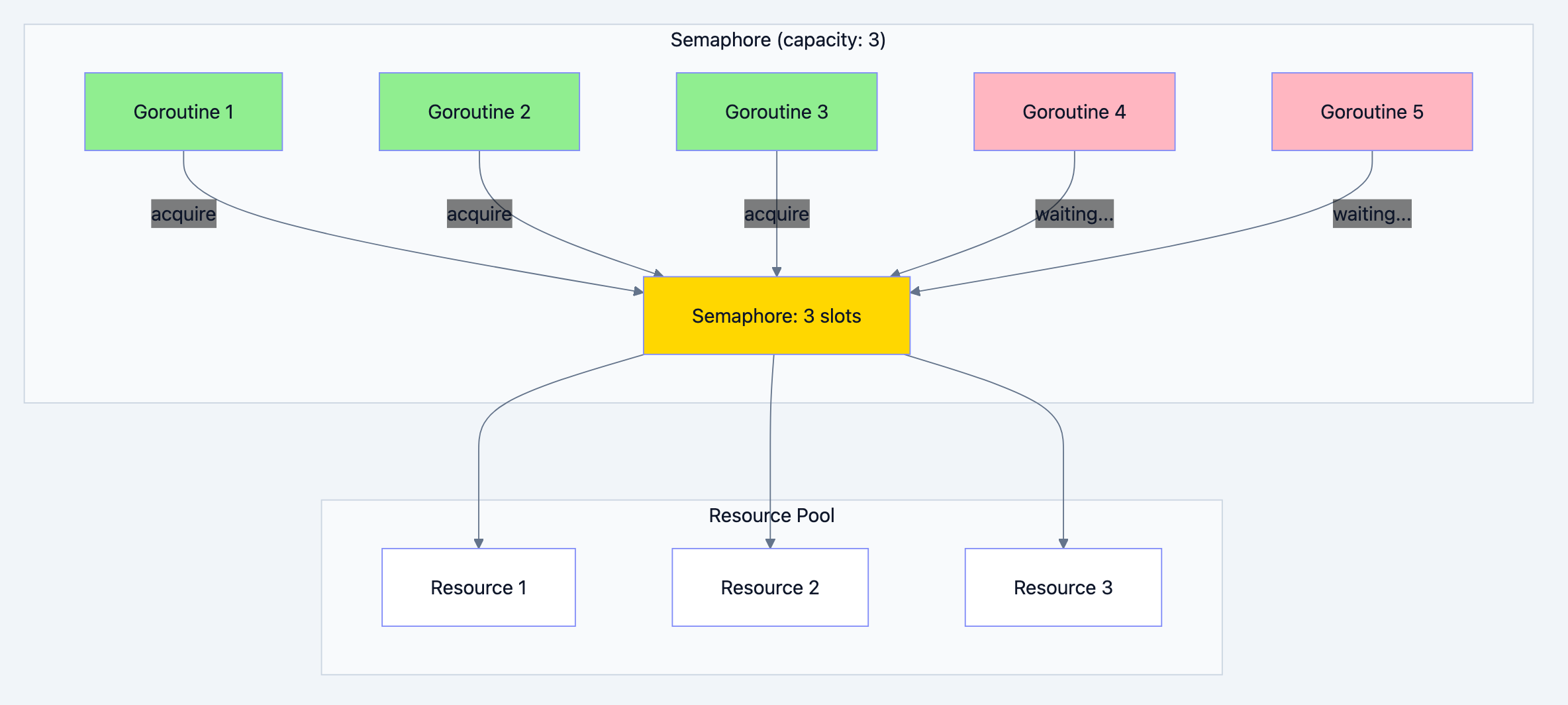
Concurrency pattern diagram 1
Implementing Semaphore in Go
Go doesn't have a built-in semaphore, but we can easily create one using a buffered channel:
go// Filename: semaphore_basic.go
package main

import (
    "fmt"
    "sync"
    "time"
)

// Semaphore limits concurrent access to a resource
// Why: A buffered channel naturally implements semaphore semantics
// - Channel capacity = max concurrent operations
// - Send = acquire (blocks when full)
// - Receive = release (unblocks a waiter)
type Semaphore struct {
    sem chan struct{}
}

// NewSemaphore creates a new semaphore with given capacity
// Why: Constructor ensures proper initialization
func NewSemaphore(capacity int) *Semaphore {
    return &Semaphore{
        sem: make(chan struct{}, capacity),
    }
}

// Acquire blocks until a slot is available
// Why: Sending to a full channel blocks the goroutine
func (s *Semaphore) Acquire() {
    s.sem <- struct{}{}
}

// TryAcquire attempts to acquire without blocking
// Why: Sometimes you want to fail fast if resource unavailable
// Returns true if acquired, false if would block
func (s *Semaphore) TryAcquire() bool {
    select {
    case s.sem <- struct{}{}:
        return true
    default:
        return false
    }
}

// AcquireWithTimeout tries to acquire with a timeout
// Why: Prevents indefinite waiting
// Returns true if acquired, false if timed out
func (s *Semaphore) AcquireWithTimeout(timeout time.Duration) bool {
    select {
    case s.sem <- struct{}{}:
        return true
    case <-time.After(timeout):
        return false
    }
}

// Release releases a semaphore slot
// Why: Receiving from the channel frees a slot for another goroutine
func (s *Semaphore) Release() {
    <-s.sem
}

// Available returns the number of available slots
// Why: Useful for monitoring and debugging
func (s *Semaphore) Available() int {
    return cap(s.sem) - len(s.sem)
}

func main() {
    // Create semaphore with capacity 3
    sem := NewSemaphore(3)

    var wg sync.WaitGroup

    // Try to run 10 goroutines, but only 3 can run at once
    for i := 1; i <= 10; i++ {
        wg.Add(1)
        go func(id int) {
            defer wg.Done()

            fmt.Printf("Goroutine %d: waiting to acquire...\n", id)
            sem.Acquire()
            fmt.Printf("Goroutine %d: acquired! (available: %d)\n", id, sem.Available())

            // Simulate work
            time.Sleep(500 * time.Millisecond)

            sem.Release()
            fmt.Printf("Goroutine %d: released (available: %d)\n", id, sem.Available())
        }(i)
    }

    wg.Wait()
    fmt.Println("\nAll goroutines completed!")
}
Expected Output:
Goroutine 1: waiting to acquire...
Goroutine 1: acquired! (available: 2)
Goroutine 2: waiting to acquire...
Goroutine 2: acquired! (available: 1)
Goroutine 3: waiting to acquire...
Goroutine 3: acquired! (available: 0)
Goroutine 4: waiting to acquire...
Goroutine 5: waiting to acquire...
... (4, 5, etc. wait)
Goroutine 1: released (available: 1)
Goroutine 4: acquired! (available: 0)
...
All goroutines completed!
Real World Example 1: Database Connection Limiter
Protect your database from connection exhaustion:
go// Filename: db_connection_limiter.go
package main

import (
    "context"
    "database/sql"
    "fmt"
    "math/rand"
    "sync"
    "sync/atomic"
    "time"
)

// DBConnectionLimiter limits concurrent database operations
type DBConnectionLimiter struct {
    sem            chan struct{}
    maxConnections int
    activeCount    int64
    totalQueries   int64
    waitTime       int64 // nanoseconds spent waiting
}

// NewDBConnectionLimiter creates a new limiter
func NewDBConnectionLimiter(maxConnections int) *DBConnectionLimiter {
    return &DBConnectionLimiter{
        sem:            make(chan struct{}, maxConnections),
        maxConnections: maxConnections,
    }
}

// Query executes a database query with connection limiting
// Why: Wrapping the semaphore in a method provides a clean API
// and allows for metrics collection
func (l *DBConnectionLimiter) Query(ctx context.Context, query string, args ...interface{}) ([]map[string]interface{}, error) {
    // Acquire semaphore
    waitStart := time.Now()

    select {
    case l.sem <- struct{}{}:
        // Got a connection slot
    case <-ctx.Done():
        return nil, ctx.Err()
    }

    // Track metrics
    waitDuration := time.Since(waitStart)
    atomic.AddInt64(&l.waitTime, int64(waitDuration))
    atomic.AddInt64(&l.activeCount, 1)
    atomic.AddInt64(&l.totalQueries, 1)

    defer func() {
        atomic.AddInt64(&l.activeCount, -1)
        <-l.sem // Release semaphore
    }()

    // Execute query (simulated)
    return l.executeQuery(ctx, query, args...)
}

// executeQuery simulates database query execution
func (l *DBConnectionLimiter) executeQuery(ctx context.Context, query string, args ...interface{}) ([]map[string]interface{}, error) {
    // Simulate query execution time
    queryTime := time.Duration(50+rand.Intn(200)) * time.Millisecond

    select {
    case <-time.After(queryTime):
        // Query completed
        return []map[string]interface{}{
            {"id": 1, "result": "data"},
        }, nil
    case <-ctx.Done():
        return nil, ctx.Err()
    }
}

// Stats returns current statistics
func (l *DBConnectionLimiter) Stats() (active, total int64, avgWait time.Duration) {
    active = atomic.LoadInt64(&l.activeCount)
    total = atomic.LoadInt64(&l.totalQueries)
    totalWait := atomic.LoadInt64(&l.waitTime)
    if total > 0 {
        avgWait = time.Duration(totalWait / total)
    }
    return
}

// Available returns available connection slots
func (l *DBConnectionLimiter) Available() int {
    return l.maxConnections - int(atomic.LoadInt64(&l.activeCount))
}

func main() {
    rand.Seed(time.Now().UnixNano())

    // Create limiter with 5 max connections
    limiter := NewDBConnectionLimiter(5)

    ctx := context.Background()
    var wg sync.WaitGroup

    fmt.Println("Database Connection Limiter Demo")
    fmt.Println("================================")
    fmt.Printf("Max concurrent connections: 5\n")
    fmt.Printf("Simulating 20 concurrent queries...\n\n")

    // Start stats printer
    done := make(chan struct{})
    go func() {
        ticker := time.NewTicker(200 * time.Millisecond)
        defer ticker.Stop()
        for {
            select {
            case <-ticker.C:
                active, total, avgWait := limiter.Stats()
                fmt.Printf("📊 Active: %d/%d | Total: %d | Avg Wait: %v\n",
                    active, 5, total, avgWait.Round(time.Millisecond))
            case <-done:
                return
            }
        }
    }()

    // Simulate 20 concurrent database queries
    for i := 1; i <= 20; i++ {
        wg.Add(1)
        go func(queryID int) {
            defer wg.Done()

            query := fmt.Sprintf("SELECT * FROM users WHERE id = %d", queryID)
            result, err := limiter.Query(ctx, query)

            if err != nil {
                fmt.Printf("❌ Query %d failed: %v\n", queryID, err)
            } else {
                fmt.Printf("✅ Query %d completed: %d rows\n", queryID, len(result))
            }
        }(i)
    }

    wg.Wait()
    close(done)

    // Final stats
    active, total, avgWait := limiter.Stats()
    fmt.Printf("\n📈 Final Stats:\n")
    fmt.Printf("   Total queries: %d\n", total)
    fmt.Printf("   Average wait time: %v\n", avgWait.Round(time.Millisecond))
}
Real World Example 2: API Rate Limiter
Control concurrent requests to external APIs:
go// Filename: api_rate_limiter.go
package main

import (
    "context"
    "encoding/json"
    "fmt"
    "math/rand"
    "sync"
    "time"
)

// APIClient wraps HTTP client with rate limiting
type APIClient struct {
    baseURL        string
    maxConcurrent  int
    sem            chan struct{}
    requestTimeout time.Duration
}

// APIResponse represents an API response
type APIResponse struct {
    Status  int
    Body    map[string]interface{}
    Latency time.Duration
}

// NewAPIClient creates a new rate-limited API client
func NewAPIClient(baseURL string, maxConcurrent int, timeout time.Duration) *APIClient {
    return &APIClient{
        baseURL:        baseURL,
        maxConcurrent:  maxConcurrent,
        sem:            make(chan struct{}, maxConcurrent),
        requestTimeout: timeout,
    }
}

// Get performs a rate-limited GET request
func (c *APIClient) Get(ctx context.Context, path string) (*APIResponse, error) {
    // Acquire semaphore
    select {
    case c.sem <- struct{}{}:
        defer func() { <-c.sem }()
    case <-ctx.Done():
        return nil, fmt.Errorf("context cancelled while waiting for semaphore")
    }

    // Create request context with timeout
    reqCtx, cancel := context.WithTimeout(ctx, c.requestTimeout)
    defer cancel()

    return c.doRequest(reqCtx, "GET", path)
}

// doRequest simulates an HTTP request
func (c *APIClient) doRequest(ctx context.Context, method, path string) (*APIResponse, error) {
    start := time.Now()

    // Simulate network latency
    latency := time.Duration(100+rand.Intn(300)) * time.Millisecond

    select {
    case <-time.After(latency):
        // Request completed
    case <-ctx.Done():
        return nil, ctx.Err()
    }

    // Simulate occasional errors (10% chance)
    if rand.Float32() < 0.1 {
        return &APIResponse{
            Status:  500,
            Latency: time.Since(start),
        }, fmt.Errorf("server error")
    }

    return &APIResponse{
        Status: 200,
        Body: map[string]interface{}{
            "path":   path,
            "method": method,
            "data":   "response data",
        },
        Latency: time.Since(start),
    }, nil
}

// BatchGet performs multiple GET requests with rate limiting
func (c *APIClient) BatchGet(ctx context.Context, paths []string) []struct {
    Path     string
    Response *APIResponse
    Error    error
} {
    results := make([]struct {
        Path     string
        Response *APIResponse
        Error    error
    }, len(paths))

    var wg sync.WaitGroup

    for i, path := range paths {
        wg.Add(1)
        go func(index int, p string) {
            defer wg.Done()

            resp, err := c.Get(ctx, p)
            results[index] = struct {
                Path     string
                Response *APIResponse
                Error    error
            }{
                Path:     p,
                Response: resp,
                Error:    err,
            }
        }(i, path)
    }

    wg.Wait()
    return results
}

func main() {
    rand.Seed(time.Now().UnixNano())

    // Create client with max 3 concurrent requests
    client := NewAPIClient("https://api.example.com", 3, 5*time.Second)

    // Generate 15 paths to request
    paths := make([]string, 15)
    for i := range paths {
        paths[i] = fmt.Sprintf("/users/%d", i+1)
    }

    fmt.Println("🌐 API Rate Limiter Demo")
    fmt.Println("========================")
    fmt.Printf("Max concurrent requests: 3\n")
    fmt.Printf("Total requests: %d\n\n", len(paths))

    start := time.Now()

    // Batch request with rate limiting
    results := client.BatchGet(context.Background(), paths)

    totalTime := time.Since(start)

    // Print results
    successCount := 0
    errorCount := 0
    var totalLatency time.Duration

    for _, r := range results {
        if r.Error != nil {
            errorCount++
            fmt.Printf("❌ %s: %v\n", r.Path, r.Error)
        } else {
            successCount++
            totalLatency += r.Response.Latency
            fmt.Printf("✅ %s: %d (%v)\n", r.Path, r.Response.Status, r.Response.Latency.Round(time.Millisecond))
        }
    }

    fmt.Printf("\n📊 Summary:\n")
    fmt.Printf("   Success: %d\n", successCount)
    fmt.Printf("   Errors: %d\n", errorCount)
    fmt.Printf("   Total time: %v\n", totalTime.Round(time.Millisecond))
    fmt.Printf("   Avg latency: %v\n", (totalLatency / time.Duration(successCount)).Round(time.Millisecond))

    // Show that rate limiting worked
    sequentialTime := totalLatency
    fmt.Printf("\n⚡ Without rate limit (sequential): ~%v\n", sequentialTime.Round(time.Millisecond))
    fmt.Printf("⚡ With rate limit (3 concurrent): %v\n", totalTime.Round(time.Millisecond))
}
Real World Example 3: File System Access Limiter
Prevent "too many open files" errors:
go// Filename: file_access_limiter.go
package main

import (
    "context"
    "crypto/md5"
    "fmt"
    "io"
    "math/rand"
    "os"
    "path/filepath"
    "sync"
    "time"
)

// FileProcessor processes files with limited concurrent access
type FileProcessor struct {
    maxOpenFiles int
    sem          chan struct{}
}

// FileResult represents the result of processing a file
type FileResult struct {
    Path     string
    Size     int64
    Hash     string
    Duration time.Duration
    Error    error
}

// NewFileProcessor creates a new processor with file limit
func NewFileProcessor(maxOpenFiles int) *FileProcessor {
    return &FileProcessor{
        maxOpenFiles: maxOpenFiles,
        sem:          make(chan struct{}, maxOpenFiles),
    }
}

// ProcessFile processes a single file with semaphore control
func (fp *FileProcessor) ProcessFile(ctx context.Context, path string) FileResult {
    // Acquire semaphore before opening file
    select {
    case fp.sem <- struct{}{}:
        defer func() { <-fp.sem }()
    case <-ctx.Done():
        return FileResult{Path: path, Error: ctx.Err()}
    }

    start := time.Now()

    // Simulate file processing
    size, hash, err := fp.processFileInternal(path)

    return FileResult{
        Path:     path,
        Size:     size,
        Hash:     hash,
        Duration: time.Since(start),
        Error:    err,
    }
}

// processFileInternal simulates processing a file
func (fp *FileProcessor) processFileInternal(path string) (int64, string, error) {
    // Simulate file I/O
    time.Sleep(time.Duration(50+rand.Intn(150)) * time.Millisecond)

    // Simulate file size and hash
    size := int64(1000 + rand.Intn(100000))
    hash := fmt.Sprintf("%x", md5.Sum([]byte(path)))[:8]

    // Simulate occasional errors (5%)
    if rand.Float32() < 0.05 {
        return 0, "", fmt.Errorf("permission denied")
    }

    return size, hash, nil
}

// ProcessFiles processes multiple files concurrently with limit
func (fp *FileProcessor) ProcessFiles(ctx context.Context, paths []string) []FileResult {
    results := make([]FileResult, len(paths))
    var wg sync.WaitGroup

    for i, path := range paths {
        wg.Add(1)
        go func(index int, p string) {
            defer wg.Done()
            results[index] = fp.ProcessFile(ctx, p)
        }(i, path)
    }

    wg.Wait()
    return results
}

func main() {
    rand.Seed(time.Now().UnixNano())

    // Create processor with max 10 open files
    processor := NewFileProcessor(10)

    // Generate test file paths
    files := make([]string, 50)
    for i := range files {
        files[i] = filepath.Join("/data/files", fmt.Sprintf("document_%03d.pdf", i+1))
    }

    fmt.Println("📁 File Processor with Open File Limit")
    fmt.Println("======================================")
    fmt.Printf("Max concurrent open files: 10\n")
    fmt.Printf("Total files to process: %d\n\n", len(files))

    start := time.Now()
    results := processor.ProcessFiles(context.Background(), files)
    totalTime := time.Since(start)

    // Calculate stats
    var totalSize int64
    var totalDuration time.Duration
    successCount := 0
    errorCount := 0

    for _, r := range results {
        if r.Error != nil {
            errorCount++
        } else {
            successCount++
            totalSize += r.Size
            totalDuration += r.Duration
        }
    }

    fmt.Printf("📊 Results:\n")
    fmt.Printf("   Files processed: %d/%d\n", successCount, len(files))
    fmt.Printf("   Errors: %d\n", errorCount)
    fmt.Printf("   Total size: %.2f MB\n", float64(totalSize)/(1024*1024))
    fmt.Printf("   Total wall-clock time: %v\n", totalTime.Round(time.Millisecond))
    fmt.Printf("   Sum of processing times: %v\n", totalDuration.Round(time.Millisecond))
    fmt.Printf("   Parallelization factor: %.1fx\n", float64(totalDuration)/float64(totalTime))

    // Show first few results
    fmt.Println("\nFirst 5 results:")
    for i := 0; i < 5 && i < len(results); i++ {
        r := results[i]
        if r.Error != nil {
            fmt.Printf("   ❌ %s: %v\n", filepath.Base(r.Path), r.Error)
        } else {
            fmt.Printf("   ✅ %s: %d bytes, hash=%s (%v)\n",
                filepath.Base(r.Path), r.Size, r.Hash, r.Duration.Round(time.Millisecond))
        }
    }
}
Weighted Semaphore
For resources with different costs:
go// Filename: weighted_semaphore.go
package main

import (
    "context"
    "fmt"
    "sync"
    "time"
)

// WeightedSemaphore allows acquiring multiple slots at once
// Why: Some operations need more resources than others
// e.g., large queries vs small queries
type WeightedSemaphore struct {
    size    int64
    current int64
    mu      sync.Mutex
    cond    *sync.Cond
}

// NewWeightedSemaphore creates a semaphore with total weight capacity
func NewWeightedSemaphore(size int64) *WeightedSemaphore {
    ws := &WeightedSemaphore{size: size}
    ws.cond = sync.NewCond(&ws.mu)
    return ws
}

// Acquire blocks until n slots are available
func (ws *WeightedSemaphore) Acquire(ctx context.Context, n int64) error {
    ws.mu.Lock()
    defer ws.mu.Unlock()

    for ws.size-ws.current < n {
        // Check context before waiting
        select {
        case <-ctx.Done():
            return ctx.Err()
        default:
        }

        // Wait for release
        ws.cond.Wait()
    }

    ws.current += n
    return nil
}

// TryAcquire attempts to acquire without blocking
func (ws *WeightedSemaphore) TryAcquire(n int64) bool {
    ws.mu.Lock()
    defer ws.mu.Unlock()

    if ws.size-ws.current >= n {
        ws.current += n
        return true
    }
    return false
}

// Release releases n slots
func (ws *WeightedSemaphore) Release(n int64) {
    ws.mu.Lock()
    ws.current -= n
    ws.mu.Unlock()
    ws.cond.Broadcast()
}

// Available returns available capacity
func (ws *WeightedSemaphore) Available() int64 {
    ws.mu.Lock()
    defer ws.mu.Unlock()
    return ws.size - ws.current
}

// QueryType represents different query complexities
type QueryType struct {
    Name   string
    Weight int64
    Time   time.Duration
}

func main() {
    // Create semaphore with 100 "units" of capacity
    sem := NewWeightedSemaphore(100)

    // Different query types with different weights
    queryTypes := []QueryType{
        {Name: "Simple", Weight: 10, Time: 50 * time.Millisecond},
        {Name: "Medium", Weight: 30, Time: 150 * time.Millisecond},
        {Name: "Complex", Weight: 50, Time: 300 * time.Millisecond},
        {Name: "Heavy", Weight: 80, Time: 500 * time.Millisecond},
    }

    fmt.Println("⚖️  Weighted Semaphore Demo")
    fmt.Println("===========================")
    fmt.Printf("Total capacity: 100 units\n\n")

    var wg sync.WaitGroup
    ctx := context.Background()

    // Run various queries
    for i := 0; i < 10; i++ {
        qt := queryTypes[i%len(queryTypes)]

        wg.Add(1)
        go func(id int, query QueryType) {
            defer wg.Done()

            fmt.Printf("Query %d (%s, weight=%d): waiting... (available: %d)\n",
                id, query.Name, query.Weight, sem.Available())

            if err := sem.Acquire(ctx, query.Weight); err != nil {
                fmt.Printf("Query %d: failed to acquire: %v\n", id, err)
                return
            }

            fmt.Printf("Query %d (%s): acquired! (available: %d)\n",
                id, query.Name, sem.Available())

            time.Sleep(query.Time)

            sem.Release(query.Weight)
            fmt.Printf("Query %d (%s): released (available: %d)\n",
                id, query.Name, sem.Available())
        }(i, qt)

        time.Sleep(20 * time.Millisecond) // Stagger starts
    }

    wg.Wait()
    fmt.Println("\nAll queries completed!")
}
Using golang.org/x/sync/semaphore
Go's extended library provides a production-ready semaphore:
go// Filename: x_sync_semaphore.go
package main

import (
    "context"
    "fmt"
    "time"

    "golang.org/x/sync/semaphore"
)

func main() {
    // Create weighted semaphore with capacity 3
    sem := semaphore.NewWeighted(3)

    ctx := context.Background()

    fmt.Println("Using golang.org/x/sync/semaphore")
    fmt.Println("==================================\n")

    // Acquire 1 slot
    if err := sem.Acquire(ctx, 1); err != nil {
        fmt.Printf("Acquire failed: %v\n", err)
        return
    }
    fmt.Println("Acquired 1 slot")

    // Try to acquire 2 more (should succeed)
    if err := sem.Acquire(ctx, 2); err != nil {
        fmt.Printf("Acquire failed: %v\n", err)
        return
    }
    fmt.Println("Acquired 2 more slots (now at capacity)")

    // Try to acquire 1 more with timeout (should fail)
    ctxTimeout, cancel := context.WithTimeout(ctx, 100*time.Millisecond)
    defer cancel()

    if err := sem.Acquire(ctxTimeout, 1); err != nil {
        fmt.Printf("Acquire timed out as expected: %v\n", err)
    }

    // Release 2 slots
    sem.Release(2)
    fmt.Println("Released 2 slots")

    // Now we can acquire 1
    if err := sem.Acquire(ctx, 1); err != nil {
        fmt.Printf("Acquire failed: %v\n", err)
        return
    }
    fmt.Println("Acquired 1 slot successfully")

    // TryAcquire example
    if sem.TryAcquire(1) {
        fmt.Println("TryAcquire succeeded")
        sem.Release(1)
    } else {
        fmt.Println("TryAcquire failed (would block)")
    }
}
When to Use Semaphore
Perfect Use Cases
| Scenario | Why Semaphore Fits |
|---|---|
| Database connections | Fixed connection pool size |
| API rate limiting | Max concurrent requests |
| File descriptors | OS has limits on open files |
| Memory-intensive ops | Control total memory usage |
| External services | Service has concurrency limits |
| Thread pools | Limit parallel execution |
Semaphore vs Other Patterns
| Pattern | Use Case |
|---|---|
| Semaphore | Limit concurrent access to N |
| Mutex | Exclusive access (N=1) |
| Worker Pool | Fixed workers, unlimited queue |
| Rate Limiter | Limit requests per time period |
Summary
The Semaphore pattern is essential when you need to control concurrent access to limited resources:
- Bounded concurrency: Allow exactly N concurrent operations
- Simple implementation: Buffered channel in Go
- Weighted option: For resources with different costs
- Production ready: Use golang.org/x/sync/semaphore
Key Takeaways:
- Use buffered channels:
make(chan struct{}, N)is a simple semaphore - Always release: Use defer to ensure release happens
- Consider timeouts: Don't wait forever for resources
- Monitor usage: Track wait times and utilization
- Size appropriately: Match semaphore size to actual resource limits
Next Steps
- Practice: Add connection limiting to your database layer
- Explore: Rate limiting with token bucket algorithm
- Read: golang.org/x/sync package documentation
- Build: Monitor semaphore metrics in production