Pipeline Pattern in Go: Building Data Processing Assembly Lines
You have a stream of data. It needs to go through multiple transformations. First, parse it. Then, validate it. Then, enrich it. Then, format it. Finally, store it. Each step depends on the previous one, but within each step, you can process many items in parallel.
This is the Pipeline pattern. It's how you build scalable, maintainable data processing systems that can handle millions of records without breaking a sweat.
The Real World Parallel: A Car Factory Assembly Line
Think of it like this: In a car factory, the chassis moves along a conveyor belt through different stations. Station 1 adds the engine. Station 2 installs the transmission. Station 3 adds the electrical system. Station 4 installs the interior. Each station specializes in one task. Cars flow through continuously. If Station 2 is slow, cars queue up, but Station 1 keeps working on new cars. This is a pipeline.
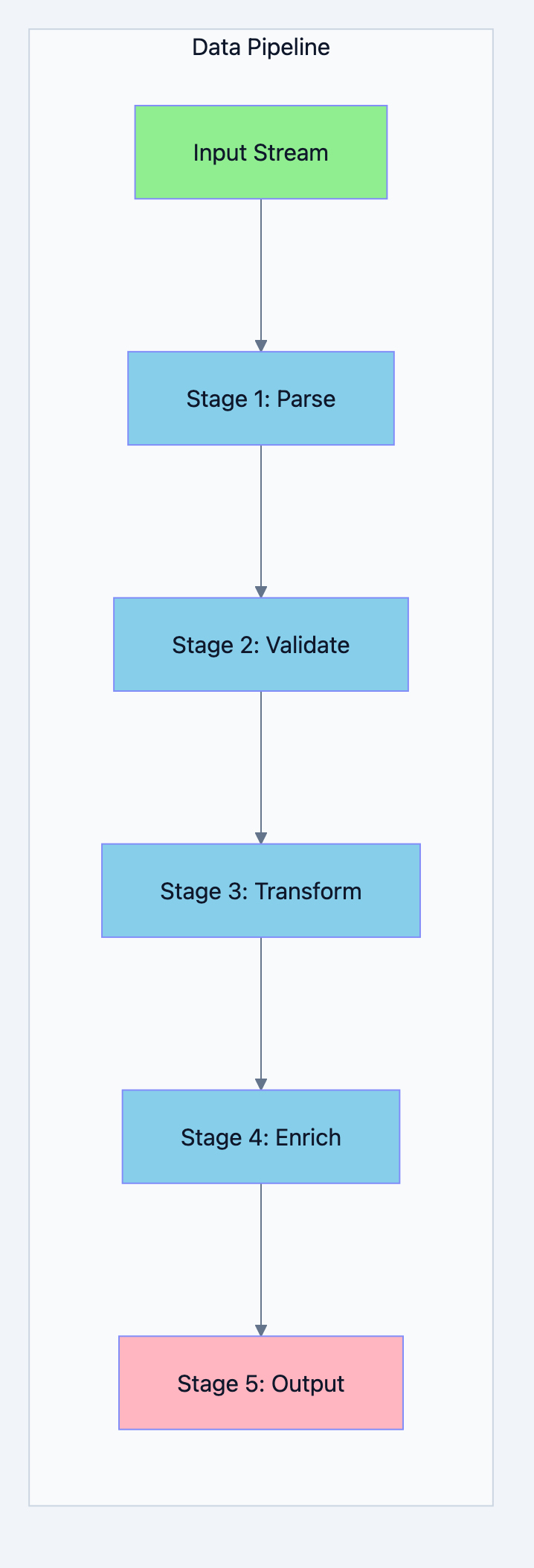
Concurrency pattern diagram 1
Why Pipelines?
Consider processing a large CSV file:
go// Without pipeline - everything in memory at once
func processWithoutPipeline(filename string) error {
    // Read ENTIRE file into memory
    data, _ := ioutil.ReadFile(filename) // 10GB file = 10GB in memory!

    // Parse ALL records
    records := parseAll(data) // Now you have 10GB raw + parsed data

    // Validate ALL records
    valid := validateAll(records) // Even more memory

    // Transform ALL records
    transformed := transformAll(valid) // Memory keeps growing

    // Finally write
    return writeAll(transformed)
    // Peak memory: potentially 40GB+ for a 10GB file!
}

// With pipeline - constant memory regardless of file size
func processWithPipeline(filename string) error {
    // Each stage processes one record at a time
    // Memory usage stays constant: ~few KB regardless of file size!
    lines := readLines(filename)      // Stream of lines
    records := parse(lines)           // Stream of records
    valid := validate(records)        // Stream of valid records
    transformed := transform(valid)   // Stream of transformed records
    return write(transformed)
}
Benefits of Pipelines:
- Constant memory: Process gigabytes with kilobytes of memory
- Natural concurrency: Each stage can run in parallel
- Composable: Mix and match stages like LEGO blocks
- Testable: Each stage can be tested independently
- Maintainable: Clear separation of concerns
Basic Pipeline Implementation
Let's build a pipeline step by step:
go// Filename: basic_pipeline.go
package main

import (
    "fmt"
    "strings"
)

// Stage 1: Generator - produces values
// Why: Every pipeline needs a source of data
// This stage reads input and sends it downstream
func generator(data []string) <-chan string {
    out := make(chan string)

    go func() {
        defer close(out)
        for _, item := range data {
            out <- item
        }
    }()

    return out
}

// Stage 2: Transform - converts to uppercase
// Why: Each stage takes an input channel and returns an output channel
// This creates composable building blocks
func toUpper(input <-chan string) <-chan string {
    out := make(chan string)

    go func() {
        defer close(out)
        for s := range input {
            out <- strings.ToUpper(s)
        }
    }()

    return out
}

// Stage 3: Filter - removes short strings
// Why: Stages can filter, letting only some items through
func filterShort(minLength int, input <-chan string) <-chan string {
    out := make(chan string)

    go func() {
        defer close(out)
        for s := range input {
            if len(s) >= minLength {
                out <- s
            }
        }
    }()

    return out
}

// Stage 4: Prefix - adds a prefix to each string
func addPrefix(prefix string, input <-chan string) <-chan string {
    out := make(chan string)

    go func() {
        defer close(out)
        for s := range input {
            out <- prefix + s
        }
    }()

    return out
}

// Sink - consumes the final output
// Why: The final stage collects or processes results
func collect(input <-chan string) []string {
    var result []string
    for s := range input {
        result = append(result, s)
    }
    return result
}

func main() {
    // Input data
    data := []string{"hello", "go", "pipeline", "is", "awesome", "pattern"}

    fmt.Println("Input:", data)
    fmt.Println()

    // Build the pipeline by connecting stages
    // Why: Each function returns a channel that feeds the next
    stage1 := generator(data)
    stage2 := toUpper(stage1)
    stage3 := filterShort(4, stage2)
    stage4 := addPrefix("-> ", stage3)
    result := collect(stage4)

    fmt.Println("Output:", result)

    // Alternative: Chain calls for cleaner syntax
    fmt.Println("\nSame result with chained calls:")
    result2 := collect(
        addPrefix("=> ",
            filterShort(4,
                toUpper(
                    generator(data)))))

    fmt.Println("Output:", result2)
}
Expected Output:
Input: [hello go pipeline is awesome pattern]

Output: [-> HELLO -> PIPELINE -> AWESOME -> PATTERN]

Same result with chained calls:
Output: [=> HELLO => PIPELINE => AWESOME => PATTERN]
Real World Example 1: Log Processing Pipeline
Processing log files is a perfect use case for pipelines:
go// Filename: log_pipeline.go
package main

import (
    "bufio"
    "context"
    "encoding/json"
    "fmt"
    "os"
    "regexp"
    "strings"
    "time"
)

// LogEntry represents a parsed log entry
type LogEntry struct {
    Timestamp time.Time
    Level     string
    Service   string
    Message   string
    Raw       string
}

// AlertableEntry is an entry that needs alerting
type AlertableEntry struct {
    LogEntry
    AlertType string
    Priority  int
}

// Stage 1: Read lines from file
func readLines(ctx context.Context, filename string) (<-chan string, <-chan error) {
    lines := make(chan string)
    errc := make(chan error, 1)

    go func() {
        defer close(lines)
        defer close(errc)

        // Simulate reading from file (in production, use actual file)
        sampleLogs := []string{
            `2024-01-15T10:30:00Z INFO api-gateway Request received: GET /users`,
            `2024-01-15T10:30:01Z ERROR auth-service Authentication failed: invalid token`,
            `2024-01-15T10:30:02Z WARN database Connection pool running low: 2/10 available`,
            `2024-01-15T10:30:03Z INFO api-gateway Request completed: 200 OK (45ms)`,
            `2024-01-15T10:30:04Z ERROR payment-service Payment processing failed: timeout`,
            `2024-01-15T10:30:05Z INFO scheduler Job completed: daily-report`,
            `2024-01-15T10:30:06Z CRITICAL database Database connection lost!`,
            `2024-01-15T10:30:07Z DEBUG auth-service Token refresh attempted`,
            `2024-01-15T10:30:08Z ERROR api-gateway Upstream service unavailable`,
            `2024-01-15T10:30:09Z INFO metrics Metrics exported: 1000 data points`,
        }

        for _, line := range sampleLogs {
            select {
            case <-ctx.Done():
                errc <- ctx.Err()
                return
            case lines <- line:
                time.Sleep(10 * time.Millisecond) // Simulate reading delay
            }
        }
    }()

    return lines, errc
}

// Stage 2: Parse log lines into structured entries
func parseLogLines(ctx context.Context, lines <-chan string) (<-chan LogEntry, <-chan error) {
    entries := make(chan LogEntry)
    errc := make(chan error, 1)

    // Log format: timestamp LEVEL service message
    pattern := regexp.MustCompile(`^(\S+)\s+(\w+)\s+(\S+)\s+(.+)$`)

    go func() {
        defer close(entries)
        defer close(errc)

        for line := range lines {
            select {
            case <-ctx.Done():
                errc <- ctx.Err()
                return
            default:
            }

            matches := pattern.FindStringSubmatch(line)
            if matches == nil {
                continue // Skip unparseable lines
            }

            timestamp, err := time.Parse(time.RFC3339, matches[1])
            if err != nil {
                continue
            }

            entry := LogEntry{
                Timestamp: timestamp,
                Level:     matches[2],
                Service:   matches[3],
                Message:   matches[4],
                Raw:       line,
            }

            entries <- entry
        }
    }()

    return entries, errc
}

// Stage 3: Filter for errors and above
func filterSeverity(ctx context.Context, minLevel string, entries <-chan LogEntry) <-chan LogEntry {
    filtered := make(chan LogEntry)

    severityOrder := map[string]int{
        "DEBUG":    0,
        "INFO":     1,
        "WARN":     2,
        "WARNING":  2,
        "ERROR":    3,
        "CRITICAL": 4,
        "FATAL":    5,
    }

    minSeverity := severityOrder[minLevel]

    go func() {
        defer close(filtered)

        for entry := range entries {
            select {
            case <-ctx.Done():
                return
            default:
            }

            if severityOrder[entry.Level] >= minSeverity {
                filtered <- entry
            }
        }
    }()

    return filtered
}

// Stage 4: Enrich with alert information
func enrichForAlerting(ctx context.Context, entries <-chan LogEntry) <-chan AlertableEntry {
    alertable := make(chan AlertableEntry)

    go func() {
        defer close(alertable)

        for entry := range entries {
            select {
            case <-ctx.Done():
                return
            default:
            }

            alert := AlertableEntry{LogEntry: entry}

            // Determine alert type and priority
            switch entry.Level {
            case "CRITICAL", "FATAL":
                alert.AlertType = "PAGE"
                alert.Priority = 1
            case "ERROR":
                if strings.Contains(entry.Message, "timeout") ||
                    strings.Contains(entry.Message, "unavailable") {
                    alert.AlertType = "PAGE"
                    alert.Priority = 2
                } else {
                    alert.AlertType = "NOTIFY"
                    alert.Priority = 3
                }
            case "WARN", "WARNING":
                alert.AlertType = "LOG"
                alert.Priority = 4
            }

            alertable <- alert
        }
    }()

    return alertable
}

// Stage 5: Format for output
func formatAlerts(ctx context.Context, alerts <-chan AlertableEntry) <-chan string {
    formatted := make(chan string)

    go func() {
        defer close(formatted)

        for alert := range alerts {
            select {
            case <-ctx.Done():
                return
            default:
            }

            output := fmt.Sprintf("[P%d %s] %s | %s: %s",
                alert.Priority,
                alert.AlertType,
                alert.Service,
                alert.Level,
                alert.Message)

            formatted <- output
        }
    }()

    return formatted
}

// Sink: Collect all formatted alerts
func collectAlerts(formatted <-chan string) []string {
    var alerts []string
    for alert := range formatted {
        alerts = append(alerts, alert)
    }
    return alerts
}

func main() {
    ctx := context.Background()

    fmt.Println("🔍 Log Processing Pipeline")
    fmt.Println("=" + strings.Repeat("=", 50))
    fmt.Println()

    // Build the pipeline
    lines, lineErr := readLines(ctx, "app.log")
    entries, parseErr := parseLogLines(ctx, lines)
    filtered := filterSeverity(ctx, "WARN", entries)
    alertable := enrichForAlerting(ctx, filtered)
    formatted := formatAlerts(ctx, alertable)

    // Collect results
    alerts := collectAlerts(formatted)

    // Check for errors
    if err := <-lineErr; err != nil {
        fmt.Printf("Read error: %v\n", err)
    }
    if err := <-parseErr; err != nil {
        fmt.Printf("Parse error: %v\n", err)
    }

    // Display results
    fmt.Println("Alerts Generated:")
    fmt.Println("-" + strings.Repeat("-", 50))
    for _, alert := range alerts {
        fmt.Println(alert)
    }

    fmt.Printf("\nTotal alerts: %d\n", len(alerts))
}
Expected Output:
🔍 Log Processing Pipeline
===================================================

Alerts Generated:
---------------------------------------------------
[P3 NOTIFY] auth-service | ERROR: Authentication failed: invalid token
[P4 LOG] database | WARN: Connection pool running low: 2/10 available
[P2 PAGE] payment-service | ERROR: Payment processing failed: timeout
[P1 PAGE] database | CRITICAL: Database connection lost!
[P2 PAGE] api-gateway | ERROR: Upstream service unavailable

Total alerts: 5
Real World Example 2: ETL Data Pipeline
Extract, Transform, Load pipeline for data processing:
go// Filename: etl_pipeline.go
package main

import (
    "context"
    "encoding/json"
    "fmt"
    "math/rand"
    "strings"
    "sync"
    "time"
)

// RawRecord represents data as it comes from the source
type RawRecord struct {
    ID        string          `json:"id"`
    Data      json.RawMessage `json:"data"`
    Source    string          `json:"source"`
    Timestamp string          `json:"timestamp"`
}

// CleanRecord represents validated and cleaned data
type CleanRecord struct {
    ID        string
    Name      string
    Email     string
    Amount    float64
    Currency  string
    Source    string
    Timestamp time.Time
}

// EnrichedRecord has additional derived data
type EnrichedRecord struct {
    CleanRecord
    AmountUSD     float64
    CustomerTier  string
    ProcessedAt   time.Time
    ProcessingMS  int64
}

// LoadResult represents the result of loading a record
type LoadResult struct {
    RecordID string
    Success  bool
    Error    error
}

// ETL Pipeline Stages

// Extract: Generate sample raw records
func extract(ctx context.Context, count int) <-chan RawRecord {
    out := make(chan RawRecord)

    go func() {
        defer close(out)

        sources := []string{"web", "mobile", "api", "partner"}
        currencies := []string{"USD", "EUR", "GBP", "JPY"}

        for i := 0; i < count; i++ {
            select {
            case <-ctx.Done():
                return
            default:
            }

            data := map[string]interface{}{
                "name":     fmt.Sprintf("Customer %d", i+1),
                "email":    fmt.Sprintf("customer%d@example.com", i+1),
                "amount":   100.0 + rand.Float64()*900.0,
                "currency": currencies[rand.Intn(len(currencies))],
            }

            dataJSON, _ := json.Marshal(data)

            record := RawRecord{
                ID:        fmt.Sprintf("REC-%05d", i+1),
                Data:      dataJSON,
                Source:    sources[rand.Intn(len(sources))],
                Timestamp: time.Now().Format(time.RFC3339),
            }

            out <- record
            time.Sleep(5 * time.Millisecond) // Simulate extraction delay
        }
    }()

    return out
}

// Transform Stage 1: Parse and validate
func parseAndValidate(ctx context.Context, input <-chan RawRecord) (<-chan CleanRecord, <-chan error) {
    out := make(chan CleanRecord)
    errc := make(chan error, 100)

    go func() {
        defer close(out)
        defer close(errc)

        for raw := range input {
            select {
            case <-ctx.Done():
                return
            default:
            }

            var data struct {
                Name     string  `json:"name"`
                Email    string  `json:"email"`
                Amount   float64 `json:"amount"`
                Currency string  `json:"currency"`
            }

            if err := json.Unmarshal(raw.Data, &data); err != nil {
                errc <- fmt.Errorf("parse error for %s: %w", raw.ID, err)
                continue
            }

            // Validation
            if data.Email == "" || !strings.Contains(data.Email, "@") {
                errc <- fmt.Errorf("invalid email for %s", raw.ID)
                continue
            }

            if data.Amount <= 0 {
                errc <- fmt.Errorf("invalid amount for %s", raw.ID)
                continue
            }

            timestamp, err := time.Parse(time.RFC3339, raw.Timestamp)
            if err != nil {
                errc <- fmt.Errorf("invalid timestamp for %s", raw.ID)
                continue
            }

            clean := CleanRecord{
                ID:        raw.ID,
                Name:      data.Name,
                Email:     data.Email,
                Amount:    data.Amount,
                Currency:  data.Currency,
                Source:    raw.Source,
                Timestamp: timestamp,
            }

            out <- clean
        }
    }()

    return out, errc
}

// Transform Stage 2: Enrich with derived data
func enrich(ctx context.Context, input <-chan CleanRecord) <-chan EnrichedRecord {
    out := make(chan EnrichedRecord)

    // Exchange rates (simplified)
    exchangeRates := map[string]float64{
        "USD": 1.0,
        "EUR": 1.10,
        "GBP": 1.27,
        "JPY": 0.0067,
    }

    go func() {
        defer close(out)

        for clean := range input {
            select {
            case <-ctx.Done():
                return
            default:
            }

            start := time.Now()

            // Convert to USD
            rate := exchangeRates[clean.Currency]
            if rate == 0 {
                rate = 1.0
            }
            amountUSD := clean.Amount * rate

            // Determine customer tier
            var tier string
            switch {
            case amountUSD >= 500:
                tier = "GOLD"
            case amountUSD >= 200:
                tier = "SILVER"
            default:
                tier = "BRONZE"
            }

            enriched := EnrichedRecord{
                CleanRecord:  clean,
                AmountUSD:    amountUSD,
                CustomerTier: tier,
                ProcessedAt:  time.Now(),
                ProcessingMS: time.Since(start).Milliseconds(),
            }

            out <- enriched
        }
    }()

    return out
}

// Load: Write to destination (simulated)
func load(ctx context.Context, input <-chan EnrichedRecord) <-chan LoadResult {
    out := make(chan LoadResult)

    go func() {
        defer close(out)

        for record := range input {
            select {
            case <-ctx.Done():
                return
            default:
            }

            // Simulate database write
            time.Sleep(10 * time.Millisecond)

            // Simulate occasional failures (5%)
            var err error
            success := true
            if rand.Float32() < 0.05 {
                err = fmt.Errorf("database write failed")
                success = false
            }

            out <- LoadResult{
                RecordID: record.ID,
                Success:  success,
                Error:    err,
            }
        }
    }()

    return out
}

// Statistics collector
type Stats struct {
    mu             sync.Mutex
    Extracted      int
    Validated      int
    ValidationErrs int
    Enriched       int
    Loaded         int
    LoadErrors     int
    TierCounts     map[string]int
    SourceCounts   map[string]int
}

func main() {
    rand.Seed(time.Now().UnixNano())
    ctx := context.Background()

    recordCount := 50

    fmt.Println("📊 ETL Pipeline Demo")
    fmt.Println("=" + strings.Repeat("=", 50))
    fmt.Printf("Processing %d records...\n\n", recordCount)

    start := time.Now()

    // Build the pipeline
    rawRecords := extract(ctx, recordCount)
    cleanRecords, validationErrors := parseAndValidate(ctx, rawRecords)
    enrichedRecords := enrich(ctx, cleanRecords)
    loadResults := load(ctx, enrichedRecords)

    // Collect statistics
    stats := &Stats{
        TierCounts:   make(map[string]int),
        SourceCounts: make(map[string]int),
    }

    // Process validation errors in background
    go func() {
        for err := range validationErrors {
            stats.mu.Lock()
            stats.ValidationErrs++
            stats.mu.Unlock()
            fmt.Printf("⚠️  Validation: %v\n", err)
        }
    }()

    // Collect load results
    for result := range loadResults {
        stats.mu.Lock()
        if result.Success {
            stats.Loaded++
        } else {
            stats.LoadErrors++
            fmt.Printf("❌ Load failed: %s - %v\n", result.RecordID, result.Error)
        }
        stats.mu.Unlock()
    }

    totalTime := time.Since(start)

    // Print summary
    fmt.Println("\n" + strings.Repeat("-", 50))
    fmt.Println("📈 Pipeline Statistics:")
    fmt.Printf("   Records processed: %d\n", recordCount)
    fmt.Printf("   Successfully loaded: %d\n", stats.Loaded)
    fmt.Printf("   Validation errors: %d\n", stats.ValidationErrs)
    fmt.Printf("   Load errors: %d\n", stats.LoadErrors)
    fmt.Printf("   Total time: %v\n", totalTime.Round(time.Millisecond))
    fmt.Printf("   Throughput: %.1f records/second\n",
        float64(recordCount)/totalTime.Seconds())
}
Parallel Stages: Fan-Out Within Pipeline
For CPU-intensive stages, you can parallelize within a stage:
go// Filename: parallel_pipeline_stage.go
package main

import (
    "context"
    "fmt"
    "math/rand"
    "runtime"
    "sync"
    "time"
)

// Record to process
type Record struct {
    ID   int
    Data string
}

// ProcessedRecord after expensive computation
type ProcessedRecord struct {
    ID       int
    Data     string
    Result   int
    Duration time.Duration
}

// Generator stage
func generate(ctx context.Context, count int) <-chan Record {
    out := make(chan Record)

    go func() {
        defer close(out)
        for i := 0; i < count; i++ {
            select {
            case <-ctx.Done():
                return
            case out <- Record{ID: i, Data: fmt.Sprintf("data-%d", i)}:
            }
        }
    }()

    return out
}

// Parallel processing stage with fan-out within the stage
// Why: For CPU-bound work, parallelize within a single stage
func parallelProcess(ctx context.Context, input <-chan Record, workers int) <-chan ProcessedRecord {
    out := make(chan ProcessedRecord)

    var wg sync.WaitGroup

    // Start multiple workers for this stage
    for i := 0; i < workers; i++ {
        wg.Add(1)
        go func(workerID int) {
            defer wg.Done()

            for record := range input {
                select {
                case <-ctx.Done():
                    return
                default:
                }

                start := time.Now()

                // Simulate CPU-intensive work
                result := expensiveComputation(record.Data)

                processed := ProcessedRecord{
                    ID:       record.ID,
                    Data:     record.Data,
                    Result:   result,
                    Duration: time.Since(start),
                }

                select {
                case <-ctx.Done():
                    return
                case out <- processed:
                }
            }
        }(i)
    }

    // Close output when all workers done
    go func() {
        wg.Wait()
        close(out)
    }()

    return out
}

// expensiveComputation simulates CPU-intensive work
func expensiveComputation(data string) int {
    // Simulate CPU work
    time.Sleep(time.Duration(50+rand.Intn(50)) * time.Millisecond)
    return len(data) * rand.Intn(100)
}

// Collect results
func collect(input <-chan ProcessedRecord) []ProcessedRecord {
    var results []ProcessedRecord
    for r := range input {
        results = append(results, r)
    }
    return results
}

func main() {
    rand.Seed(time.Now().UnixNano())
    ctx := context.Background()

    recordCount := 20
    numWorkers := runtime.NumCPU()

    fmt.Printf("Processing %d records with %d parallel workers...\n\n", recordCount, numWorkers)

    // Sequential timing
    seqStart := time.Now()
    for i := 0; i < recordCount; i++ {
        expensiveComputation(fmt.Sprintf("data-%d", i))
    }
    seqDuration := time.Since(seqStart)

    // Parallel pipeline
    parStart := time.Now()
    records := generate(ctx, recordCount)
    processed := parallelProcess(ctx, records, numWorkers)
    results := collect(processed)
    parDuration := time.Since(parStart)

    fmt.Printf("Results (showing first 5):\n")
    for i := 0; i < 5 && i < len(results); i++ {
        fmt.Printf("  Record %d: result=%d, took %v\n",
            results[i].ID, results[i].Result, results[i].Duration.Round(time.Millisecond))
    }

    fmt.Printf("\n📊 Performance Comparison:\n")
    fmt.Printf("  Sequential: %v\n", seqDuration.Round(time.Millisecond))
    fmt.Printf("  Parallel:   %v\n", parDuration.Round(time.Millisecond))
    fmt.Printf("  Speedup:    %.1fx\n", float64(seqDuration)/float64(parDuration))
}
Error Handling in Pipelines
Proper error handling is crucial for production pipelines:
go// Filename: pipeline_error_handling.go
package main

import (
    "context"
    "fmt"
    "math/rand"
    "time"
)

// Result wraps a value with potential error
type Result[T any] struct {
    Value T
    Error error
}

// Stage that can fail
func riskyStage(ctx context.Context, input <-chan int) <-chan Result[int] {
    out := make(chan Result[int])

    go func() {
        defer close(out)

        for val := range input {
            select {
            case <-ctx.Done():
                return
            default:
            }

            // Simulate occasional errors
            if rand.Float32() < 0.2 {
                out <- Result[int]{Error: fmt.Errorf("processing failed for %d", val)}
            } else {
                out <- Result[int]{Value: val * 2}
            }
        }
    }()

    return out
}

// ErrorFilter separates successful results from errors
func errorFilter[T any](ctx context.Context, input <-chan Result[T]) (<-chan T, <-chan error) {
    values := make(chan T)
    errors := make(chan error)

    go func() {
        defer close(values)
        defer close(errors)

        for result := range input {
            select {
            case <-ctx.Done():
                return
            default:
            }

            if result.Error != nil {
                errors <- result.Error
            } else {
                values <- result.Value
            }
        }
    }()

    return values, errors
}

// RetryStage retries failed operations
func retryStage(ctx context.Context, input <-chan int, maxRetries int, process func(int) (int, error)) <-chan Result[int] {
    out := make(chan Result[int])

    go func() {
        defer close(out)

        for val := range input {
            var lastErr error
            var result int

            for attempt := 0; attempt <= maxRetries; attempt++ {
                select {
                case <-ctx.Done():
                    return
                default:
                }

                result, lastErr = process(val)
                if lastErr == nil {
                    break
                }

                if attempt < maxRetries {
                    // Exponential backoff
                    backoff := time.Duration(1<<uint(attempt)) * 10 * time.Millisecond
                    time.Sleep(backoff)
                }
            }

            if lastErr != nil {
                out <- Result[int]{Error: fmt.Errorf("failed after %d retries: %w", maxRetries+1, lastErr)}
            } else {
                out <- Result[int]{Value: result}
            }
        }
    }()

    return out
}

func main() {
    rand.Seed(time.Now().UnixNano())
    ctx := context.Background()

    // Generate input
    input := make(chan int, 10)
    go func() {
        for i := 1; i <= 10; i++ {
            input <- i
        }
        close(input)
    }()

    // Pipeline with error handling
    results := riskyStage(ctx, input)
    values, errors := errorFilter(ctx, results)

    // Collect errors in background
    go func() {
        for err := range errors {
            fmt.Printf("❌ Error: %v\n", err)
        }
    }()

    // Collect successful values
    fmt.Println("✅ Successful results:")
    for val := range values {
        fmt.Printf("   %d\n", val)
    }
}
Pipeline with Graceful Shutdown
go// Filename: pipeline_graceful_shutdown.go
package main

import (
    "context"
    "fmt"
    "os"
    "os/signal"
    "syscall"
    "time"
)

// GracefulPipeline demonstrates proper shutdown handling
func runPipeline(ctx context.Context) {
    // Stage 1: Generate numbers
    numbers := make(chan int)
    go func() {
        defer close(numbers)
        for i := 1; ; i++ {
            select {
            case <-ctx.Done():
                fmt.Println("Stage 1: Context cancelled, stopping generation")
                return
            case numbers <- i:
                time.Sleep(100 * time.Millisecond)
            }
        }
    }()

    // Stage 2: Double numbers
    doubled := make(chan int)
    go func() {
        defer close(doubled)
        for n := range numbers {
            select {
            case <-ctx.Done():
                fmt.Println("Stage 2: Context cancelled, draining input")
                // Drain remaining input to unblock upstream
                for range numbers {
                }
                return
            case doubled <- n * 2:
            }
        }
    }()

    // Stage 3: Print results
    for n := range doubled {
        fmt.Printf("Result: %d\n", n)
    }

    fmt.Println("Pipeline completed")
}

func main() {
    // Create context that cancels on SIGINT/SIGTERM
    ctx, cancel := context.WithCancel(context.Background())

    // Handle shutdown signals
    sigChan := make(chan os.Signal, 1)
    signal.Notify(sigChan, syscall.SIGINT, syscall.SIGTERM)

    go func() {
        sig := <-sigChan
        fmt.Printf("\nReceived signal: %v\n", sig)
        fmt.Println("Initiating graceful shutdown...")
        cancel()
    }()

    fmt.Println("Pipeline running. Press Ctrl+C to stop.")
    runPipeline(ctx)
}
When to Use Pipeline Pattern
Perfect Use Cases
| Scenario | Why Pipeline Fits |
|---|---|
| ETL processing | Clear Extract → Transform → Load stages |
| Log processing | Parse → Filter → Enrich → Alert |
| Image processing | Read → Decode → Transform → Encode → Write |
| Data validation | Parse → Validate → Clean → Store |
| Stream processing | Continuous data flow through stages |
| File conversion | Read → Parse → Convert → Write |
When to Choose Something Else
| Scenario | Better Pattern |
|---|---|
| Independent tasks | Worker Pool |
| Aggregating results | Fan-Out Fan-In |
| Request-response | Simple handlers |
| One-time batch | Parallel for loop |
Summary
The Pipeline pattern transforms complex data processing into manageable, composable stages:
- Streaming: Process data item by item, not all at once
- Composable: Mix and match stages like building blocks
- Concurrent: Each stage runs in its own goroutine
- Efficient: Constant memory regardless of data size
Key Takeaways:
- Each stage is a goroutine: Takes input channel, returns output channel
- Close channels when done: Signals downstream stages to finish
- Use context for cancellation: Allows graceful shutdown
- Handle errors explicitly: Don't let errors disappear silently
- Parallelize within stages: For CPU-bound work, use multiple workers per stage
Next Steps
- Practice: Build an image processing pipeline
- Explore: Combine with Worker Pool for bounded concurrency
- Read: Go's io.Pipe for connecting readers and writers
- Build: Add metrics to monitor pipeline throughput