Worker Pool Pattern in Go: Managing Concurrent Tasks Like a Factory Floor
You have 10,000 images to resize. You have 50,000 emails to send. You have a million records to process. Your first instinct might be to spin up a goroutine for each task. After all, goroutines are cheap, right?
Then reality hits. Your database crashes because you opened 10,000 connections simultaneously. Your API provider blocks you for exceeding rate limits. Your server runs out of memory. Your program becomes a chaotic mess where nothing completes because everything is fighting for resources.
This is where the Worker Pool pattern saves the day. It's the difference between a chaotic mob and a well-organized assembly line.
The Real World Parallel: A Restaurant Kitchen
Think of it like this: Imagine a busy restaurant on a Saturday night. Orders are flooding in. The kitchen has 5 chefs. Now, the restaurant could hire 100 chefs for the rush hour, but that would be expensive, chaotic, and they'd bump into each other constantly. Instead, the 5 chefs work from a queue of orders. When one chef finishes a dish, they take the next order from the queue. The kitchen stays organized, dishes come out consistently, and resources are used efficiently.
This is exactly what a Worker Pool does for your Go program:
- Fixed number of workers (goroutines) instead of unlimited
- Queue of jobs waiting to be processed
- Controlled resource usage (database connections, memory, API calls)
- Predictable performance under load
Why You Need Worker Pools
Let's see what happens without one:
go// Filename: bad_approach.go
// DON'T DO THIS - This creates 10,000 goroutines and database connections!
package main

import (
    "database/sql"
    "fmt"
    "sync"
)

func processWithoutPool(userIDs []int, db *sql.DB) {
    var wg sync.WaitGroup

    for _, userID := range userIDs {
        wg.Add(1)
        go func(id int) {
            defer wg.Done()
            // Each goroutine opens a new database connection
            // With 10,000 users, you'll have 10,000 concurrent connections!
            row := db.QueryRow("SELECT * FROM users WHERE id = ?", id)
            // Process row...
            _ = row
        }(userID)
    }

    wg.Wait()
}

func main() {
    // With 10,000 users, this will:
    // 1. Exhaust database connection pool
    // 2. Overwhelm the database server
    // 3. Cause connection timeouts and errors
    // 4. Potentially crash your application
    userIDs := make([]int, 10000)
    for i := range userIDs {
        userIDs[i] = i + 1
    }

    // db := connectToDatabase()
    // processWithoutPool(userIDs, db)
    fmt.Println("This approach would cause chaos with 10,000 concurrent operations!")
}
Expected Output:
This approach would cause chaos with 10,000 concurrent operations!
The Problems:
- Resource exhaustion: Databases have connection limits (often 100-500)
- Memory pressure: 10,000 goroutines with their stacks eat memory
- Thundering herd: All goroutines compete for the same resources simultaneously
- No backpressure: System accepts work faster than it can process
- Unpredictable latency: Everything slows down under contention
The Worker Pool Solution
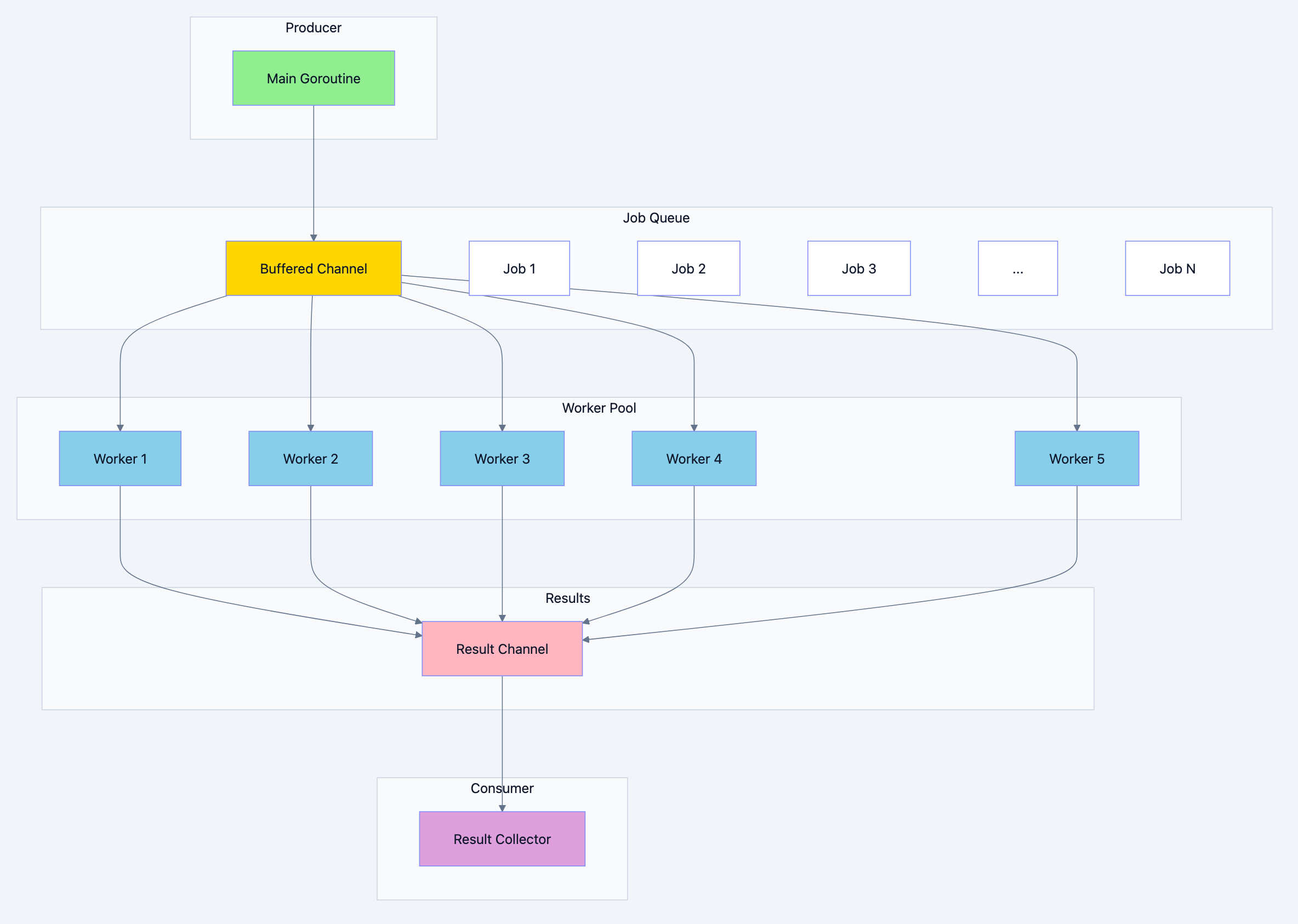
Concurrency pattern diagram 1
Basic Worker Pool Implementation
Let's build a worker pool step by step:
go// Filename: basic_worker_pool.go
package main

import (
    "fmt"
    "sync"
    "time"
)

// Job represents a unit of work to be done
// Why: Encapsulating work in a struct makes it easy to pass around
// and allows for adding metadata like priority or retry count later
type Job struct {
    ID   int
    Data string
}

// Result represents the outcome of processing a job
// Why: Separating Job and Result allows workers to return
// different data structures than what they receive
type Result struct {
    JobID    int
    Output   string
    Duration time.Duration
    Error    error
}

// worker is a goroutine that processes jobs from the jobs channel
// Why: Each worker runs in its own goroutine, taking jobs from
// a shared channel. This creates natural load balancing - faster
// workers naturally take more jobs.
func worker(id int, jobs <-chan Job, results chan<- Result, wg *sync.WaitGroup) {
    // Why: defer ensures Done() is called even if worker panics
    defer wg.Done()

    // Why: range over channel automatically exits when channel closes
    for job := range jobs {
        start := time.Now()

        // Simulate some work (in real code, this would be actual processing)
        time.Sleep(time.Duration(50+job.ID%100) * time.Millisecond)

        // Process the job
        output := fmt.Sprintf("Worker %d processed job %d: %s", id, job.ID, job.Data)

        // Send result back
        results <- Result{
            JobID:    job.ID,
            Output:   output,
            Duration: time.Since(start),
        }
    }

    fmt.Printf("Worker %d: shutting down\n", id)
}

func main() {
    const numWorkers = 5
    const numJobs = 20

    // Why: Buffered channels prevent blocking when sending jobs
    // Buffer size equals number of jobs so producer doesn't block
    jobs := make(chan Job, numJobs)
    results := make(chan Result, numJobs)

    var wg sync.WaitGroup

    // Start workers
    // Why: Starting workers before sending jobs ensures no jobs are missed
    fmt.Printf("Starting %d workers...\n", numWorkers)
    for w := 1; w <= numWorkers; w++ {
        wg.Add(1)
        go worker(w, jobs, results, &wg)
    }

    // Send jobs
    // Why: Jobs are sent to a channel, not directly to workers
    // This decouples job creation from job processing
    fmt.Printf("Sending %d jobs...\n", numJobs)
    for j := 1; j <= numJobs; j++ {
        jobs <- Job{
            ID:   j,
            Data: fmt.Sprintf("task-%d", j),
        }
    }
    close(jobs) // Signal no more jobs are coming

    // Wait for all workers to finish in a separate goroutine
    // Why: This allows us to collect results while workers are still running
    go func() {
        wg.Wait()
        close(results) // Safe to close after all workers are done
    }()

    // Collect results
    // Why: Collecting results as they come in (streaming) is more
    // memory efficient than waiting for all results
    fmt.Println("\nResults:")
    for result := range results {
        fmt.Printf("  Job %d completed in %v\n", result.JobID, result.Duration)
    }

    fmt.Println("\nAll jobs completed!")
}
Expected Output:
Starting 5 workers...
Sending 20 jobs...

Results:
  Job 1 completed in 51ms
  Job 2 completed in 52ms
  Job 5 completed in 55ms
  Job 3 completed in 53ms
  Job 4 completed in 54ms
  Job 6 completed in 56ms
  ...
Worker 1: shutting down
Worker 3: shutting down
Worker 2: shutting down
Worker 4: shutting down
Worker 5: shutting down

All jobs completed!
Real World Example 1: Image Processing Service
Let's build a realistic image processing service that resizes uploaded images:
go// Filename: image_processor.go
package main

import (
    "context"
    "fmt"
    "sync"
    "time"
)

// ImageJob represents an image to be processed
type ImageJob struct {
    ImageID   string
    SourceURL string
    Width     int
    Height    int
    Quality   int
}

// ImageResult represents the processed image
type ImageResult struct {
    ImageID     string
    OutputURL   string
    OriginalSize int64
    NewSize     int64
    Duration    time.Duration
    Error       error
}

// ImageProcessor manages a pool of workers for image processing
// Why: Encapsulating the worker pool in a struct makes it reusable
// and allows for configuration and lifecycle management
type ImageProcessor struct {
    numWorkers int
    jobs       chan ImageJob
    results    chan ImageResult
    wg         sync.WaitGroup
    ctx        context.Context
    cancel     context.CancelFunc
}

// NewImageProcessor creates a new image processing pool
// Why: Constructor pattern ensures proper initialization
func NewImageProcessor(numWorkers, bufferSize int) *ImageProcessor {
    ctx, cancel := context.WithCancel(context.Background())

    return &ImageProcessor{
        numWorkers: numWorkers,
        jobs:       make(chan ImageJob, bufferSize),
        results:    make(chan ImageResult, bufferSize),
        ctx:        ctx,
        cancel:     cancel,
    }
}

// Start begins the worker pool
// Why: Separating Start from New allows for configuration changes
// between creation and starting
func (p *ImageProcessor) Start() {
    for i := 1; i <= p.numWorkers; i++ {
        p.wg.Add(1)
        go p.worker(i)
    }

    fmt.Printf("Image processor started with %d workers\n", p.numWorkers)
}

// worker processes images from the job queue
func (p *ImageProcessor) worker(id int) {
    defer p.wg.Done()

    for {
        select {
        case <-p.ctx.Done():
            // Context cancelled, shut down gracefully
            fmt.Printf("Worker %d: received shutdown signal\n", id)
            return

        case job, ok := <-p.jobs:
            if !ok {
                // Channel closed, no more jobs
                fmt.Printf("Worker %d: job channel closed\n", id)
                return
            }

            result := p.processImage(id, job)
            p.results <- result
        }
    }
}

// processImage does the actual image processing
// Why: Separating processing logic makes it easy to test and modify
func (p *ImageProcessor) processImage(workerID int, job ImageJob) ImageResult {
    start := time.Now()

    // Simulate image processing steps
    // In real code, this would use an image library like imaging or bimg

    // Step 1: Download image (simulated)
    time.Sleep(50 * time.Millisecond)

    // Step 2: Decode image (simulated)
    time.Sleep(30 * time.Millisecond)

    // Step 3: Resize image (simulated)
    time.Sleep(100 * time.Millisecond)

    // Step 4: Encode and save (simulated)
    time.Sleep(40 * time.Millisecond)

    // Simulate occasional errors (10% chance)
    var err error
    if job.Width > 4000 {
        err = fmt.Errorf("image too large: max width is 4000px")
    }

    return ImageResult{
        ImageID:     job.ImageID,
        OutputURL:   fmt.Sprintf("https://cdn.example.com/processed/%s_%dx%d.jpg", job.ImageID, job.Width, job.Height),
        OriginalSize: 2500000, // 2.5 MB simulated
        NewSize:     int64(job.Width * job.Height * 3 / 10), // Rough estimate
        Duration:    time.Since(start),
        Error:       err,
    }
}

// Submit adds a job to the processing queue
// Why: Method returns immediately, job is processed asynchronously
func (p *ImageProcessor) Submit(job ImageJob) {
    p.jobs <- job
}

// Results returns the results channel for consuming processed images
// Why: Exposing channel allows for flexible result handling
func (p *ImageProcessor) Results() <-chan ImageResult {
    return p.results
}

// Shutdown gracefully stops the worker pool
// Why: Graceful shutdown ensures all in-flight jobs complete
func (p *ImageProcessor) Shutdown() {
    fmt.Println("Initiating graceful shutdown...")

    // Stop accepting new jobs
    close(p.jobs)

    // Wait for workers to finish current jobs
    p.wg.Wait()

    // Close results channel
    close(p.results)

    fmt.Println("Shutdown complete")
}

// ForceShutdown immediately stops all workers
// Why: Sometimes you need to stop immediately (e.g., critical error)
func (p *ImageProcessor) ForceShutdown() {
    fmt.Println("Force shutdown initiated...")
    p.cancel()
    p.wg.Wait()
    close(p.results)
    fmt.Println("Force shutdown complete")
}

func main() {
    // Create processor with 3 workers and buffer for 100 jobs
    processor := NewImageProcessor(3, 100)
    processor.Start()

    // Start result collector in separate goroutine
    var resultWg sync.WaitGroup
    resultWg.Add(1)
    go func() {
        defer resultWg.Done()

        successCount := 0
        errorCount := 0

        for result := range processor.Results() {
            if result.Error != nil {
                errorCount++
                fmt.Printf("FAILED: Image %s - %v\n", result.ImageID, result.Error)
            } else {
                successCount++
                fmt.Printf("SUCCESS: Image %s processed in %v (%.1f KB -> %.1f KB)\n",
                    result.ImageID,
                    result.Duration,
                    float64(result.OriginalSize)/1024,
                    float64(result.NewSize)/1024,
                )
            }
        }

        fmt.Printf("\nProcessing complete: %d succeeded, %d failed\n", successCount, errorCount)
    }()

    // Submit jobs
    images := []ImageJob{
        {ImageID: "img001", SourceURL: "https://example.com/photo1.jpg", Width: 800, Height: 600, Quality: 85},
        {ImageID: "img002", SourceURL: "https://example.com/photo2.jpg", Width: 1200, Height: 800, Quality: 90},
        {ImageID: "img003", SourceURL: "https://example.com/photo3.jpg", Width: 1920, Height: 1080, Quality: 95},
        {ImageID: "img004", SourceURL: "https://example.com/photo4.jpg", Width: 640, Height: 480, Quality: 80},
        {ImageID: "img005", SourceURL: "https://example.com/photo5.jpg", Width: 5000, Height: 3000, Quality: 90}, // This will fail
        {ImageID: "img006", SourceURL: "https://example.com/photo6.jpg", Width: 2560, Height: 1440, Quality: 85},
        {ImageID: "img007", SourceURL: "https://example.com/photo7.jpg", Width: 3840, Height: 2160, Quality: 90},
        {ImageID: "img008", SourceURL: "https://example.com/photo8.jpg", Width: 1024, Height: 768, Quality: 85},
    }

    fmt.Printf("\nSubmitting %d images for processing...\n\n", len(images))
    for _, img := range images {
        processor.Submit(img)
    }

    // Shutdown processor (waits for all jobs to complete)
    processor.Shutdown()

    // Wait for result collector to finish
    resultWg.Wait()
}
Expected Output:
Image processor started with 3 workers

Submitting 8 images for processing...

SUCCESS: Image img001 processed in 220ms (2441.4 KB -> 140.6 KB)
SUCCESS: Image img002 processed in 220ms (2441.4 KB -> 281.3 KB)
SUCCESS: Image img003 processed in 220ms (2441.4 KB -> 607.5 KB)
SUCCESS: Image img004 processed in 220ms (2441.4 KB -> 90.0 KB)
FAILED: Image img005 - image too large: max width is 4000px
SUCCESS: Image img006 processed in 220ms (2441.4 KB -> 1080.0 KB)
SUCCESS: Image img007 processed in 220ms (2441.4 KB -> 2430.0 KB)
SUCCESS: Image img008 processed in 220ms (2441.4 KB -> 230.4 KB)
Worker 1: job channel closed
Worker 2: job channel closed
Worker 3: job channel closed
Initiating graceful shutdown...
Shutdown complete

Processing complete: 7 succeeded, 1 failed
Real World Example 2: Database Batch Processor
Processing large amounts of database records efficiently:
go// Filename: database_batch_processor.go
package main

import (
    "context"
    "fmt"
    "math/rand"
    "sync"
    "sync/atomic"
    "time"
)

// User represents a database user record
type User struct {
    ID        int
    Email     string
    Name      string
    LastLogin time.Time
}

// EmailJob represents an email to be sent
type EmailJob struct {
    UserID  int
    Email   string
    Name    string
    Subject string
    Body    string
}

// EmailResult represents the result of sending an email
type EmailResult struct {
    UserID   int
    Success  bool
    Error    error
    Duration time.Duration
}

// BatchEmailSender processes emails in batches with controlled concurrency
type BatchEmailSender struct {
    numWorkers     int
    jobs           chan EmailJob
    results        chan EmailResult
    wg             sync.WaitGroup
    totalSent      int64
    totalFailed    int64
    totalProcessed int64
}

// NewBatchEmailSender creates a new batch email sender
func NewBatchEmailSender(numWorkers int) *BatchEmailSender {
    return &BatchEmailSender{
        numWorkers: numWorkers,
        jobs:       make(chan EmailJob, numWorkers*10), // Buffer 10x workers
        results:    make(chan EmailResult, numWorkers*10),
    }
}

// Start begins the worker pool
func (s *BatchEmailSender) Start(ctx context.Context) {
    for i := 1; i <= s.numWorkers; i++ {
        s.wg.Add(1)
        go s.emailWorker(ctx, i)
    }

    fmt.Printf("Email sender started with %d workers\n", s.numWorkers)
}

// emailWorker sends emails from the job queue
func (s *BatchEmailSender) emailWorker(ctx context.Context, id int) {
    defer s.wg.Done()

    for {
        select {
        case <-ctx.Done():
            return
        case job, ok := <-s.jobs:
            if !ok {
                return
            }
            result := s.sendEmail(job)
            s.results <- result

            // Update counters atomically
            atomic.AddInt64(&s.totalProcessed, 1)
            if result.Success {
                atomic.AddInt64(&s.totalSent, 1)
            } else {
                atomic.AddInt64(&s.totalFailed, 1)
            }
        }
    }
}

// sendEmail simulates sending an email
func (s *BatchEmailSender) sendEmail(job EmailJob) EmailResult {
    start := time.Now()

    // Simulate email sending with variable latency
    delay := time.Duration(20+rand.Intn(80)) * time.Millisecond
    time.Sleep(delay)

    // Simulate 5% failure rate
    var err error
    success := true
    if rand.Float32() < 0.05 {
        err = fmt.Errorf("SMTP connection failed")
        success = false
    }

    return EmailResult{
        UserID:   job.UserID,
        Success:  success,
        Error:    err,
        Duration: time.Since(start),
    }
}

// Submit adds an email job to the queue
func (s *BatchEmailSender) Submit(job EmailJob) {
    s.jobs <- job
}

// Results returns the results channel
func (s *BatchEmailSender) Results() <-chan EmailResult {
    return s.results
}

// Stats returns current processing statistics
func (s *BatchEmailSender) Stats() (processed, sent, failed int64) {
    return atomic.LoadInt64(&s.totalProcessed),
        atomic.LoadInt64(&s.totalSent),
        atomic.LoadInt64(&s.totalFailed)
}

// Shutdown gracefully stops the sender
func (s *BatchEmailSender) Shutdown() {
    close(s.jobs)
    s.wg.Wait()
    close(s.results)
}

// simulateGetInactiveUsers simulates fetching inactive users from database
func simulateGetInactiveUsers(count int) []User {
    users := make([]User, count)
    for i := 0; i < count; i++ {
        users[i] = User{
            ID:        i + 1,
            Email:     fmt.Sprintf("user%d@example.com", i+1),
            Name:      fmt.Sprintf("User %d", i+1),
            LastLogin: time.Now().AddDate(0, 0, -30-rand.Intn(60)),
        }
    }
    return users
}

func main() {
    rand.Seed(time.Now().UnixNano())

    // Create sender with 10 workers (simulating 10 concurrent SMTP connections)
    sender := NewBatchEmailSender(10)

    ctx, cancel := context.WithCancel(context.Background())
    defer cancel()

    sender.Start(ctx)

    // Start progress reporter
    go func() {
        ticker := time.NewTicker(500 * time.Millisecond)
        defer ticker.Stop()

        for {
            select {
            case <-ctx.Done():
                return
            case <-ticker.C:
                processed, sent, failed := sender.Stats()
                fmt.Printf("Progress: %d processed, %d sent, %d failed\n",
                    processed, sent, failed)
            }
        }
    }()

    // Start result collector
    var resultWg sync.WaitGroup
    resultWg.Add(1)
    go func() {
        defer resultWg.Done()
        for result := range sender.Results() {
            if !result.Success {
                fmt.Printf("  Failed to send to user %d: %v\n", result.UserID, result.Error)
            }
        }
    }()

    // Get inactive users (simulating database query)
    fmt.Println("Fetching inactive users...")
    users := simulateGetInactiveUsers(100)
    fmt.Printf("Found %d inactive users\n\n", len(users))

    // Submit email jobs
    fmt.Println("Submitting email jobs...")
    startTime := time.Now()

    for _, user := range users {
        sender.Submit(EmailJob{
            UserID:  user.ID,
            Email:   user.Email,
            Name:    user.Name,
            Subject: "We miss you!",
            Body:    fmt.Sprintf("Hi %s, it's been a while since we saw you...", user.Name),
        })
    }

    // Shutdown and wait
    sender.Shutdown()
    cancel() // Stop progress reporter
    resultWg.Wait()

    // Final stats
    totalDuration := time.Since(startTime)
    processed, sent, failed := sender.Stats()

    fmt.Printf("\n" + "=" + "\n")
    fmt.Printf("Final Results:\n")
    fmt.Printf("  Total processed: %d\n", processed)
    fmt.Printf("  Successfully sent: %d\n", sent)
    fmt.Printf("  Failed: %d\n", failed)
    fmt.Printf("  Total time: %v\n", totalDuration)
    fmt.Printf("  Throughput: %.1f emails/second\n", float64(processed)/totalDuration.Seconds())
}
Expected Output:
Email sender started with 10 workers
Fetching inactive users...
Found 100 inactive users

Submitting email jobs...
Progress: 45 processed, 43 sent, 2 failed
  Failed to send to user 12: SMTP connection failed
  Failed to send to user 34: SMTP connection failed
Progress: 89 processed, 85 sent, 4 failed
  Failed to send to user 67: SMTP connection failed
  Failed to send to user 78: SMTP connection failed
Progress: 100 processed, 95 sent, 5 failed
  Failed to send to user 91: SMTP connection failed

=
Final Results:
  Total processed: 100
  Successfully sent: 95
  Failed: 5
  Total time: 1.12s
  Throughput: 89.3 emails/second
Advanced Worker Pool Features
Dynamic Worker Pool with Auto-Scaling
go// Filename: dynamic_worker_pool.go
package main

import (
    "context"
    "fmt"
    "sync"
    "sync/atomic"
    "time"
)

// DynamicPool automatically scales workers based on queue depth
type DynamicPool struct {
    minWorkers  int
    maxWorkers  int
    jobs        chan func()
    workerCount int64
    wg          sync.WaitGroup
    ctx         context.Context
    cancel      context.CancelFunc
    mu          sync.Mutex
}

// NewDynamicPool creates a pool that scales between min and max workers
func NewDynamicPool(minWorkers, maxWorkers int) *DynamicPool {
    ctx, cancel := context.WithCancel(context.Background())

    pool := &DynamicPool{
        minWorkers: minWorkers,
        maxWorkers: maxWorkers,
        jobs:       make(chan func(), maxWorkers*100),
        ctx:        ctx,
        cancel:     cancel,
    }

    // Start minimum workers
    for i := 0; i < minWorkers; i++ {
        pool.addWorker()
    }

    // Start the scaler
    go pool.scaler()

    return pool
}

// addWorker adds a new worker to the pool
func (p *DynamicPool) addWorker() {
    p.wg.Add(1)
    atomic.AddInt64(&p.workerCount, 1)

    go func() {
        defer p.wg.Done()
        defer atomic.AddInt64(&p.workerCount, -1)

        idleTimeout := time.NewTimer(30 * time.Second)
        defer idleTimeout.Stop()

        for {
            idleTimeout.Reset(30 * time.Second)

            select {
            case <-p.ctx.Done():
                return

            case job, ok := <-p.jobs:
                if !ok {
                    return
                }
                job()

            case <-idleTimeout.C:
                // Idle timeout - consider shutting down if we're above minimum
                if atomic.LoadInt64(&p.workerCount) > int64(p.minWorkers) {
                    fmt.Println("Worker idle timeout, shutting down")
                    return
                }
            }
        }
    }()
}

// scaler monitors queue depth and scales workers accordingly
func (p *DynamicPool) scaler() {
    ticker := time.NewTicker(100 * time.Millisecond)
    defer ticker.Stop()

    for {
        select {
        case <-p.ctx.Done():
            return
        case <-ticker.C:
            queueDepth := len(p.jobs)
            currentWorkers := atomic.LoadInt64(&p.workerCount)

            // Scale up if queue is getting deep
            if queueDepth > int(currentWorkers)*5 && currentWorkers < int64(p.maxWorkers) {
                fmt.Printf("Scaling up: queue=%d, workers=%d\n", queueDepth, currentWorkers)
                p.addWorker()
            }
        }
    }
}

// Submit adds a job to the pool
func (p *DynamicPool) Submit(job func()) {
    p.jobs <- job
}

// WorkerCount returns current number of active workers
func (p *DynamicPool) WorkerCount() int64 {
    return atomic.LoadInt64(&p.workerCount)
}

// QueueDepth returns current number of jobs waiting
func (p *DynamicPool) QueueDepth() int {
    return len(p.jobs)
}

// Shutdown gracefully stops the pool
func (p *DynamicPool) Shutdown() {
    close(p.jobs)
    p.cancel()
    p.wg.Wait()
}

func main() {
    pool := NewDynamicPool(2, 10)

    fmt.Printf("Starting with %d workers\n", pool.WorkerCount())

    // Submit burst of jobs
    var jobWg sync.WaitGroup
    for i := 0; i < 100; i++ {
        jobWg.Add(1)
        jobNum := i
        pool.Submit(func() {
            defer jobWg.Done()
            time.Sleep(100 * time.Millisecond) // Simulate work
            fmt.Printf("Job %d completed (workers: %d, queue: %d)\n",
                jobNum, pool.WorkerCount(), pool.QueueDepth())
        })
    }

    // Wait for jobs to complete
    jobWg.Wait()

    fmt.Printf("\nAll jobs done. Workers: %d\n", pool.WorkerCount())

    // Wait a bit to see workers scale down
    fmt.Println("Waiting for idle workers to scale down...")
    time.Sleep(35 * time.Second)

    fmt.Printf("After idle period. Workers: %d\n", pool.WorkerCount())

    pool.Shutdown()
}
Worker Pool with Retries and Dead Letter Queue
go// Filename: worker_pool_with_retry.go
package main

import (
    "errors"
    "fmt"
    "math/rand"
    "sync"
    "time"
)

// RetryableJob is a job that can be retried on failure
type RetryableJob struct {
    ID          int
    Data        string
    Attempts    int
    MaxAttempts int
    LastError   error
}

// DeadLetterEntry is a job that exceeded retry attempts
type DeadLetterEntry struct {
    Job       RetryableJob
    FinalError error
    FailedAt  time.Time
}

// RetryableWorkerPool handles jobs with automatic retry
type RetryableWorkerPool struct {
    numWorkers      int
    jobs            chan RetryableJob
    retryQueue      chan RetryableJob
    deadLetterQueue chan DeadLetterEntry
    wg              sync.WaitGroup
}

// NewRetryableWorkerPool creates a pool with retry support
func NewRetryableWorkerPool(numWorkers int) *RetryableWorkerPool {
    return &RetryableWorkerPool{
        numWorkers:      numWorkers,
        jobs:            make(chan RetryableJob, 100),
        retryQueue:      make(chan RetryableJob, 100),
        deadLetterQueue: make(chan DeadLetterEntry, 100),
    }
}

// Start begins the worker pool
func (p *RetryableWorkerPool) Start() {
    // Start main workers
    for i := 1; i <= p.numWorkers; i++ {
        p.wg.Add(1)
        go p.worker(i)
    }

    // Start retry processor
    p.wg.Add(1)
    go p.retryProcessor()
}

// worker processes jobs
func (p *RetryableWorkerPool) worker(id int) {
    defer p.wg.Done()

    for job := range p.jobs {
        job.Attempts++

        err := p.processJob(job)
        if err != nil {
            job.LastError = err

            if job.Attempts >= job.MaxAttempts {
                // Send to dead letter queue
                p.deadLetterQueue <- DeadLetterEntry{
                    Job:        job,
                    FinalError: err,
                    FailedAt:   time.Now(),
                }
                fmt.Printf("Worker %d: Job %d moved to DLQ after %d attempts: %v\n",
                    id, job.ID, job.Attempts, err)
            } else {
                // Send for retry
                p.retryQueue <- job
                fmt.Printf("Worker %d: Job %d failed (attempt %d/%d), queued for retry: %v\n",
                    id, job.ID, job.Attempts, job.MaxAttempts, err)
            }
        } else {
            fmt.Printf("Worker %d: Job %d succeeded on attempt %d\n",
                id, job.ID, job.Attempts)
        }
    }
}

// processJob simulates job processing with random failures
func (p *RetryableWorkerPool) processJob(job RetryableJob) error {
    time.Sleep(50 * time.Millisecond)

    // 40% chance of failure
    if rand.Float32() < 0.4 {
        return errors.New("random processing error")
    }
    return nil
}

// retryProcessor handles retry with exponential backoff
func (p *RetryableWorkerPool) retryProcessor() {
    defer p.wg.Done()

    for job := range p.retryQueue {
        // Exponential backoff: 100ms, 200ms, 400ms, etc.
        backoff := time.Duration(100<<uint(job.Attempts-1)) * time.Millisecond
        if backoff > 5*time.Second {
            backoff = 5 * time.Second
        }

        fmt.Printf("Retry processor: Job %d waiting %v before retry\n", job.ID, backoff)
        time.Sleep(backoff)

        // Resubmit to main queue
        p.jobs <- job
    }
}

// Submit adds a job to the pool
func (p *RetryableWorkerPool) Submit(job RetryableJob) {
    p.jobs <- job
}

// DeadLetterQueue returns the DLQ channel for monitoring
func (p *RetryableWorkerPool) DeadLetterQueue() <-chan DeadLetterEntry {
    return p.deadLetterQueue
}

// Shutdown gracefully stops the pool
func (p *RetryableWorkerPool) Shutdown() {
    close(p.jobs)
    close(p.retryQueue)
    p.wg.Wait()
    close(p.deadLetterQueue)
}

func main() {
    rand.Seed(time.Now().UnixNano())

    pool := NewRetryableWorkerPool(3)
    pool.Start()

    // Monitor dead letter queue
    var dlqWg sync.WaitGroup
    dlqWg.Add(1)
    go func() {
        defer dlqWg.Done()
        for entry := range pool.DeadLetterQueue() {
            fmt.Printf("\n*** DLQ ALERT: Job %d permanently failed: %v ***\n\n",
                entry.Job.ID, entry.FinalError)
        }
    }()

    // Submit jobs
    for i := 1; i <= 10; i++ {
        pool.Submit(RetryableJob{
            ID:          i,
            Data:        fmt.Sprintf("task-%d", i),
            MaxAttempts: 3,
        })
    }

    // Wait a bit for processing
    time.Sleep(5 * time.Second)

    pool.Shutdown()
    dlqWg.Wait()

    fmt.Println("\nPool shutdown complete")
}
Best Practices and Common Mistakes
Best Practices
go// Filename: worker_pool_best_practices.go
package main

import (
    "context"
    "fmt"
    "runtime"
    "sync"
    "time"
)

// BEST PRACTICE 1: Size your worker pool appropriately
func recommendedWorkerCount(workType string) int {
    numCPU := runtime.NumCPU()

    switch workType {
    case "cpu-bound":
        // CPU-bound work: match CPU cores
        return numCPU

    case "io-bound":
        // IO-bound work: can have more workers than CPUs
        // because they spend most time waiting
        return numCPU * 4

    case "mixed":
        // Mixed workload: somewhere in between
        return numCPU * 2

    case "external-limited":
        // Limited by external resource (e.g., database connections)
        // Match the external limit
        return 25 // Example: typical DB connection pool size

    default:
        return numCPU
    }
}

// BEST PRACTICE 2: Always use context for cancellation
func workerWithContext(ctx context.Context, id int, jobs <-chan int) {
    for {
        select {
        case <-ctx.Done():
            fmt.Printf("Worker %d: cancelled\n", id)
            return
        case job, ok := <-jobs:
            if !ok {
                return
            }
            fmt.Printf("Worker %d: processing job %d\n", id, job)
        }
    }
}

// BEST PRACTICE 3: Use buffered channels appropriately
func createChannels(numWorkers int) (chan int, chan int) {
    // Job channel: buffer based on expected burst size
    // Too small: producer blocks frequently
    // Too large: wastes memory
    jobs := make(chan int, numWorkers*10)

    // Result channel: buffer based on processing needs
    results := make(chan int, numWorkers*10)

    return jobs, results
}

// BEST PRACTICE 4: Graceful shutdown pattern
type GracefulPool struct {
    jobs   chan int
    wg     sync.WaitGroup
    ctx    context.Context
    cancel context.CancelFunc
}

func NewGracefulPool(workers int) *GracefulPool {
    ctx, cancel := context.WithCancel(context.Background())
    p := &GracefulPool{
        jobs:   make(chan int, workers*10),
        ctx:    ctx,
        cancel: cancel,
    }

    for i := 0; i < workers; i++ {
        p.wg.Add(1)
        go p.worker(i)
    }

    return p
}

func (p *GracefulPool) worker(id int) {
    defer p.wg.Done()

    for {
        select {
        case <-p.ctx.Done():
            // Drain remaining jobs before exiting
            for job := range p.jobs {
                fmt.Printf("Worker %d: processing remaining job %d\n", id, job)
            }
            return
        case job, ok := <-p.jobs:
            if !ok {
                return
            }
            fmt.Printf("Worker %d: processing job %d\n", id, job)
            time.Sleep(10 * time.Millisecond)
        }
    }
}

func (p *GracefulPool) Submit(job int) {
    p.jobs <- job
}

func (p *GracefulPool) Shutdown(timeout time.Duration) error {
    close(p.jobs) // Stop accepting new jobs

    done := make(chan struct{})
    go func() {
        p.wg.Wait()
        close(done)
    }()

    select {
    case <-done:
        return nil
    case <-time.After(timeout):
        p.cancel() // Force cancel if timeout
        return fmt.Errorf("shutdown timed out")
    }
}

func main() {
    fmt.Println("Recommended worker counts:")
    fmt.Printf("  CPU-bound: %d\n", recommendedWorkerCount("cpu-bound"))
    fmt.Printf("  IO-bound: %d\n", recommendedWorkerCount("io-bound"))
    fmt.Printf("  Mixed: %d\n", recommendedWorkerCount("mixed"))
    fmt.Printf("  External-limited: %d\n", recommendedWorkerCount("external-limited"))

    fmt.Println("\nDemonstrating graceful shutdown:")
    pool := NewGracefulPool(3)

    // Submit some jobs
    for i := 1; i <= 20; i++ {
        pool.Submit(i)
    }

    // Graceful shutdown with 5 second timeout
    if err := pool.Shutdown(5 * time.Second); err != nil {
        fmt.Printf("Shutdown error: %v\n", err)
    } else {
        fmt.Println("Shutdown completed gracefully")
    }
}
Common Mistakes to Avoid
go// Filename: worker_pool_mistakes.go
package main

import (
    "fmt"
    "sync"
    "time"
)

// MISTAKE 1: Forgetting to close channels
func mistakeUnclosedChannel() {
    jobs := make(chan int, 10)
    var wg sync.WaitGroup

    // Worker
    wg.Add(1)
    go func() {
        defer wg.Done()
        for job := range jobs {
            fmt.Println("Processing:", job)
        }
        // This will never be reached if jobs is never closed!
    }()

    for i := 0; i < 5; i++ {
        jobs <- i
    }

    // MISTAKE: Forgetting to close(jobs)
    // The worker goroutine will hang forever!
    // close(jobs) // <- This line is missing

    // wg.Wait() // This would deadlock
}

// CORRECT: Always close channels when done sending
func correctCloseChannel() {
    jobs := make(chan int, 10)
    var wg sync.WaitGroup

    wg.Add(1)
    go func() {
        defer wg.Done()
        for job := range jobs {
            fmt.Println("Processing:", job)
        }
    }()

    for i := 0; i < 5; i++ {
        jobs <- i
    }

    close(jobs) // Signal no more jobs
    wg.Wait()   // Now this works correctly
}

// MISTAKE 2: Sending to closed channel (causes panic)
func mistakeSendToClosedChannel() {
    defer func() {
        if r := recover(); r != nil {
            fmt.Println("Recovered from panic:", r)
        }
    }()

    jobs := make(chan int)
    close(jobs)
    jobs <- 1 // PANIC: send on closed channel
}

// MISTAKE 3: Not using WaitGroup correctly
func mistakeWaitGroup() {
    var wg sync.WaitGroup

    for i := 0; i < 5; i++ {
        // MISTAKE: wg.Add inside goroutine can cause race
        go func(n int) {
            wg.Add(1) // Wrong place!
            defer wg.Done()
            fmt.Println(n)
        }(i)
    }

    wg.Wait() // May finish before goroutines even start!
}

// CORRECT: Add before starting goroutine
func correctWaitGroup() {
    var wg sync.WaitGroup

    for i := 0; i < 5; i++ {
        wg.Add(1) // Add before goroutine starts
        go func(n int) {
            defer wg.Done()
            fmt.Println(n)
        }(i)
    }

    wg.Wait()
}

// MISTAKE 4: Not buffering result channel appropriately
func mistakeUnbufferedResults() {
    jobs := make(chan int, 100)
    results := make(chan int) // Unbuffered!

    // Workers
    for w := 0; w < 3; w++ {
        go func() {
            for job := range jobs {
                // If main isn't reading results fast enough,
                // this send will block, reducing throughput
                results <- job * 2
            }
        }()
    }

    // Send jobs
    for i := 0; i < 10; i++ {
        jobs <- i
    }
    close(jobs)

    // If we don't read results, workers will block forever!
}

// CORRECT: Buffer based on expected throughput
func correctBufferedResults() {
    jobs := make(chan int, 100)
    results := make(chan int, 100) // Buffered appropriately

    var wg sync.WaitGroup

    // Workers
    for w := 0; w < 3; w++ {
        wg.Add(1)
        go func() {
            defer wg.Done()
            for job := range jobs {
                results <- job * 2
            }
        }()
    }

    // Send jobs
    for i := 0; i < 10; i++ {
        jobs <- i
    }
    close(jobs)

    // Wait and close results
    go func() {
        wg.Wait()
        close(results)
    }()

    // Collect results
    for result := range results {
        fmt.Println("Result:", result)
    }
}

func main() {
    fmt.Println("Demonstrating correct patterns:")
    correctCloseChannel()
    fmt.Println()
    correctWaitGroup()
    fmt.Println()
    correctBufferedResults()
}
When to Use Worker Pool Pattern
Use Worker Pool When:
| Scenario | Why Worker Pool Helps |
|---|---|
| Database operations | Limited connection pool |
| API calls | Rate limits, connection limits |
| File processing | Disk I/O bottleneck |
| Image/video processing | Memory constraints |
| Email sending | SMTP connection limits |
| Web scraping | Politeness, rate limiting |
| Batch processing | Resource efficiency |
Don't Use Worker Pool When:
| Scenario | Better Alternative |
|---|---|
| Few, quick tasks | Simple goroutines |
| Single long-running task | Single goroutine |
| Unlimited resources | May not need pooling |
| Real-time streaming | Pipeline pattern |
| Task dependencies | DAG/workflow patterns |
Summary
The Worker Pool pattern is your go-to solution when you need controlled concurrency. Like a well-run kitchen with a fixed number of chefs, it provides:
- Resource Control: Fixed number of concurrent operations
- Backpressure: Queue depth provides natural rate limiting
- Efficiency: Reuse goroutines instead of creating new ones
- Predictability: Known resource usage under load
Key Takeaways:
- Size pools based on bottleneck: CPU cores for CPU-bound, more for I/O-bound
- Buffer channels appropriately: Too small blocks producers, too large wastes memory
- Always close channels: When producer is done, close the jobs channel
- Use context for cancellation: Allows graceful shutdown
- Consider retries: Production systems need failure handling
- Monitor queue depth: Helps identify bottlenecks
Next Steps
- Practice: Implement a worker pool for your next batch processing task
- Explore: Fan-Out/Fan-In pattern for parallel processing with aggregation
- Read: Go's context package for deadline and cancellation propagation
- Build: Add metrics (prometheus) to monitor your worker pools in production