Designing a Banking Database at Scale
The Stakes Are Different Here
When you design a database for a social media app and something goes wrong, users see a stale post. When you design a database for a bank and something goes wrong, people lose money. Careers end. Lawsuits happen. Trust evaporates.
Bank processes over 10 million transactions daily. That's roughly 115 transactions per second on average, with peaks hitting 1000+ TPS during salary days, festive seasons, and market hours. Every single transaction must be:
- Atomic: Either complete fully or not at all
- Consistent: Never violate business rules (negative balance, duplicate transfers)
- Isolated: Concurrent transactions don't interfere
- Durable: Once confirmed, never lost even if the data center burns down
This guide covers everything: the schema design, transaction management, scaling strategies, disaster recovery, and the operational practices that keep a bank running.
Part 1: Understanding Banking Requirements
Core Banking Operations
Before designing anything, understand what a bank actually does:

Banking database diagram 1
Scale Parameters
| Metric | Value | Implication |
|---|---|---|
| Total Customers | 80+ million | Massive user table |
| Daily Transactions | 10+ million | ~115 TPS average, 1000+ TPS peak |
| Accounts | 100+ million | Multiple accounts per customer |
| Branches | 6000+ | Geographic distribution |
| ATMs | 18000+ | Real-time sync required |
| Digital Users | 50+ million | Mobile/Web scale |
| Data Retention | 10+ years | Regulatory requirement |
Regulatory Requirements
Banking databases must comply with:
- RBI Guidelines: Transaction logs, audit trails, data retention
- PCI-DSS: Card data security
- Data Localization: Customer data must stay in India
- Right to Audit: Regulators can demand any data anytime
- Disaster Recovery: RPO near-zero, RTO < 4 hours
Part 2: Database Technology Choices
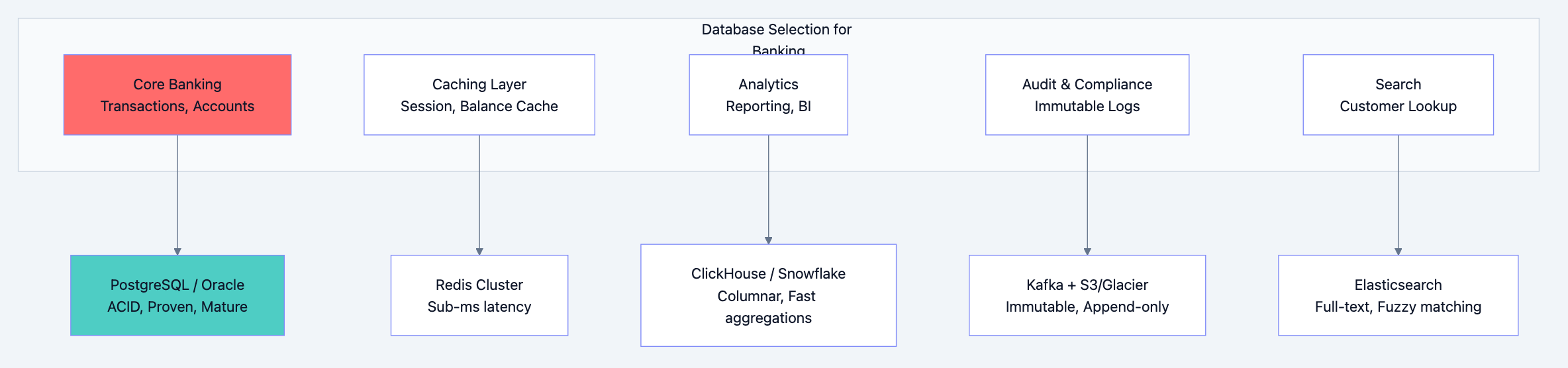
The Primary Database: Why PostgreSQL (or Oracle)
For the core banking system, you need a rock-solid ACID-compliant relational database.
Banking database diagram 2
Why PostgreSQL for Core Banking:
- Proven ACID Compliance: Decades of battle-testing
- Serializable Isolation: Prevents all anomalies
- Row-Level Locking: High concurrency without blocking
- Point-in-Time Recovery: Restore to any second
- Logical Replication: Zero-downtime migrations
- Extensions: PostGIS for branch locations, pg_partman for partitioning
Why NOT NoSQL for Transactions:
- Eventual consistency is unacceptable for money
- Complex joins needed (account + customer + branch)
- ACID transactions across multiple tables required
- Regulatory audits expect relational structure
The Supporting Cast
| Use Case | Technology | Why |
|---|---|---|
| Session/Cache | Redis Cluster | Sub-ms reads, atomic operations |
| Message Queue | Apache Kafka | Durable, ordered, replayable |
| Analytics | ClickHouse | Columnar, fast aggregations |
| Search | Elasticsearch | Customer name search, fuzzy matching |
| Document Store | MongoDB | KYC documents, unstructured data |
| Time-Series | TimescaleDB | Transaction metrics, monitoring |
Part 3: Schema Design
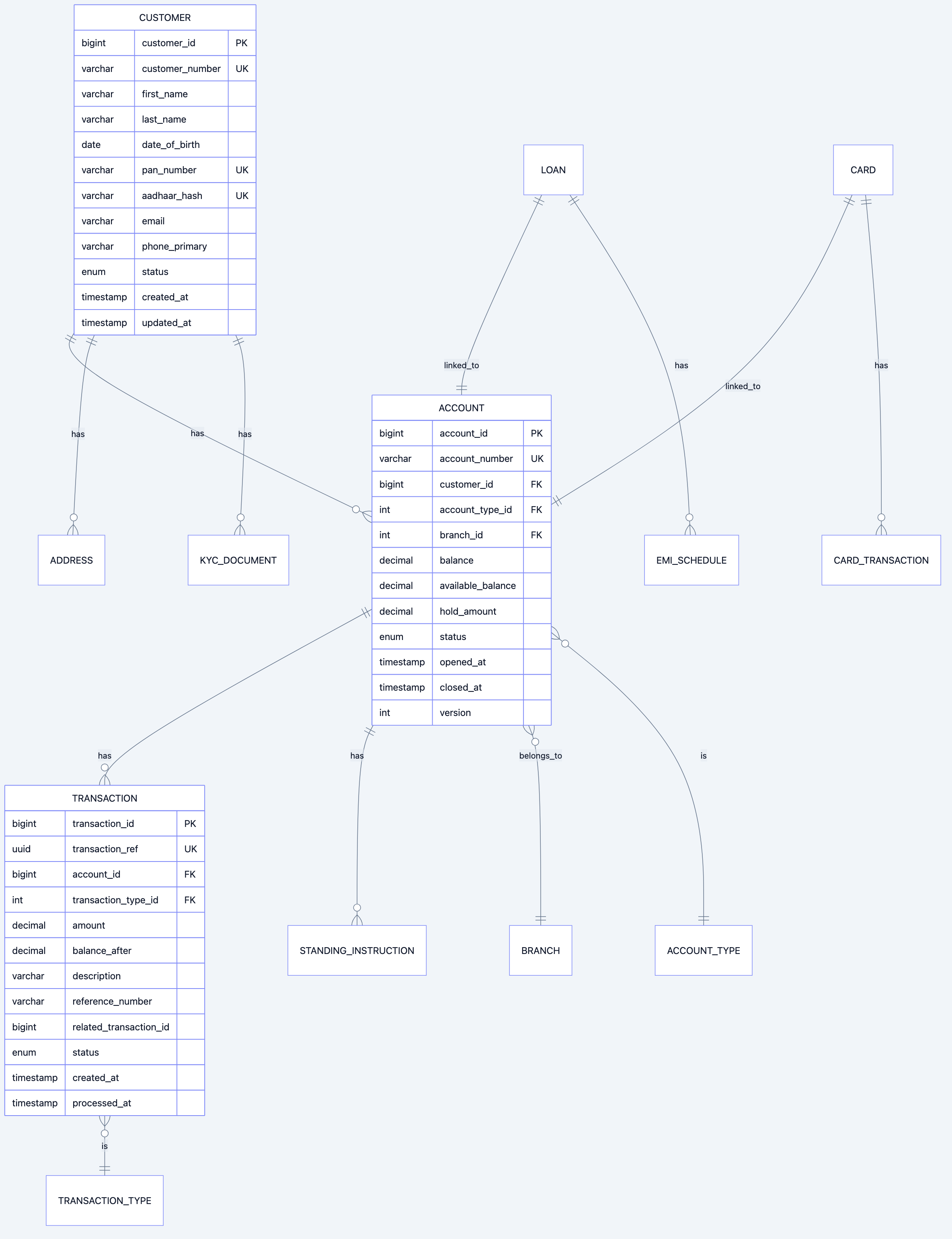
Core Entities
Banking database diagram 3
Detailed Schema with Partitioning
sql-- ============================================
-- CUSTOMER TABLE
-- ============================================
-- Customers are rarely updated, frequently read
-- Partition by customer_id range for even distribution

CREATE TABLE customers (
    customer_id         BIGSERIAL PRIMARY KEY,
    customer_number     VARCHAR(20) NOT NULL UNIQUE,

    -- Personal Information
    first_name          VARCHAR(100) NOT NULL,
    middle_name         VARCHAR(100),
    last_name           VARCHAR(100) NOT NULL,
    date_of_birth       DATE NOT NULL,
    gender              CHAR(1) CHECK (gender IN ('M', 'F', 'O')),

    -- Identity (Hashed for security)
    pan_number          VARCHAR(10) UNIQUE,  -- Encrypted at rest
    aadhaar_hash        VARCHAR(64) UNIQUE,  -- Only hash stored

    -- Contact
    email               VARCHAR(255),
    phone_primary       VARCHAR(15) NOT NULL,
    phone_secondary     VARCHAR(15),

    -- Status
    status              VARCHAR(20) NOT NULL DEFAULT 'ACTIVE'
                        CHECK (status IN ('PENDING_KYC', 'ACTIVE', 'SUSPENDED', 'CLOSED')),
    kyc_status          VARCHAR(20) NOT NULL DEFAULT 'PENDING'
                        CHECK (kyc_status IN ('PENDING', 'VERIFIED', 'EXPIRED', 'REJECTED')),
    kyc_verified_at     TIMESTAMP,

    -- Risk Classification
    risk_category       VARCHAR(20) DEFAULT 'NORMAL'
                        CHECK (risk_category IN ('LOW', 'NORMAL', 'HIGH', 'PEP')),

    -- Audit
    created_at          TIMESTAMP NOT NULL DEFAULT CURRENT_TIMESTAMP,
    updated_at          TIMESTAMP NOT NULL DEFAULT CURRENT_TIMESTAMP,
    created_by          BIGINT NOT NULL,
    updated_by          BIGINT NOT NULL,

    -- Soft delete
    is_deleted          BOOLEAN NOT NULL DEFAULT FALSE,
    deleted_at          TIMESTAMP
);

-- Indexes for common queries
CREATE INDEX idx_customers_phone ON customers(phone_primary);
CREATE INDEX idx_customers_email ON customers(email) WHERE email IS NOT NULL;
CREATE INDEX idx_customers_status ON customers(status) WHERE status != 'CLOSED';
CREATE INDEX idx_customers_name ON customers(last_name, first_name);

-- ============================================
-- ACCOUNT TABLE
-- ============================================
-- Critical table - balance updates are hot path
-- Version column for optimistic locking

CREATE TABLE accounts (
    account_id          BIGSERIAL PRIMARY KEY,
    account_number      VARCHAR(20) NOT NULL UNIQUE,

    -- Relationships
    customer_id         BIGINT NOT NULL REFERENCES customers(customer_id),
    account_type_id     INT NOT NULL REFERENCES account_types(account_type_id),
    branch_id           INT NOT NULL REFERENCES branches(branch_id),

    -- Balance Information
    balance             DECIMAL(18,2) NOT NULL DEFAULT 0.00
                        CHECK (balance >= 0 OR account_type_id IN (SELECT account_type_id FROM account_types WHERE allows_overdraft = TRUE)),
    available_balance   DECIMAL(18,2) NOT NULL DEFAULT 0.00,
    hold_amount         DECIMAL(18,2) NOT NULL DEFAULT 0.00 CHECK (hold_amount >= 0),
    minimum_balance     DECIMAL(18,2) NOT NULL DEFAULT 0.00,

    -- Overdraft (for current accounts)
    overdraft_limit     DECIMAL(18,2) DEFAULT 0.00,
    overdraft_used      DECIMAL(18,2) DEFAULT 0.00,

    -- Interest
    interest_rate       DECIMAL(5,4),  -- e.g., 0.0350 = 3.5%
    last_interest_calc  DATE,
    accrued_interest    DECIMAL(18,2) DEFAULT 0.00,

    -- Status
    status              VARCHAR(20) NOT NULL DEFAULT 'ACTIVE'
                        CHECK (status IN ('PENDING', 'ACTIVE', 'DORMANT', 'FROZEN', 'CLOSED')),
    dormant_since       DATE,

    -- Limits
    daily_withdrawal_limit  DECIMAL(18,2) DEFAULT 100000.00,
    daily_transfer_limit    DECIMAL(18,2) DEFAULT 500000.00,

    -- Dates
    opened_at           TIMESTAMP NOT NULL DEFAULT CURRENT_TIMESTAMP,
    closed_at           TIMESTAMP,

    -- Optimistic Locking
    version             INT NOT NULL DEFAULT 1,

    -- Audit
    created_at          TIMESTAMP NOT NULL DEFAULT CURRENT_TIMESTAMP,
    updated_at          TIMESTAMP NOT NULL DEFAULT CURRENT_TIMESTAMP,

    -- Constraints
    CONSTRAINT chk_available_balance
        CHECK (available_balance = balance - hold_amount + COALESCE(overdraft_limit, 0) - COALESCE(overdraft_used, 0))
);

-- Critical indexes
CREATE INDEX idx_accounts_customer ON accounts(customer_id);
CREATE INDEX idx_accounts_branch ON accounts(branch_id);
CREATE INDEX idx_accounts_status ON accounts(status) WHERE status = 'ACTIVE';
CREATE UNIQUE INDEX idx_accounts_number_active ON accounts(account_number) WHERE status != 'CLOSED';

-- ============================================
-- TRANSACTION TABLE (PARTITIONED)
-- ============================================
-- This is the highest volume table
-- Partitioned by date for performance and archival
-- Write-heavy, read for recent transactions

CREATE TABLE transactions (
    transaction_id      BIGSERIAL,
    transaction_ref     UUID NOT NULL DEFAULT gen_random_uuid(),

    -- Account Reference
    account_id          BIGINT NOT NULL,

    -- Transaction Details
    transaction_type_id INT NOT NULL REFERENCES transaction_types(transaction_type_id),
    amount              DECIMAL(18,2) NOT NULL CHECK (amount > 0),

    -- Direction
    direction           CHAR(1) NOT NULL CHECK (direction IN ('C', 'D')),  -- Credit/Debit

    -- Running Balance (Snapshot)
    balance_before      DECIMAL(18,2) NOT NULL,
    balance_after       DECIMAL(18,2) NOT NULL,

    -- Description
    description         VARCHAR(500),
    narration           VARCHAR(100),  -- Short narration for statement

    -- Reference
    reference_number    VARCHAR(50),   -- UTR, RRN, etc.
    related_txn_id      BIGINT,        -- For transfer pairs

    -- Channel
    channel             VARCHAR(20) NOT NULL
                        CHECK (channel IN ('BRANCH', 'ATM', 'NETBANKING', 'MOBILE', 'UPI', 'NEFT', 'RTGS', 'IMPS', 'API')),

    -- Status
    status              VARCHAR(20) NOT NULL DEFAULT 'PENDING'
                        CHECK (status IN ('PENDING', 'PROCESSING', 'COMPLETED', 'FAILED', 'REVERSED')),

    -- Timestamps
    created_at          TIMESTAMP NOT NULL DEFAULT CURRENT_TIMESTAMP,
    processed_at        TIMESTAMP,

    -- Audit
    initiated_by        BIGINT,  -- User/System ID
    approved_by         BIGINT,  -- For high-value transactions
    ip_address          INET,
    device_id           VARCHAR(100),

    PRIMARY KEY (transaction_id, created_at)
) PARTITION BY RANGE (created_at);

-- Create monthly partitions
CREATE TABLE transactions_2024_01 PARTITION OF transactions
    FOR VALUES FROM ('2024-01-01') TO ('2024-02-01');
CREATE TABLE transactions_2024_02 PARTITION OF transactions
    FOR VALUES FROM ('2024-02-01') TO ('2024-03-01');
-- ... continue for all months

-- Create future partitions automatically (pg_partman or cron job)

-- Indexes on partitioned table
CREATE INDEX idx_txn_account_date ON transactions(account_id, created_at DESC);
CREATE INDEX idx_txn_ref ON transactions(transaction_ref);
CREATE INDEX idx_txn_reference_number ON transactions(reference_number) WHERE reference_number IS NOT NULL;
CREATE INDEX idx_txn_status ON transactions(status) WHERE status IN ('PENDING', 'PROCESSING');

-- ============================================
-- TRANSACTION LEDGER (DOUBLE-ENTRY)
-- ============================================
-- Every transaction has two entries: debit and credit
-- This ensures books always balance

CREATE TABLE ledger_entries (
    entry_id            BIGSERIAL,
    transaction_id      BIGINT NOT NULL,

    -- Account
    account_id          BIGINT NOT NULL,

    -- Entry Type
    entry_type          CHAR(1) NOT NULL CHECK (entry_type IN ('D', 'C')),  -- Debit/Credit

    -- Amount
    amount              DECIMAL(18,2) NOT NULL CHECK (amount > 0),

    -- GL Account for reconciliation
    gl_account_id       INT NOT NULL REFERENCES gl_accounts(gl_account_id),

    -- Timestamp
    created_at          TIMESTAMP NOT NULL DEFAULT CURRENT_TIMESTAMP,

    PRIMARY KEY (entry_id, created_at)
) PARTITION BY RANGE (created_at);

-- ============================================
-- AUDIT LOG TABLE
-- ============================================
-- Immutable audit trail for all changes
-- Required by regulators

CREATE TABLE audit_logs (
    audit_id            BIGSERIAL,

    -- What changed
    table_name          VARCHAR(100) NOT NULL,
    record_id           BIGINT NOT NULL,
    operation           CHAR(1) NOT NULL CHECK (operation IN ('I', 'U', 'D')),

    -- Change details
    old_values          JSONB,
    new_values          JSONB,
    changed_fields      TEXT[],

    -- Who changed
    user_id             BIGINT,
    user_type           VARCHAR(20),  -- CUSTOMER, EMPLOYEE, SYSTEM

    -- When/Where
    created_at          TIMESTAMP NOT NULL DEFAULT CURRENT_TIMESTAMP,
    ip_address          INET,
    user_agent          TEXT,
    session_id          VARCHAR(100),

    PRIMARY KEY (audit_id, created_at)
) PARTITION BY RANGE (created_at);

-- Immutable - no updates or deletes allowed
REVOKE UPDATE, DELETE ON audit_logs FROM PUBLIC;
Supporting Tables
sql-- ============================================
-- ACCOUNT TYPES
-- ============================================
CREATE TABLE account_types (
    account_type_id     SERIAL PRIMARY KEY,
    code                VARCHAR(20) NOT NULL UNIQUE,
    name                VARCHAR(100) NOT NULL,
    category            VARCHAR(20) NOT NULL CHECK (category IN ('SAVINGS', 'CURRENT', 'FD', 'RD', 'LOAN')),

    -- Rules
    minimum_balance     DECIMAL(18,2) NOT NULL DEFAULT 0,
    allows_overdraft    BOOLEAN NOT NULL DEFAULT FALSE,
    interest_rate       DECIMAL(5,4),

    -- Limits
    max_daily_withdrawal    DECIMAL(18,2),
    max_daily_transfer      DECIMAL(18,2),

    is_active           BOOLEAN NOT NULL DEFAULT TRUE
);

INSERT INTO account_types (code, name, category, minimum_balance, interest_rate) VALUES
('SAV_REGULAR', 'Regular Savings', 'SAVINGS', 10000.00, 0.0300),
('SAV_SALARY', 'Salary Account', 'SAVINGS', 0.00, 0.0300),
('SAV_SENIOR', 'Senior Citizen Savings', 'SAVINGS', 10000.00, 0.0350),
('CUR_REGULAR', 'Current Account', 'CURRENT', 25000.00, 0.0000),
('CUR_PREMIUM', 'Premium Current', 'CURRENT', 100000.00, 0.0000);

-- ============================================
-- BRANCHES
-- ============================================
CREATE TABLE branches (
    branch_id           SERIAL PRIMARY KEY,
    branch_code         VARCHAR(10) NOT NULL UNIQUE,  -- IFSC suffix
    ifsc_code           VARCHAR(11) NOT NULL UNIQUE,

    name                VARCHAR(200) NOT NULL,
    address             TEXT NOT NULL,
    city                VARCHAR(100) NOT NULL,
    state               VARCHAR(100) NOT NULL,
    pincode             VARCHAR(6) NOT NULL,

    -- Contact
    phone               VARCHAR(15),
    email               VARCHAR(255),

    -- Manager
    manager_employee_id BIGINT,

    -- Geo location (for nearby branch search)
    latitude            DECIMAL(10, 8),
    longitude           DECIMAL(11, 8),

    -- Status
    is_active           BOOLEAN NOT NULL DEFAULT TRUE,

    -- Audit
    created_at          TIMESTAMP NOT NULL DEFAULT CURRENT_TIMESTAMP
);

CREATE INDEX idx_branches_city ON branches(city);
CREATE INDEX idx_branches_geo ON branches USING GIST (
    ST_SetSRID(ST_MakePoint(longitude, latitude), 4326)
);  -- Requires PostGIS

-- ============================================
-- TRANSACTION TYPES
-- ============================================
CREATE TABLE transaction_types (
    transaction_type_id SERIAL PRIMARY KEY,
    code                VARCHAR(30) NOT NULL UNIQUE,
    name                VARCHAR(100) NOT NULL,
    category            VARCHAR(30) NOT NULL,

    -- Rules
    requires_approval   BOOLEAN NOT NULL DEFAULT FALSE,
    approval_threshold  DECIMAL(18,2),  -- Amount above which approval needed

    -- GL Mapping
    debit_gl_account    INT,
    credit_gl_account   INT,

    is_active           BOOLEAN NOT NULL DEFAULT TRUE
);

INSERT INTO transaction_types (code, name, category, requires_approval, approval_threshold) VALUES
('CASH_DEPOSIT', 'Cash Deposit', 'DEPOSIT', FALSE, NULL),
('CASH_WITHDRAWAL', 'Cash Withdrawal', 'WITHDRAWAL', TRUE, 200000.00),
('NEFT_CREDIT', 'NEFT Credit', 'TRANSFER_IN', FALSE, NULL),
('NEFT_DEBIT', 'NEFT Debit', 'TRANSFER_OUT', TRUE, 1000000.00),
('RTGS_CREDIT', 'RTGS Credit', 'TRANSFER_IN', FALSE, NULL),
('RTGS_DEBIT', 'RTGS Debit', 'TRANSFER_OUT', TRUE, 500000.00),
('IMPS_CREDIT', 'IMPS Credit', 'TRANSFER_IN', FALSE, NULL),
('IMPS_DEBIT', 'IMPS Debit', 'TRANSFER_OUT', FALSE, NULL),
('UPI_CREDIT', 'UPI Credit', 'TRANSFER_IN', FALSE, NULL),
('UPI_DEBIT', 'UPI Debit', 'TRANSFER_OUT', FALSE, NULL),
('ATM_WITHDRAWAL', 'ATM Withdrawal', 'WITHDRAWAL', FALSE, NULL),
('POS_PURCHASE', 'POS Purchase', 'PURCHASE', FALSE, NULL),
('INTEREST_CREDIT', 'Interest Credit', 'INTEREST', FALSE, NULL),
('CHARGE_DEBIT', 'Service Charge', 'CHARGE', FALSE, NULL);
Part 4: Transaction Management
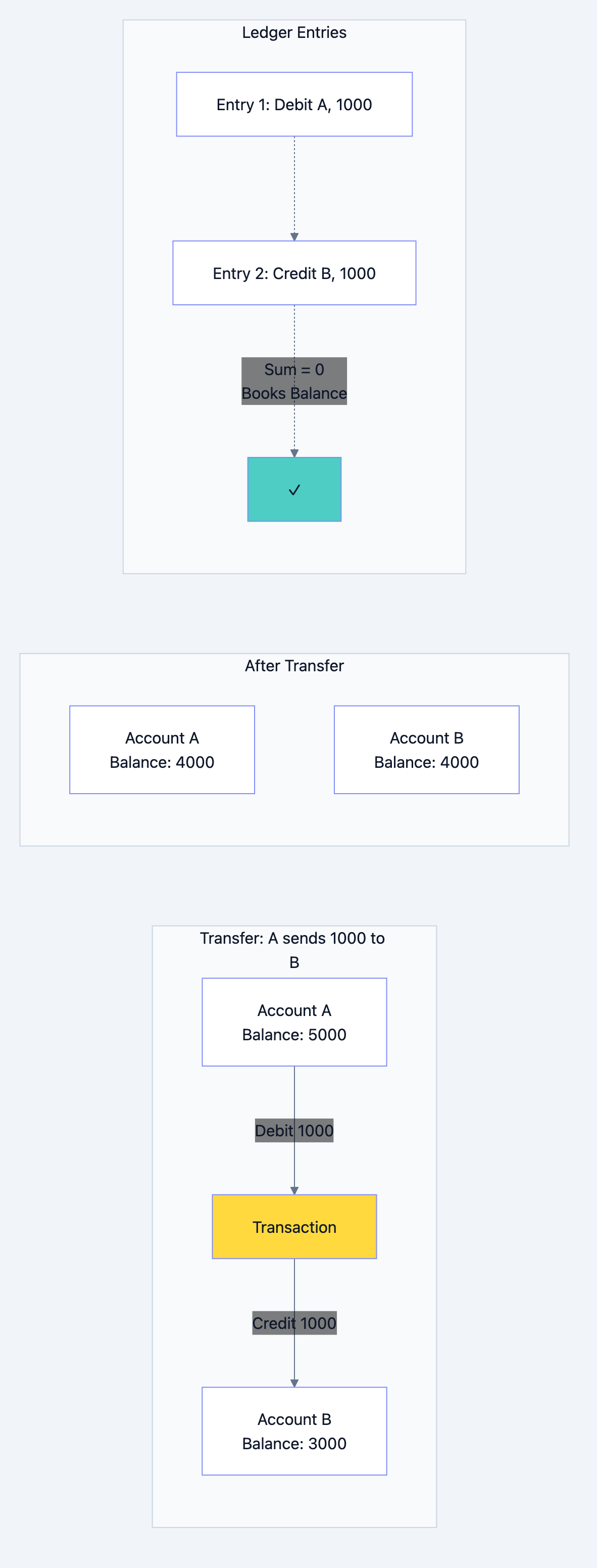
The Golden Rule: Double-Entry Bookkeeping
Every money movement has two sides. Money doesn't appear or disappear it moves.
Banking database diagram 4
Transaction Processing with Proper Isolation
go// transaction_service.go
package banking

import (
    "context"
    "database/sql"
    "fmt"
    "time"

    "github.com/google/uuid"
    "github.com/jackc/pgx/v5"
    "github.com/jackc/pgx/v5/pgxpool"
)

type TransactionService struct {
    db     *pgxpool.Pool
    cache  *RedisClient
    kafka  *KafkaProducer
}

type TransferRequest struct {
    FromAccountID   int64
    ToAccountID     int64
    Amount          float64
    Description     string
    Channel         string
    IdempotencyKey  string  // Prevents duplicate processing
    InitiatedBy     int64
    IPAddress       string
}

type TransferResult struct {
    TransactionRef  string
    FromBalance     float64
    ToBalance       float64
    ProcessedAt     time.Time
}

// Transfer executes a fund transfer with full ACID compliance
func (s *TransactionService) Transfer(ctx context.Context, req TransferRequest) (*TransferResult, error) {
    // 1. Idempotency Check - Prevent duplicate transactions
    existing, err := s.checkIdempotency(ctx, req.IdempotencyKey)
    if err != nil {
        return nil, fmt.Errorf("idempotency check failed: %w", err)
    }
    if existing != nil {
        return existing, nil  // Return cached result
    }

    // 2. Validate request
    if err := s.validateTransfer(ctx, req); err != nil {
        return nil, err
    }

    // 3. Generate transaction reference
    txnRef := uuid.New().String()

    // 4. Execute transfer in serializable transaction
    var result *TransferResult

    err = s.executeInTransaction(ctx, pgx.Serializable, func(tx pgx.Tx) error {
        // 4a. Lock accounts in consistent order (prevent deadlock)
        fromAccount, toAccount, err := s.lockAccountsForTransfer(ctx, tx, req.FromAccountID, req.ToAccountID)
        if err != nil {
            return err
        }

        // 4b. Validate balances
        if fromAccount.AvailableBalance < req.Amount {
            return ErrInsufficientBalance
        }

        // 4c. Check daily limits
        if err := s.checkDailyLimits(ctx, tx, fromAccount, req.Amount); err != nil {
            return err
        }

        // 4d. Debit from source account
        fromBalanceAfter, err := s.debitAccount(ctx, tx, fromAccount, req.Amount, txnRef)
        if err != nil {
            return err
        }

        // 4e. Credit to destination account
        toBalanceAfter, err := s.creditAccount(ctx, tx, toAccount, req.Amount, txnRef)
        if err != nil {
            return err
        }

        // 4f. Create transaction records
        if err := s.createTransactionRecords(ctx, tx, req, txnRef, fromAccount, toAccount, fromBalanceAfter, toBalanceAfter); err != nil {
            return err
        }

        // 4g. Create ledger entries (double-entry)
        if err := s.createLedgerEntries(ctx, tx, req, txnRef, fromAccount.AccountID, toAccount.AccountID); err != nil {
            return err
        }

        result = &TransferResult{
            TransactionRef: txnRef,
            FromBalance:    fromBalanceAfter,
            ToBalance:      toBalanceAfter,
            ProcessedAt:    time.Now(),
        }

        return nil
    })

    if err != nil {
        // Log failure for monitoring
        s.logTransactionFailure(ctx, req, txnRef, err)
        return nil, err
    }

    // 5. Post-transaction actions (outside main transaction)
    go s.postTransactionActions(context.Background(), req, result)

    // 6. Cache idempotency result
    s.cacheIdempotencyResult(ctx, req.IdempotencyKey, result)

    return result, nil
}

// lockAccountsForTransfer locks both accounts in consistent order to prevent deadlocks
func (s *TransactionService) lockAccountsForTransfer(ctx context.Context, tx pgx.Tx, fromID, toID int64) (*Account, *Account, error) {
    // CRITICAL: Always lock in ascending ID order to prevent deadlocks
    var firstID, secondID int64
    if fromID < toID {
        firstID, secondID = fromID, toID
    } else {
        firstID, secondID = toID, fromID
    }

    // Lock first account
    firstAccount, err := s.lockAccountForUpdate(ctx, tx, firstID)
    if err != nil {
        return nil, nil, err
    }

    // Lock second account
    secondAccount, err := s.lockAccountForUpdate(ctx, tx, secondID)
    if err != nil {
        return nil, nil, err
    }

    // Return in from/to order
    if fromID < toID {
        return firstAccount, secondAccount, nil
    }
    return secondAccount, firstAccount, nil
}

// lockAccountForUpdate acquires a row-level lock with optimistic locking check
func (s *TransactionService) lockAccountForUpdate(ctx context.Context, tx pgx.Tx, accountID int64) (*Account, error) {
    query := `
        SELECT account_id, account_number, customer_id, balance,
               available_balance, hold_amount, status, version,
               daily_withdrawal_limit, daily_transfer_limit
        FROM accounts
        WHERE account_id = $1
        FOR UPDATE NOWAIT
    `
    // NOWAIT: Fail immediately if lock not available (don't wait)
    // This prevents long lock chains

    var account Account
    err := tx.QueryRow(ctx, query, accountID).Scan(
        &account.AccountID, &account.AccountNumber, &account.CustomerID,
        &account.Balance, &account.AvailableBalance, &account.HoldAmount,
        &account.Status, &account.Version,
        &account.DailyWithdrawalLimit, &account.DailyTransferLimit,
    )

    if err == pgx.ErrNoRows {
        return nil, ErrAccountNotFound
    }
    if err != nil {
        // Check if it's a lock timeout
        if isLockError(err) {
            return nil, ErrAccountLocked
        }
        return nil, err
    }

    if account.Status != "ACTIVE" {
        return nil, ErrAccountNotActive
    }

    return &account, nil
}

// debitAccount decreases balance with optimistic locking
func (s *TransactionService) debitAccount(ctx context.Context, tx pgx.Tx, account *Account, amount float64, txnRef string) (float64, error) {
    newBalance := account.Balance - amount
    newAvailable := account.AvailableBalance - amount

    query := `
        UPDATE accounts
        SET balance = $1,
            available_balance = $2,
            version = version + 1,
            updated_at = CURRENT_TIMESTAMP
        WHERE account_id = $3
        AND version = $4
        RETURNING balance
    `

    var balanceAfter float64
    err := tx.QueryRow(ctx, query, newBalance, newAvailable, account.AccountID, account.Version).Scan(&balanceAfter)

    if err == pgx.ErrNoRows {
        // Version mismatch - concurrent modification
        return 0, ErrConcurrentModification
    }
    if err != nil {
        return 0, err
    }

    return balanceAfter, nil
}

// creditAccount increases balance
func (s *TransactionService) creditAccount(ctx context.Context, tx pgx.Tx, account *Account, amount float64, txnRef string) (float64, error) {
    newBalance := account.Balance + amount
    newAvailable := account.AvailableBalance + amount

    query := `
        UPDATE accounts
        SET balance = $1,
            available_balance = $2,
            version = version + 1,
            updated_at = CURRENT_TIMESTAMP
        WHERE account_id = $3
        AND version = $4
        RETURNING balance
    `

    var balanceAfter float64
    err := tx.QueryRow(ctx, query, newBalance, newAvailable, account.AccountID, account.Version).Scan(&balanceAfter)

    if err == pgx.ErrNoRows {
        return 0, ErrConcurrentModification
    }
    if err != nil {
        return 0, err
    }

    return balanceAfter, nil
}

// createTransactionRecords creates the transaction pair
func (s *TransactionService) createTransactionRecords(
    ctx context.Context,
    tx pgx.Tx,
    req TransferRequest,
    txnRef string,
    fromAccount, toAccount *Account,
    fromBalanceAfter, toBalanceAfter float64,
) error {
    // Create debit transaction
    debitQuery := `
        INSERT INTO transactions (
            transaction_ref, account_id, transaction_type_id,
            amount, direction, balance_before, balance_after,
            description, channel, status, processed_at,
            initiated_by, ip_address
        ) VALUES (
            $1, $2, (SELECT transaction_type_id FROM transaction_types WHERE code = 'TRANSFER_DEBIT'),
            $3, 'D', $4, $5,
            $6, $7, 'COMPLETED', CURRENT_TIMESTAMP,
            $8, $9
        ) RETURNING transaction_id
    `

    var debitTxnID int64
    err := tx.QueryRow(ctx, debitQuery,
        txnRef, fromAccount.AccountID,
        req.Amount, fromAccount.Balance, fromBalanceAfter,
        req.Description, req.Channel,
        req.InitiatedBy, req.IPAddress,
    ).Scan(&debitTxnID)
    if err != nil {
        return err
    }

    // Create credit transaction
    creditQuery := `
        INSERT INTO transactions (
            transaction_ref, account_id, transaction_type_id,
            amount, direction, balance_before, balance_after,
            description, related_txn_id, channel, status, processed_at,
            initiated_by, ip_address
        ) VALUES (
            $1, $2, (SELECT transaction_type_id FROM transaction_types WHERE code = 'TRANSFER_CREDIT'),
            $3, 'C', $4, $5,
            $6, $7, $8, 'COMPLETED', CURRENT_TIMESTAMP,
            $9, $10
        )
    `

    _, err = tx.Exec(ctx, creditQuery,
        txnRef, toAccount.AccountID,
        req.Amount, toAccount.Balance, toBalanceAfter,
        req.Description, debitTxnID, req.Channel,
        req.InitiatedBy, req.IPAddress,
    )

    return err
}

// createLedgerEntries creates double-entry bookkeeping records
func (s *TransactionService) createLedgerEntries(
    ctx context.Context,
    tx pgx.Tx,
    req TransferRequest,
    txnRef string,
    fromAccountID, toAccountID int64,
) error {
    query := `
        INSERT INTO ledger_entries (
            transaction_id, account_id, entry_type, amount, gl_account_id
        )
        SELECT
            t.transaction_id,
            $1,
            'D',
            $2,
            (SELECT gl_account_id FROM gl_accounts WHERE code = 'CUSTOMER_DEPOSITS')
        FROM transactions t
        WHERE t.transaction_ref = $3 AND t.direction = 'D'
        UNION ALL
        SELECT
            t.transaction_id,
            $4,
            'C',
            $2,
            (SELECT gl_account_id FROM gl_accounts WHERE code = 'CUSTOMER_DEPOSITS')
        FROM transactions t
        WHERE t.transaction_ref = $3 AND t.direction = 'C'
    `

    _, err := tx.Exec(ctx, query, fromAccountID, req.Amount, txnRef, toAccountID)
    return err
}

// executeInTransaction executes a function within a database transaction
func (s *TransactionService) executeInTransaction(
    ctx context.Context,
    isolationLevel pgx.TxIsoLevel,
    fn func(tx pgx.Tx) error,
) error {
    tx, err := s.db.BeginTx(ctx, pgx.TxOptions{
        IsoLevel: isolationLevel,
    })
    if err != nil {
        return err
    }

    defer func() {
        if p := recover(); p != nil {
            tx.Rollback(ctx)
            panic(p)
        }
    }()

    if err := fn(tx); err != nil {
        tx.Rollback(ctx)
        return err
    }

    return tx.Commit(ctx)
}

// postTransactionActions handles non-critical post-transaction work
func (s *TransactionService) postTransactionActions(ctx context.Context, req TransferRequest, result *TransferResult) {
    // Publish to Kafka for downstream systems
    s.kafka.Publish("transactions", TransactionEvent{
        TransactionRef: result.TransactionRef,
        FromAccount:    req.FromAccountID,
        ToAccount:      req.ToAccountID,
        Amount:         req.Amount,
        Timestamp:      result.ProcessedAt,
    })

    // Invalidate balance cache
    s.cache.Del(fmt.Sprintf("balance:%d", req.FromAccountID))
    s.cache.Del(fmt.Sprintf("balance:%d", req.ToAccountID))

    // Send notifications (async)
    s.sendTransactionNotifications(ctx, req, result)
}

// checkDailyLimits verifies transaction doesn't exceed daily limits
func (s *TransactionService) checkDailyLimits(ctx context.Context, tx pgx.Tx, account *Account, amount float64) error {
    query := `
        SELECT COALESCE(SUM(amount), 0)
        FROM transactions
        WHERE account_id = $1
        AND direction = 'D'
        AND status = 'COMPLETED'
        AND created_at >= CURRENT_DATE
    `

    var todayTotal float64
    err := tx.QueryRow(ctx, query, account.AccountID).Scan(&todayTotal)
    if err != nil {
        return err
    }

    if todayTotal+amount > account.DailyTransferLimit {
        return ErrDailyLimitExceeded
    }

    return nil
}
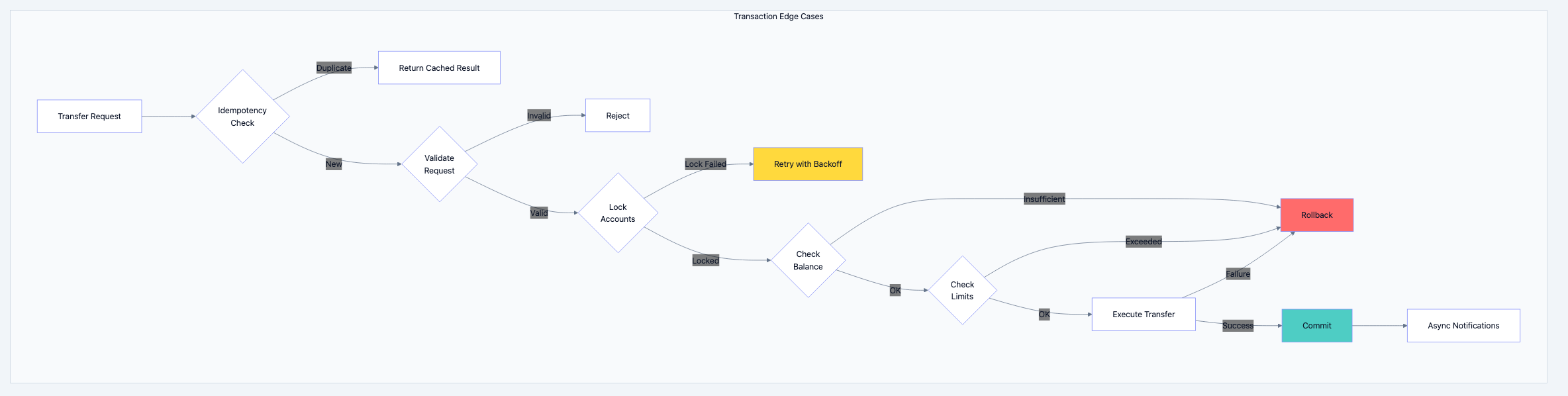
Handling Edge Cases
Banking database diagram 5
Idempotency: Preventing Double Charges
go// idempotency.go
// Critical for preventing duplicate transactions when clients retry

type IdempotencyStore struct {
    redis *redis.Client
    db    *pgxpool.Pool
}

// CheckAndLock atomically checks if request was processed and locks if new
func (s *IdempotencyStore) CheckAndLock(ctx context.Context, key string, ttl time.Duration) (*TransferResult, bool, error) {
    // Use Redis for fast check + lock
    script := `
        local existing = redis.call('GET', KEYS[1])
        if existing then
            return existing
        end
        redis.call('SET', KEYS[1], 'PROCESSING', 'NX', 'EX', ARGV[1])
        return nil
    `

    result, err := s.redis.Eval(ctx, script, []string{key}, int(ttl.Seconds())).Result()
    if err != nil && err != redis.Nil {
        return nil, false, err
    }

    if result != nil && result != "PROCESSING" {
        // Already processed, return cached result
        var cached TransferResult
        if err := json.Unmarshal([]byte(result.(string)), &cached); err != nil {
            return nil, false, err
        }
        return &cached, false, nil
    }

    // New request, lock acquired
    return nil, true, nil
}

// Store saves the result for future duplicate requests
func (s *IdempotencyStore) Store(ctx context.Context, key string, result *TransferResult, ttl time.Duration) error {
    data, err := json.Marshal(result)
    if err != nil {
        return err
    }

    // Store in Redis (fast reads)
    if err := s.redis.Set(ctx, key, data, ttl).Err(); err != nil {
        return err
    }

    // Also persist to database (durability for long-running idempotency)
    query := `
        INSERT INTO idempotency_keys (key, result, created_at, expires_at)
        VALUES ($1, $2, CURRENT_TIMESTAMP, CURRENT_TIMESTAMP + $3::interval)
        ON CONFLICT (key) DO UPDATE SET result = $2
    `
    _, err = s.db.Exec(ctx, query, key, data, ttl.String())
    return err
}
Part 5: Scaling Strategies
Architecture Overview
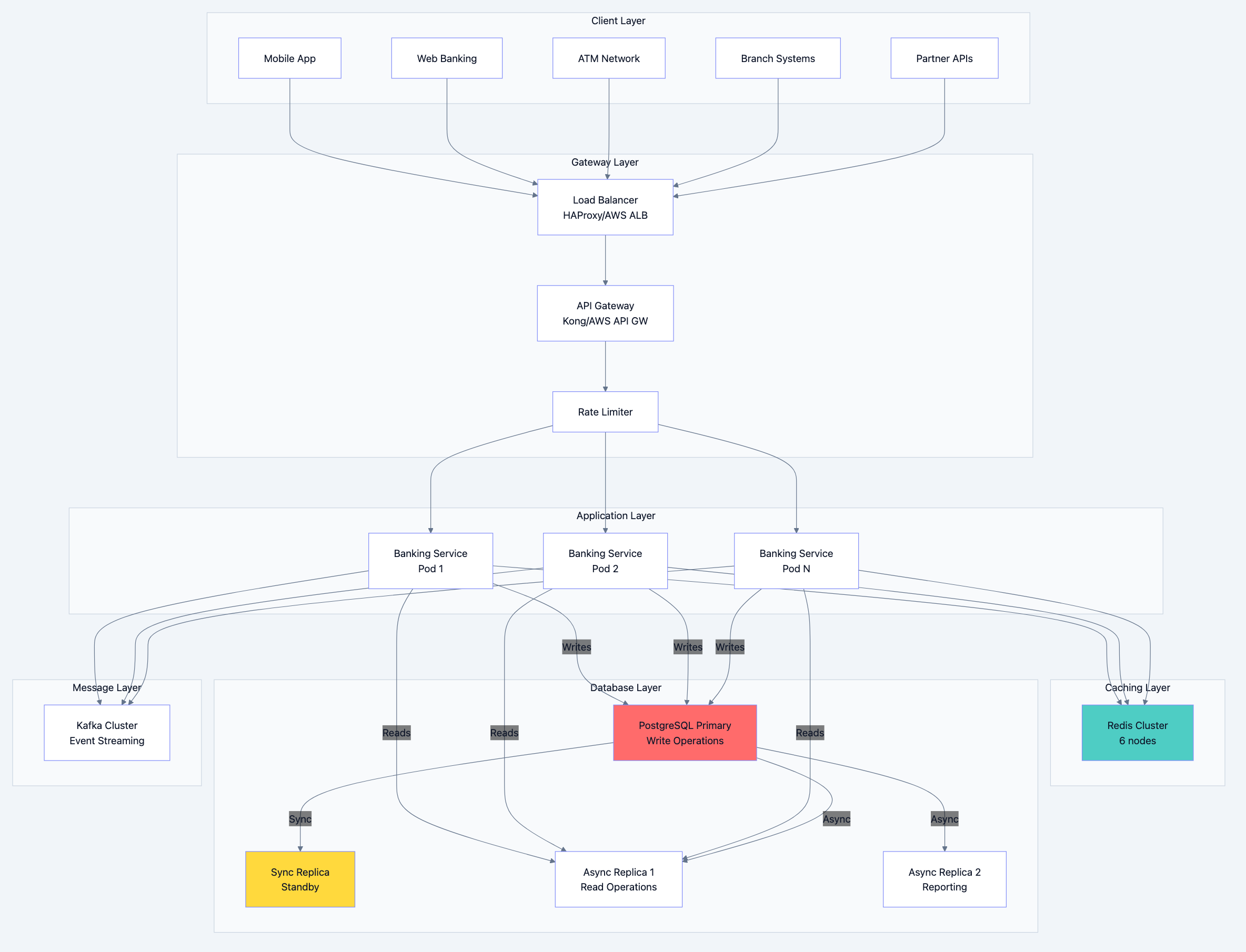
Banking database diagram 6
Read Scaling with Replicas
go// db_router.go
// Routes queries to appropriate database based on operation type

type DBRouter struct {
    primary      *pgxpool.Pool
    readReplicas []*pgxpool.Pool
    current      int32
}

func NewDBRouter(primaryDSN string, replicaDSNs []string) (*DBRouter, error) {
    primary, err := pgxpool.New(context.Background(), primaryDSN)
    if err != nil {
        return nil, err
    }

    replicas := make([]*pgxpool.Pool, len(replicaDSNs))
    for i, dsn := range replicaDSNs {
        replica, err := pgxpool.New(context.Background(), dsn)
        if err != nil {
            return nil, err
        }
        replicas[i] = replica
    }

    return &DBRouter{
        primary:      primary,
        readReplicas: replicas,
    }, nil
}

// Primary returns the primary database for writes
func (r *DBRouter) Primary() *pgxpool.Pool {
    return r.primary
}

// Replica returns a read replica using round-robin
func (r *DBRouter) Replica() *pgxpool.Pool {
    if len(r.readReplicas) == 0 {
        return r.primary
    }

    // Atomic round-robin
    idx := atomic.AddInt32(&r.current, 1)
    return r.readReplicas[int(idx)%len(r.readReplicas)]
}

// ReadAfterWrite returns primary if recent write, otherwise replica
func (r *DBRouter) ReadAfterWrite(ctx context.Context, accountID int64) *pgxpool.Pool {
    // Check if this account had recent write
    key := fmt.Sprintf("recent_write:%d", accountID)
    if exists, _ := redisClient.Exists(ctx, key).Result(); exists > 0 {
        return r.primary  // Read from primary to see own writes
    }
    return r.Replica()
}
Connection Pooling Configuration
go// pool_config.go
// Proper connection pool sizing is critical for performance

func CreateDatabasePool(dsn string, config PoolConfig) (*pgxpool.Pool, error) {
    poolConfig, err := pgxpool.ParseConfig(dsn)
    if err != nil {
        return nil, err
    }

    // Pool sizing
    // Rule of thumb: (core_count * 2) + effective_spindle_count
    // For SSD: core_count * 2-4
    poolConfig.MaxConns = 100  // Maximum connections
    poolConfig.MinConns = 10   // Minimum idle connections

    // Timeouts
    poolConfig.MaxConnLifetime = 1 * time.Hour      // Recycle connections
    poolConfig.MaxConnIdleTime = 30 * time.Minute   // Close idle connections
    poolConfig.HealthCheckPeriod = 1 * time.Minute  // Check connection health

    // Connection timeout
    poolConfig.ConnConfig.ConnectTimeout = 5 * time.Second

    // Statement cache (prepared statements)
    poolConfig.ConnConfig.DefaultQueryExecMode = pgx.QueryExecModeCacheStatement

    return pgxpool.NewWithConfig(context.Background(), poolConfig)
}
Sharding Strategy for Extreme Scale
For a bank a scale, eventually you'll need sharding. Here's the approach:
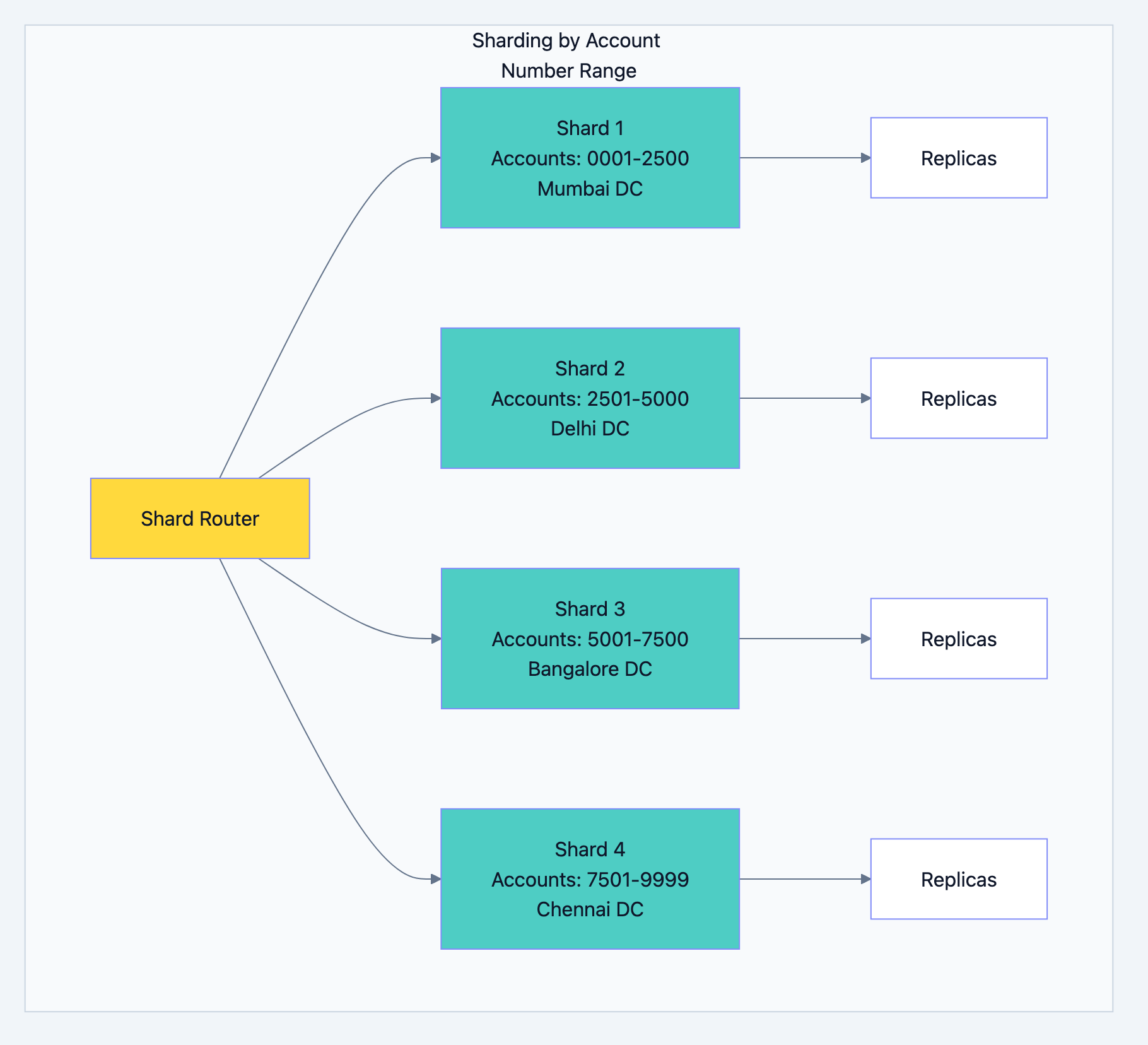
Banking database diagram 7
go// shard_router.go
// Deterministic routing based on account number

type ShardRouter struct {
    shards map[int]*pgxpool.Pool  // shard_id -> connection pool
    config ShardConfig
}

type ShardConfig struct {
    Ranges []ShardRange
}

type ShardRange struct {
    ShardID   int
    StartAcc  string
    EndAcc    string
    DSN       string
}

// GetShardForAccount determines which shard an account belongs to
func (r *ShardRouter) GetShardForAccount(accountNumber string) (*pgxpool.Pool, error) {
    for _, rang := range r.config.Ranges {
        if accountNumber >= rang.StartAcc && accountNumber <= rang.EndAcc {
            return r.shards[rang.ShardID], nil
        }
    }
    return nil, fmt.Errorf("no shard found for account: %s", accountNumber)
}

// Cross-shard transfer requires distributed transaction
func (r *ShardRouter) CrossShardTransfer(ctx context.Context, req TransferRequest) (*TransferResult, error) {
    fromShard, _ := r.GetShardForAccount(req.FromAccountNumber)
    toShard, _ := r.GetShardForAccount(req.ToAccountNumber)

    if fromShard == toShard {
        // Same shard - normal transaction
        return r.singleShardTransfer(ctx, fromShard, req)
    }

    // Different shards - use Saga pattern
    return r.crossShardSagaTransfer(ctx, fromShard, toShard, req)
}

// Saga pattern for cross-shard transfers
func (r *ShardRouter) crossShardSagaTransfer(ctx context.Context, fromShard, toShard *pgxpool.Pool, req TransferRequest) (*TransferResult, error) {
    txnRef := uuid.New().String()

    // Step 1: Hold funds in source account
    holdID, err := r.holdFunds(ctx, fromShard, req.FromAccountNumber, req.Amount, txnRef)
    if err != nil {
        return nil, err
    }

    // Step 2: Credit destination account
    err = r.creditAccount(ctx, toShard, req.ToAccountNumber, req.Amount, txnRef)
    if err != nil {
        // Compensate: Release hold
        r.releaseHold(ctx, fromShard, holdID)
        return nil, err
    }

    // Step 3: Confirm debit (release hold and deduct)
    err = r.confirmDebit(ctx, fromShard, holdID, req.FromAccountNumber, req.Amount, txnRef)
    if err != nil {
        // Compensate: Reverse credit
        r.reverseCredit(ctx, toShard, req.ToAccountNumber, req.Amount, txnRef)
        r.releaseHold(ctx, fromShard, holdID)
        return nil, err
    }

    return &TransferResult{
        TransactionRef: txnRef,
        ProcessedAt:    time.Now(),
    }, nil
}
Caching Strategy
go// cache_strategy.go
// Multi-level caching for banking operations

type BankingCache struct {
    local  *sync.Map           // L1: In-process cache (hot data)
    redis  *redis.ClusterClient // L2: Distributed cache
}

// GetBalance with multi-level caching
func (c *BankingCache) GetBalance(ctx context.Context, accountID int64) (*BalanceInfo, error) {
    key := fmt.Sprintf("balance:%d", accountID)

    // L1: Check local cache (microseconds)
    if cached, ok := c.local.Load(key); ok {
        entry := cached.(*CacheEntry)
        if time.Since(entry.CachedAt) < 100*time.Millisecond {
            return entry.Data.(*BalanceInfo), nil
        }
    }

    // L2: Check Redis (milliseconds)
    data, err := c.redis.Get(ctx, key).Bytes()
    if err == nil {
        var balance BalanceInfo
        json.Unmarshal(data, &balance)

        // Populate L1
        c.local.Store(key, &CacheEntry{
            Data:     &balance,
            CachedAt: time.Now(),
        })

        return &balance, nil
    }

    // Cache miss: Query database
    balance, err := c.queryBalanceFromDB(ctx, accountID)
    if err != nil {
        return nil, err
    }

    // Populate both caches
    data, _ = json.Marshal(balance)
    c.redis.Set(ctx, key, data, 5*time.Minute)
    c.local.Store(key, &CacheEntry{
        Data:     balance,
        CachedAt: time.Now(),
    })

    return balance, nil
}

// InvalidateBalance removes balance from all cache levels
func (c *BankingCache) InvalidateBalance(ctx context.Context, accountID int64) {
    key := fmt.Sprintf("balance:%d", accountID)
    c.local.Delete(key)
    c.redis.Del(ctx, key)

    // Publish invalidation to other nodes
    c.redis.Publish(ctx, "cache_invalidation", key)
}
Part 6: High Availability & Disaster Recovery
Multi-Region Architecture
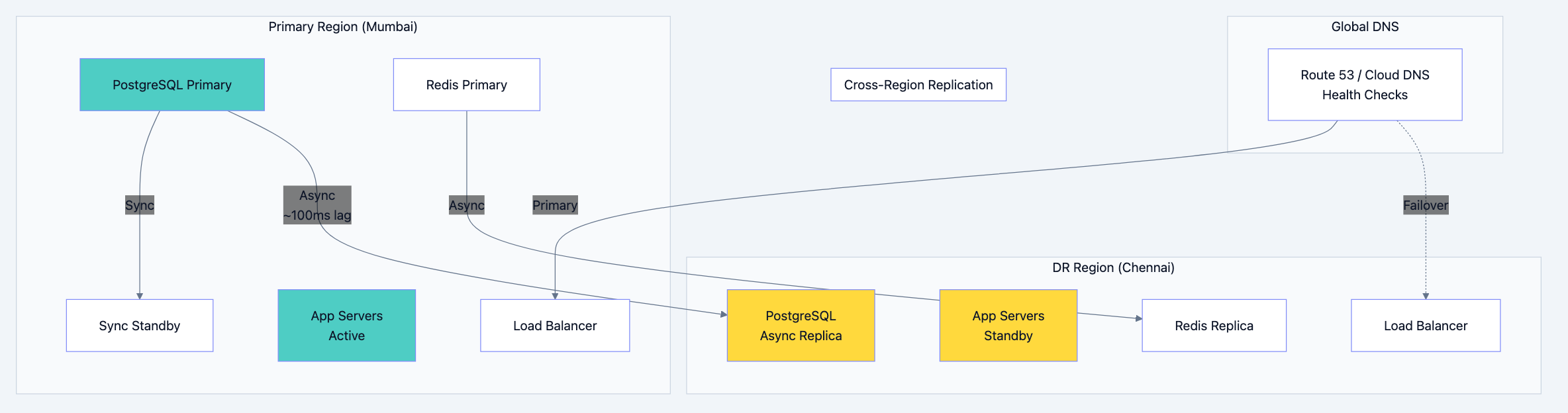
Banking database diagram 8
PostgreSQL High Availability
yaml# patroni.yml
# Patroni manages PostgreSQL HA with automatic failover

scope: banking-cluster
namespace: /banking/
name: pg-node-1

restapi:
  listen: 0.0.0.0:8008
  connect_address: pg-node-1:8008

etcd3:
  hosts:
    - etcd-1:2379
    - etcd-2:2379
    - etcd-3:2379

bootstrap:
  dcs:
    ttl: 30
    loop_wait: 10
    retry_timeout: 10
    maximum_lag_on_failover: 1048576  # 1MB - don't promote if more lag
    synchronous_mode: true            # Sync replication for zero data loss
    synchronous_mode_strict: true

  postgresql:
    use_pg_rewind: true
    parameters:
      max_connections: 200
      shared_buffers: 8GB
      effective_cache_size: 24GB
      maintenance_work_mem: 2GB
      checkpoint_completion_target: 0.9
      wal_buffers: 64MB
      default_statistics_target: 100
      random_page_cost: 1.1
      effective_io_concurrency: 200
      work_mem: 20MB
      min_wal_size: 2GB
      max_wal_size: 8GB
      max_worker_processes: 8
      max_parallel_workers_per_gather: 4
      max_parallel_workers: 8
      max_parallel_maintenance_workers: 4

      # Replication
      wal_level: replica
      hot_standby: "on"
      max_wal_senders: 10
      max_replication_slots: 10
      hot_standby_feedback: "on"

      # Logging
      log_checkpoints: "on"
      log_connections: "on"
      log_disconnections: "on"
      log_lock_waits: "on"
      log_temp_files: 0
      log_autovacuum_min_duration: 0
      log_statement: ddl

postgresql:
  listen: 0.0.0.0:5432
  connect_address: pg-node-1:5432
  data_dir: /var/lib/postgresql/data

  authentication:
    replication:
      username: replicator
      password: secret
    superuser:
      username: postgres
      password: secret
    rewind:
      username: rewind
      password: secret
Automated Failover Process
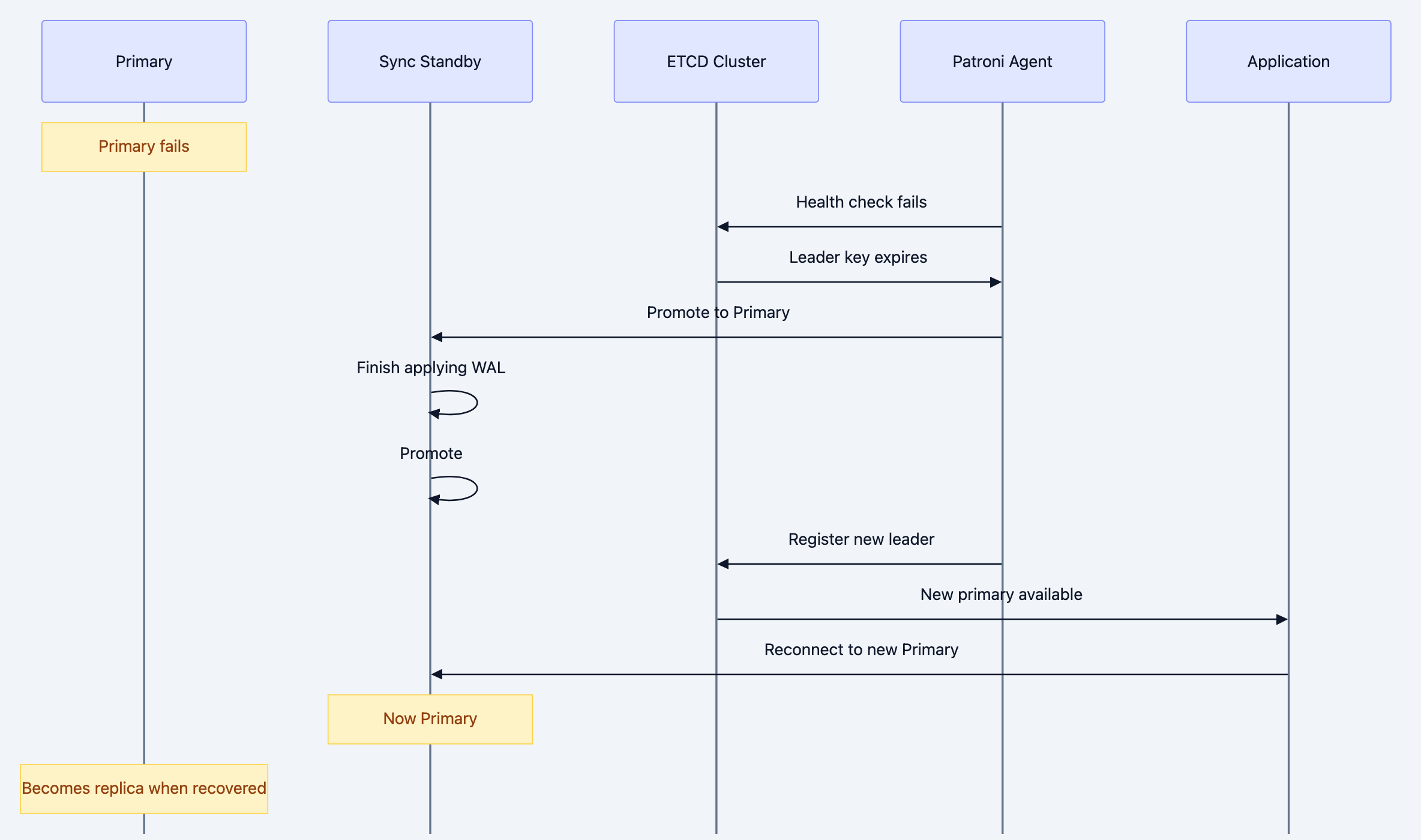
Banking database diagram 9
Backup Strategy
bash#!/bin/bash
# backup_strategy.sh
# Multi-tier backup approach for banking data

# ============================================
# TIER 1: Continuous WAL Archiving (RPO: ~0)
# ============================================
# postgresql.conf
# archive_mode = on
# archive_command = 'pgbackrest --stanza=banking archive-push %p'

# ============================================
# TIER 2: Daily Full Backups
# ============================================
backup_full() {
    DATE=$(date +%Y%m%d)

    # Use pgBackRest for efficient backups
    pgbackrest --stanza=banking \
        --type=full \
        --compress-type=zst \
        --compress-level=6 \
        backup

    # Upload to S3 Glacier for long-term retention
    aws s3 cp /var/lib/pgbackrest/backup/banking/$DATE \
        s3://bank-backups/banking/full/$DATE/ \
        --storage-class GLACIER
}

# ============================================
# TIER 3: Hourly Incremental Backups
# ============================================
backup_incremental() {
    pgbackrest --stanza=banking \
        --type=incr \
        backup
}

# ============================================
# TIER 4: Cross-Region Backup Replication
# ============================================
replicate_to_dr() {
    # Sync to DR region
    aws s3 sync s3://bank-backups/banking/ \
        s3://bank-backups-dr/banking/ \
        --source-region ap-south-1 \
        --region ap-southeast-1
}

# ============================================
# Point-in-Time Recovery
# ============================================
restore_to_point() {
    TARGET_TIME=$1  # e.g., "2024-01-15 14:30:00"

    # Stop PostgreSQL
    systemctl stop postgresql

    # Restore to specific point in time
    pgbackrest --stanza=banking \
        --type=time \
        --target="$TARGET_TIME" \
        --target-action=promote \
        restore

    # Start PostgreSQL
    systemctl start postgresql
}
Recovery Time Objectives
| Scenario | RTO | RPO | Approach |
|---|---|---|---|
| Server crash | < 30 seconds | 0 | Automatic failover to sync standby |
| Data center failure | < 5 minutes | < 1 second | Failover to DR region |
| Data corruption | < 4 hours | Point-in-time | Restore from backup |
| Regional disaster | < 4 hours | < 5 minutes | DR activation |
| Complete rebuild | < 24 hours | Last backup | Full restore |
Part 7: Security & Compliance
Data Security Architecture

Banking database diagram 10
Encryption Implementation
go// encryption.go
// Field-level encryption for sensitive data

import (
    "crypto/aes"
    "crypto/cipher"
    "crypto/rand"
    "encoding/base64"
    "io"
)

type FieldEncryptor struct {
    key []byte  // 256-bit key from HSM
}

// Encrypt sensitive field (PAN, Aadhaar, etc.)
func (e *FieldEncryptor) Encrypt(plaintext string) (string, error) {
    block, err := aes.NewCipher(e.key)
    if err != nil {
        return "", err
    }

    gcm, err := cipher.NewGCM(block)
    if err != nil {
        return "", err
    }

    nonce := make([]byte, gcm.NonceSize())
    if _, err := io.ReadFull(rand.Reader, nonce); err != nil {
        return "", err
    }

    ciphertext := gcm.Seal(nonce, nonce, []byte(plaintext), nil)
    return base64.StdEncoding.EncodeToString(ciphertext), nil
}

// Decrypt sensitive field
func (e *FieldEncryptor) Decrypt(encrypted string) (string, error) {
    ciphertext, err := base64.StdEncoding.DecodeString(encrypted)
    if err != nil {
        return "", err
    }

    block, err := aes.NewCipher(e.key)
    if err != nil {
        return "", err
    }

    gcm, err := cipher.NewGCM(block)
    if err != nil {
        return "", err
    }

    nonceSize := gcm.NonceSize()
    nonce, ciphertext := ciphertext[:nonceSize], ciphertext[nonceSize:]

    plaintext, err := gcm.Open(nil, nonce, ciphertext, nil)
    if err != nil {
        return "", err
    }

    return string(plaintext), nil
}

// Database column encryption using PostgreSQL pgcrypto
const createEncryptedColumn = `
    -- Create encrypted column
    ALTER TABLE customers ADD COLUMN pan_encrypted BYTEA;

    -- Encrypt existing data
    UPDATE customers
    SET pan_encrypted = pgp_sym_encrypt(pan_number, $1)
    WHERE pan_number IS NOT NULL;

    -- Drop plaintext column
    ALTER TABLE customers DROP COLUMN pan_number;
`
Audit Trail Implementation
sql-- audit_trigger.sql
-- Automatic audit logging for all data changes

CREATE OR REPLACE FUNCTION audit_trigger_function()
RETURNS TRIGGER AS $$
DECLARE
    audit_row audit_logs;
    changed_fields TEXT[];
BEGIN
    audit_row.table_name = TG_TABLE_NAME;
    audit_row.user_id = current_setting('app.current_user_id', true)::BIGINT;
    audit_row.user_type = current_setting('app.current_user_type', true);
    audit_row.ip_address = current_setting('app.client_ip', true)::INET;
    audit_row.session_id = current_setting('app.session_id', true);
    audit_row.created_at = CURRENT_TIMESTAMP;

    IF TG_OP = 'INSERT' THEN
        audit_row.operation = 'I';
        audit_row.record_id = NEW.id;
        audit_row.new_values = to_jsonb(NEW);
        audit_row.old_values = NULL;
    ELSIF TG_OP = 'UPDATE' THEN
        audit_row.operation = 'U';
        audit_row.record_id = NEW.id;
        audit_row.old_values = to_jsonb(OLD);
        audit_row.new_values = to_jsonb(NEW);

        -- Track which fields changed
        SELECT array_agg(key) INTO changed_fields
        FROM jsonb_each(to_jsonb(NEW))
        WHERE to_jsonb(NEW) -> key != to_jsonb(OLD) -> key;

        audit_row.changed_fields = changed_fields;
    ELSIF TG_OP = 'DELETE' THEN
        audit_row.operation = 'D';
        audit_row.record_id = OLD.id;
        audit_row.old_values = to_jsonb(OLD);
        audit_row.new_values = NULL;
    END IF;

    INSERT INTO audit_logs VALUES (audit_row.*);
    RETURN NULL;
END;
$$ LANGUAGE plpgsql;

-- Apply to critical tables
CREATE TRIGGER audit_customers
    AFTER INSERT OR UPDATE OR DELETE ON customers
    FOR EACH ROW EXECUTE FUNCTION audit_trigger_function();

CREATE TRIGGER audit_accounts
    AFTER INSERT OR UPDATE OR DELETE ON accounts
    FOR EACH ROW EXECUTE FUNCTION audit_trigger_function();

CREATE TRIGGER audit_transactions
    AFTER INSERT ON transactions
    FOR EACH ROW EXECUTE FUNCTION audit_trigger_function();
Access Control Matrix
sql-- roles_and_permissions.sql
-- Role-based access control for banking operations

-- Create roles
CREATE ROLE banking_readonly;
CREATE ROLE banking_teller;
CREATE ROLE banking_officer;
CREATE ROLE banking_manager;
CREATE ROLE banking_admin;

-- Read-only role (customer service)
GRANT SELECT ON customers, accounts, transactions TO banking_readonly;
REVOKE ALL ON audit_logs FROM banking_readonly;

-- Teller role (branch operations)
GRANT banking_readonly TO banking_teller;
GRANT INSERT ON transactions TO banking_teller;
GRANT UPDATE (balance, available_balance, hold_amount) ON accounts TO banking_teller;
-- Limit: Can only process transactions up to 50,000

-- Officer role (approvals)
GRANT banking_teller TO banking_officer;
GRANT UPDATE ON transactions TO banking_officer;
-- Can approve transactions up to 500,000

-- Manager role (branch manager)
GRANT banking_officer TO banking_manager;
GRANT INSERT, UPDATE ON customers TO banking_manager;
GRANT INSERT, UPDATE ON accounts TO banking_manager;
-- Can approve any transaction

-- Admin role (IT admin)
GRANT ALL ON ALL TABLES IN SCHEMA public TO banking_admin;
-- But restricted by application-level controls

-- Row-level security for branch isolation
ALTER TABLE customers ENABLE ROW LEVEL SECURITY;

CREATE POLICY branch_isolation ON customers
    USING (
        branch_id = current_setting('app.user_branch_id')::INT
        OR current_setting('app.user_role') = 'admin'
    );
Part 8: Monitoring & Observability
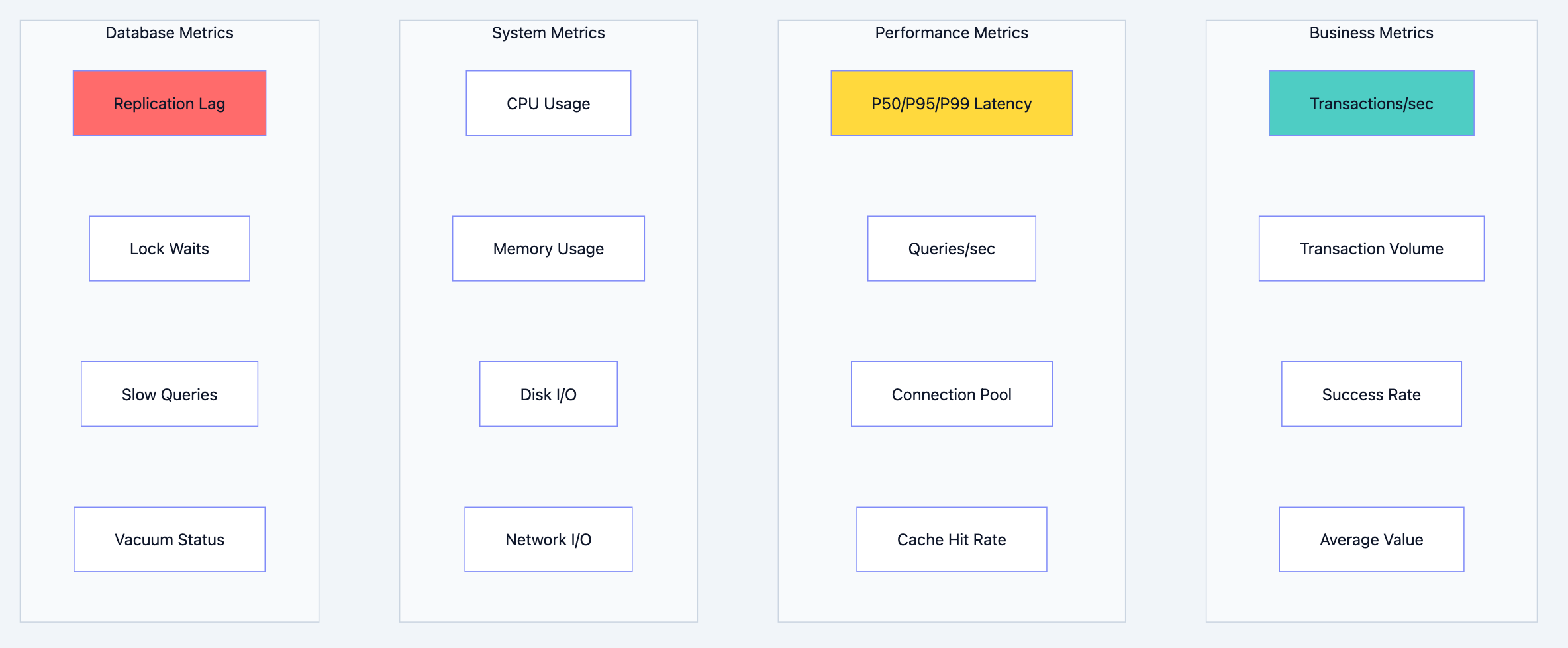
Key Metrics Dashboard
Banking database diagram 11
Monitoring Implementation
go// metrics.go
// Prometheus metrics for banking operations

import (
    "github.com/prometheus/client_golang/prometheus"
    "github.com/prometheus/client_golang/prometheus/promauto"
)

var (
    // Transaction metrics
    transactionTotal = promauto.NewCounterVec(
        prometheus.CounterOpts{
            Name: "banking_transactions_total",
            Help: "Total number of transactions processed",
        },
        []string{"type", "channel", "status"},
    )

    transactionDuration = promauto.NewHistogramVec(
        prometheus.HistogramOpts{
            Name:    "banking_transaction_duration_seconds",
            Help:    "Transaction processing duration",
            Buckets: []float64{0.01, 0.025, 0.05, 0.1, 0.25, 0.5, 1, 2.5, 5},
        },
        []string{"type"},
    )

    transactionAmount = promauto.NewHistogramVec(
        prometheus.HistogramOpts{
            Name:    "banking_transaction_amount",
            Help:    "Transaction amount distribution",
            Buckets: []float64{100, 500, 1000, 5000, 10000, 50000, 100000, 500000, 1000000},
        },
        []string{"type", "direction"},
    )

    // Account metrics
    activeAccounts = promauto.NewGauge(
        prometheus.GaugeOpts{
            Name: "banking_active_accounts",
            Help: "Number of active accounts",
        },
    )

    // Database metrics
    dbPoolSize = promauto.NewGaugeVec(
        prometheus.GaugeOpts{
            Name: "banking_db_pool_connections",
            Help: "Database connection pool status",
        },
        []string{"state"},  // idle, in_use, waiting
    )

    replicationLag = promauto.NewGauge(
        prometheus.GaugeOpts{
            Name: "banking_db_replication_lag_bytes",
            Help: "Replication lag in bytes",
        },
    )

    // Cache metrics
    cacheHits = promauto.NewCounterVec(
        prometheus.CounterOpts{
            Name: "banking_cache_hits_total",
            Help: "Cache hits",
        },
        []string{"cache_type"},
    )

    cacheMisses = promauto.NewCounterVec(
        prometheus.CounterOpts{
            Name: "banking_cache_misses_total",
            Help: "Cache misses",
        },
        []string{"cache_type"},
    )
)

// RecordTransaction records metrics for a transaction
func RecordTransaction(txnType, channel, status string, duration time.Duration, amount float64, direction string) {
    transactionTotal.WithLabelValues(txnType, channel, status).Inc()
    transactionDuration.WithLabelValues(txnType).Observe(duration.Seconds())
    transactionAmount.WithLabelValues(txnType, direction).Observe(amount)
}
Alert Rules
yaml# alerts.yml
# Prometheus alerting rules for banking system

groups:
  - name: banking_critical
    rules:
      # Transaction failures
      - alert: HighTransactionFailureRate
        expr: |
          sum(rate(banking_transactions_total{status="failed"}[5m])) /
          sum(rate(banking_transactions_total[5m])) > 0.01
        for: 2m
        labels:
          severity: critical
        annotations:
          summary: "Transaction failure rate above 1%"
          description: "{{ $value | humanizePercentage }} of transactions failing"

      # Latency
      - alert: HighTransactionLatency
        expr: |
          histogram_quantile(0.99, rate(banking_transaction_duration_seconds_bucket[5m])) > 2
        for: 5m
        labels:
          severity: critical
        annotations:
          summary: "P99 transaction latency above 2 seconds"

      # Replication lag
      - alert: HighReplicationLag
        expr: banking_db_replication_lag_bytes > 10485760  # 10MB
        for: 1m
        labels:
          severity: critical
        annotations:
          summary: "Database replication lag above 10MB"

      # Connection pool exhaustion
      - alert: ConnectionPoolExhaustion
        expr: |
          banking_db_pool_connections{state="waiting"} > 10
        for: 1m
        labels:
          severity: warning
        annotations:
          summary: "Database connection pool has waiting requests"

  - name: banking_business
    rules:
      # Unusual transaction volume
      - alert: UnusualTransactionVolume
        expr: |
          abs(sum(rate(banking_transactions_total[1h])) -
              sum(rate(banking_transactions_total[1h] offset 1d))) /
          sum(rate(banking_transactions_total[1h] offset 1d)) > 0.5
        for: 30m
        labels:
          severity: warning
        annotations:
          summary: "Transaction volume differs >50% from same time yesterday"

      # Large transaction spike
      - alert: LargeTransactionSpike
        expr: |
          sum(rate(banking_transactions_total{amount_bucket="+Inf"}[5m])) >
          2 * sum(rate(banking_transactions_total{amount_bucket="+Inf"}[5m] offset 1h))
        for: 10m
        labels:
          severity: info
        annotations:
          summary: "Large transaction volume spike detected"
Part 9: Performance Optimization
Query Optimization
sql-- slow_query_analysis.sql
-- Find and optimize slow queries

-- Enable slow query logging
ALTER SYSTEM SET log_min_duration_statement = 100;  -- Log queries > 100ms
ALTER SYSTEM SET auto_explain.log_min_duration = 100;
ALTER SYSTEM SET auto_explain.log_analyze = true;
SELECT pg_reload_conf();

-- Find worst performing queries
SELECT
    substring(query, 1, 100) as query_preview,
    calls,
    total_exec_time / 1000 as total_seconds,
    mean_exec_time as avg_ms,
    stddev_exec_time as stddev_ms,
    rows,
    shared_blks_hit + shared_blks_read as total_blocks,
    100.0 * shared_blks_hit / NULLIF(shared_blks_hit + shared_blks_read, 0) as cache_hit_pct
FROM pg_stat_statements
ORDER BY total_exec_time DESC
LIMIT 20;

-- Find queries with poor cache hit ratio
SELECT
    substring(query, 1, 100),
    100.0 * shared_blks_hit / NULLIF(shared_blks_hit + shared_blks_read, 0) as cache_hit_pct,
    calls
FROM pg_stat_statements
WHERE calls > 1000
AND shared_blks_hit + shared_blks_read > 0
ORDER BY cache_hit_pct
LIMIT 20;

-- Identify missing indexes
SELECT
    schemaname,
    relname as table_name,
    seq_scan,
    seq_tup_read,
    idx_scan,
    idx_tup_fetch,
    n_live_tup,
    round(100.0 * idx_scan / NULLIF(seq_scan + idx_scan, 0), 2) as idx_scan_pct
FROM pg_stat_user_tables
WHERE seq_scan > 100
ORDER BY seq_tup_read DESC
LIMIT 20;

-- Unused indexes (candidates for removal)
SELECT
    schemaname,
    relname as table_name,
    indexrelname as index_name,
    idx_scan,
    pg_size_pretty(pg_relation_size(indexrelid)) as index_size
FROM pg_stat_user_indexes
WHERE idx_scan = 0
AND indexrelname NOT LIKE '%_pkey'
ORDER BY pg_relation_size(indexrelid) DESC;
Index Strategy for Banking Tables
sql-- banking_indexes.sql
-- Optimized index strategy for banking workload

-- ============================================
-- ACCOUNTS TABLE INDEXES
-- ============================================

-- Primary lookup by account number
CREATE UNIQUE INDEX CONCURRENTLY idx_accounts_number_lookup
ON accounts(account_number)
WHERE status != 'CLOSED';

-- Customer's accounts list
CREATE INDEX CONCURRENTLY idx_accounts_customer_status
ON accounts(customer_id, status)
INCLUDE (account_number, account_type_id, balance)
WHERE status = 'ACTIVE';

-- Branch reporting
CREATE INDEX CONCURRENTLY idx_accounts_branch_type
ON accounts(branch_id, account_type_id)
WHERE status = 'ACTIVE';

-- ============================================
-- TRANSACTIONS TABLE INDEXES
-- ============================================

-- Customer statement query (most common)
-- Query: Get transactions for account, ordered by date, limit 50
CREATE INDEX CONCURRENTLY idx_txn_statement
ON transactions(account_id, created_at DESC)
INCLUDE (transaction_ref, amount, direction, balance_after, description, status);

-- Reference number lookup (for support queries)
CREATE INDEX CONCURRENTLY idx_txn_reference
ON transactions(reference_number)
WHERE reference_number IS NOT NULL;

-- Pending transactions (for processing queue)
CREATE INDEX CONCURRENTLY idx_txn_pending
ON transactions(status, created_at)
WHERE status IN ('PENDING', 'PROCESSING');

-- Daily totals for limit checking
CREATE INDEX CONCURRENTLY idx_txn_daily_totals
ON transactions(account_id, created_at::date, direction)
WHERE status = 'COMPLETED';

-- ============================================
-- PARTIAL INDEXES FOR HOT DATA
-- ============================================

-- Recent transactions (last 30 days) - frequently accessed
CREATE INDEX CONCURRENTLY idx_txn_recent
ON transactions(account_id, created_at DESC)
WHERE created_at > CURRENT_DATE - INTERVAL '30 days';

-- Active accounts only
CREATE INDEX CONCURRENTLY idx_accounts_active
ON accounts(account_id)
INCLUDE (balance, available_balance)
WHERE status = 'ACTIVE';

-- ============================================
-- BRIN INDEXES FOR TIME-SERIES DATA
-- ============================================

-- Efficient for time-range queries on partitioned data
CREATE INDEX CONCURRENTLY idx_txn_brin_created
ON transactions USING BRIN (created_at);
Connection Pool Optimization
go// connection_optimization.go
// Fine-tuned connection pool for banking workload

func OptimizedPoolConfig() *pgxpool.Config {
    config, _ := pgxpool.ParseConfig(os.Getenv("DATABASE_URL"))

    // Pool sizing based on workload analysis
    // Formula: connections = (core_count * 2) + effective_spindle_count
    // For SSDs: ~2-4x core count
    config.MaxConns = 50  // For 16-core server with SSD
    config.MinConns = 10  // Keep minimum ready

    // Connection lifecycle
    config.MaxConnLifetime = 30 * time.Minute     // Recycle before stale
    config.MaxConnIdleTime = 5 * time.Minute      // Release unused quickly
    config.HealthCheckPeriod = 30 * time.Second   // Detect failures

    // Query execution
    config.ConnConfig.DefaultQueryExecMode = pgx.QueryExecModeCacheStatement

    // Timeouts
    config.ConnConfig.ConnectTimeout = 5 * time.Second

    // After connect hook - set session parameters
    config.AfterConnect = func(ctx context.Context, conn *pgx.Conn) error {
        // Set work_mem for complex queries
        _, err := conn.Exec(ctx, "SET work_mem = '256MB'")
        if err != nil {
            return err
        }

        // Set statement timeout to prevent runaway queries
        _, err = conn.Exec(ctx, "SET statement_timeout = '30s'")
        return err
    }

    return config
}
Part 10: Testing Strategy
Transaction Testing
go// transaction_test.go
// Comprehensive tests for banking transactions

func TestTransferBasic(t *testing.T) {
    ctx := context.Background()
    service := setupTestService(t)

    // Create test accounts
    fromAccount := createTestAccount(t, 10000.00)
    toAccount := createTestAccount(t, 5000.00)

    // Execute transfer
    result, err := service.Transfer(ctx, TransferRequest{
        FromAccountID:  fromAccount.AccountID,
        ToAccountID:    toAccount.AccountID,
        Amount:         1000.00,
        IdempotencyKey: uuid.New().String(),
    })

    require.NoError(t, err)
    assert.Equal(t, 9000.00, result.FromBalance)
    assert.Equal(t, 6000.00, result.ToBalance)

    // Verify database state
    verifyAccountBalance(t, fromAccount.AccountID, 9000.00)
    verifyAccountBalance(t, toAccount.AccountID, 6000.00)

    // Verify transaction records
    verifyTransactionPair(t, result.TransactionRef, 1000.00)

    // Verify ledger entries balance
    verifyLedgerBalance(t, result.TransactionRef)
}

func TestTransferInsufficientBalance(t *testing.T) {
    ctx := context.Background()
    service := setupTestService(t)

    fromAccount := createTestAccount(t, 500.00)
    toAccount := createTestAccount(t, 5000.00)

    _, err := service.Transfer(ctx, TransferRequest{
        FromAccountID:  fromAccount.AccountID,
        ToAccountID:    toAccount.AccountID,
        Amount:         1000.00,
        IdempotencyKey: uuid.New().String(),
    })

    assert.ErrorIs(t, err, ErrInsufficientBalance)

    // Verify no changes
    verifyAccountBalance(t, fromAccount.AccountID, 500.00)
    verifyAccountBalance(t, toAccount.AccountID, 5000.00)
}

func TestTransferIdempotency(t *testing.T) {
    ctx := context.Background()
    service := setupTestService(t)

    fromAccount := createTestAccount(t, 10000.00)
    toAccount := createTestAccount(t, 5000.00)

    idempotencyKey := uuid.New().String()

    // First request
    result1, err := service.Transfer(ctx, TransferRequest{
        FromAccountID:  fromAccount.AccountID,
        ToAccountID:    toAccount.AccountID,
        Amount:         1000.00,
        IdempotencyKey: idempotencyKey,
    })
    require.NoError(t, err)

    // Duplicate request with same idempotency key
    result2, err := service.Transfer(ctx, TransferRequest{
        FromAccountID:  fromAccount.AccountID,
        ToAccountID:    toAccount.AccountID,
        Amount:         1000.00,
        IdempotencyKey: idempotencyKey,
    })
    require.NoError(t, err)

    // Should return same result, not process twice
    assert.Equal(t, result1.TransactionRef, result2.TransactionRef)

    // Balance should only be debited once
    verifyAccountBalance(t, fromAccount.AccountID, 9000.00)
}

func TestTransferConcurrentDeadlockPrevention(t *testing.T) {
    ctx := context.Background()
    service := setupTestService(t)

    accountA := createTestAccount(t, 10000.00)
    accountB := createTestAccount(t, 10000.00)

    var wg sync.WaitGroup
    wg.Add(2)

    var err1, err2 error

    // Concurrent transfers in opposite directions
    go func() {
        defer wg.Done()
        _, err1 = service.Transfer(ctx, TransferRequest{
            FromAccountID:  accountA.AccountID,
            ToAccountID:    accountB.AccountID,
            Amount:         100.00,
            IdempotencyKey: uuid.New().String(),
        })
    }()

    go func() {
        defer wg.Done()
        _, err2 = service.Transfer(ctx, TransferRequest{
            FromAccountID:  accountB.AccountID,
            ToAccountID:    accountA.AccountID,
            Amount:         100.00,
            IdempotencyKey: uuid.New().String(),
        })
    }()

    wg.Wait()

    // Both should succeed (no deadlock)
    require.NoError(t, err1)
    require.NoError(t, err2)

    // Balances should be consistent
    balanceA := getAccountBalance(t, accountA.AccountID)
    balanceB := getAccountBalance(t, accountB.AccountID)
    assert.Equal(t, 20000.00, balanceA+balanceB)  // Total unchanged
}

func TestTransferUnderLoad(t *testing.T) {
    if testing.Short() {
        t.Skip("Skipping load test in short mode")
    }

    ctx := context.Background()
    service := setupTestService(t)

    // Create 100 accounts
    accounts := make([]*Account, 100)
    for i := 0; i < 100; i++ {
        accounts[i] = createTestAccount(t, 10000.00)
    }

    // Run 1000 concurrent transfers
    var wg sync.WaitGroup
    errors := make(chan error, 1000)

    for i := 0; i < 1000; i++ {
        wg.Add(1)
        go func(i int) {
            defer wg.Done()

            from := accounts[rand.Intn(100)]
            to := accounts[rand.Intn(100)]
            if from.AccountID == to.AccountID {
                return
            }

            _, err := service.Transfer(ctx, TransferRequest{
                FromAccountID:  from.AccountID,
                ToAccountID:    to.AccountID,
                Amount:         1.00,
                IdempotencyKey: uuid.New().String(),
            })
            if err != nil && !errors.Is(err, ErrInsufficientBalance) {
                errors <- err
            }
        }(i)
    }

    wg.Wait()
    close(errors)

    // Check for unexpected errors
    for err := range errors {
        t.Errorf("Unexpected error: %v", err)
    }

    // Verify total balance unchanged
    totalBalance := 0.0
    for _, acc := range accounts {
        totalBalance += getAccountBalance(t, acc.AccountID)
    }
    assert.Equal(t, 1000000.00, totalBalance)  // 100 accounts * 10000
}
Summary: The Banking Database Checklist
Design Principles
- ACID is non-negotiable - Every transaction must be atomic, consistent, isolated, durable
- Double-entry bookkeeping - Every money movement has two sides
- Immutable audit trail - Every change is logged, nothing is truly deleted
- Defense in depth - Multiple layers of security and validation
Technology Stack
| Layer | Technology | Why |
|---|---|---|
| Primary DB | PostgreSQL / Oracle | ACID, mature, proven |
| Caching | Redis Cluster | Sub-ms reads, atomic operations |
| Messaging | Kafka | Durable, ordered, replayable events |
| Analytics | ClickHouse | Fast aggregations on historical data |
| Search | Elasticsearch | Customer name search, fuzzy matching |
Scaling Strategy
- Read replicas first - Most banking is read-heavy
- Connection pooling - PgBouncer or application-level
- Caching aggressively - Balance lookups, customer data
- Partitioning - Transactions by date
- Sharding - Only when other options exhausted
High Availability
- RPO: Near zero - Synchronous replication
- RTO: < 30 seconds - Automatic failover
- Multi-region DR - Async replication to DR site
- Daily backups - Point-in-time recovery capability
Security
- Encryption at rest - AES-256 for all data
- Encryption in transit - TLS 1.3 everywhere
- Field-level encryption - PAN, Aadhaar, etc.
- Row-level security - Branch isolation
- Audit everything - Complete trail for regulators
Monitoring
- Transaction success rate - Alert if < 99.9%
- P99 latency - Alert if > 2 seconds
- Replication lag - Alert if > 1 second
- Connection pool - Alert if waiting > 0
This is how you design a database that handles millions of transactions, never loses money, and lets people sleep at night.