gRPC: High-Performance RPC Framework
Why This Matters
Imagine you're building a microservices architecture with 50+ services talking to each other. Using REST APIs with JSON, you face:
- Latency: JSON parsing overhead on every request
- Contract drift: No enforced schema, breaking changes slip through
- Boilerplate: Hand-writing client libraries for every language
- Bandwidth: Verbose JSON payloads consuming network resources
Now imagine a world where:
- Services communicate 10x faster with binary serialization
- Your API contract is code-generated in 10+ languages automatically
- Type safety is enforced at compile time, catching bugs before production
- Bi-directional streaming is built-in for real-time features
This is gRPC Google's high-performance RPC framework that powers their internal microservices (handling 10 billion requests per second). It's used by Netflix, Square, Cisco, and thousands of companies to build production-grade distributed systems.
By the end of this deep-dive, you'll understand:
- How Protocol Buffers achieve 5-10x faster serialization than JSON
- The four types of gRPC calls (unary, server streaming, client streaming, bidirectional)
- How gRPC leverages HTTP/2 multiplexing for performance
- When to use gRPC vs REST vs GraphQL
Real-world impact: Netflix replaced their REST APIs with gRPC and reduced latency by 50% while increasing throughput by 100%.
What gRPC Solves
Problems with Traditional REST APIs
1. Schema Drift and Breaking Changes
With REST/JSON, you have no enforced contract:
json// Version 1: Client expects this
{"user_id": 123, "name": "Alice"}

// Version 2: Server changes field name (BREAKS CLIENT!)
{"userId": 123, "name": "Alice"}
No compile-time check catches this. It fails in production.
2. JSON Parsing Overhead
Every REST request involves:
- Serializing objects to JSON strings (expensive)
- Network transmission (verbose, large payloads)
- Parsing JSON strings back to objects (CPU-intensive)
go// JSON: 85 bytes, requires parsing
{"id":12345,"email":"user@example.com","created_at":"2026-01-27T10:30:00Z"}

// Protobuf: 32 bytes, binary format (60% smaller)
// Pre-compiled struct, no parsing needed
3. Manual Client Library Development
For a REST API, you manually write clients for each language:
- Go client
- Python client
- Java client
- JavaScript client
All duplicating the same logic, prone to inconsistencies.
4. No Built-in Streaming
REST is request-response only. For real-time features, you need:
- Server-Sent Events (SSE) - one-way only
- WebSockets - complex protocol, not HTTP/2-native
- Polling - inefficient and high latency
Real-World Scenarios Where gRPC Excels
- Microservices Communication: Low-latency service-to-service calls
- Mobile Clients: Efficient battery usage with binary payloads
- Real-Time Systems: Stock trading, gaming, IoT telemetry
- Polyglot Environments: Auto-generated clients for 10+ languages
- High-Throughput APIs: Processing millions of requests per second
How gRPC Works
gRPC is built on three key technologies:
1. Protocol Buffers (Protobuf): The Language
Protocol Buffers is Google's language-neutral, platform-neutral serialization format. You define your API in a
.proto file:protobufsyntax = "proto3"; package users; // Service definition service UserService { rpc GetUser(GetUserRequest) returns (User); rpc ListUsers(ListUsersRequest) returns (stream User); } // Message definitions message User { int64 id = 1; string email = 2; string name = 3; int64 created_at = 4; } message GetUserRequest { int64 user_id = 1; } message ListUsersRequest { int32 page_size = 1; string page_token = 2; }
From this single file, you generate client and server code in Go, Java, Python, C++, Ruby, JavaScript, etc.
2. HTTP/2: The Transport
gRPC runs over HTTP/2, giving you:
- Multiplexing: Multiple RPC calls over one TCP connection
- Header compression: HPACK reduces overhead
- Binary framing: Efficient parsing
- Flow control: Prevents overwhelming receivers
3. Four Types of RPC Calls
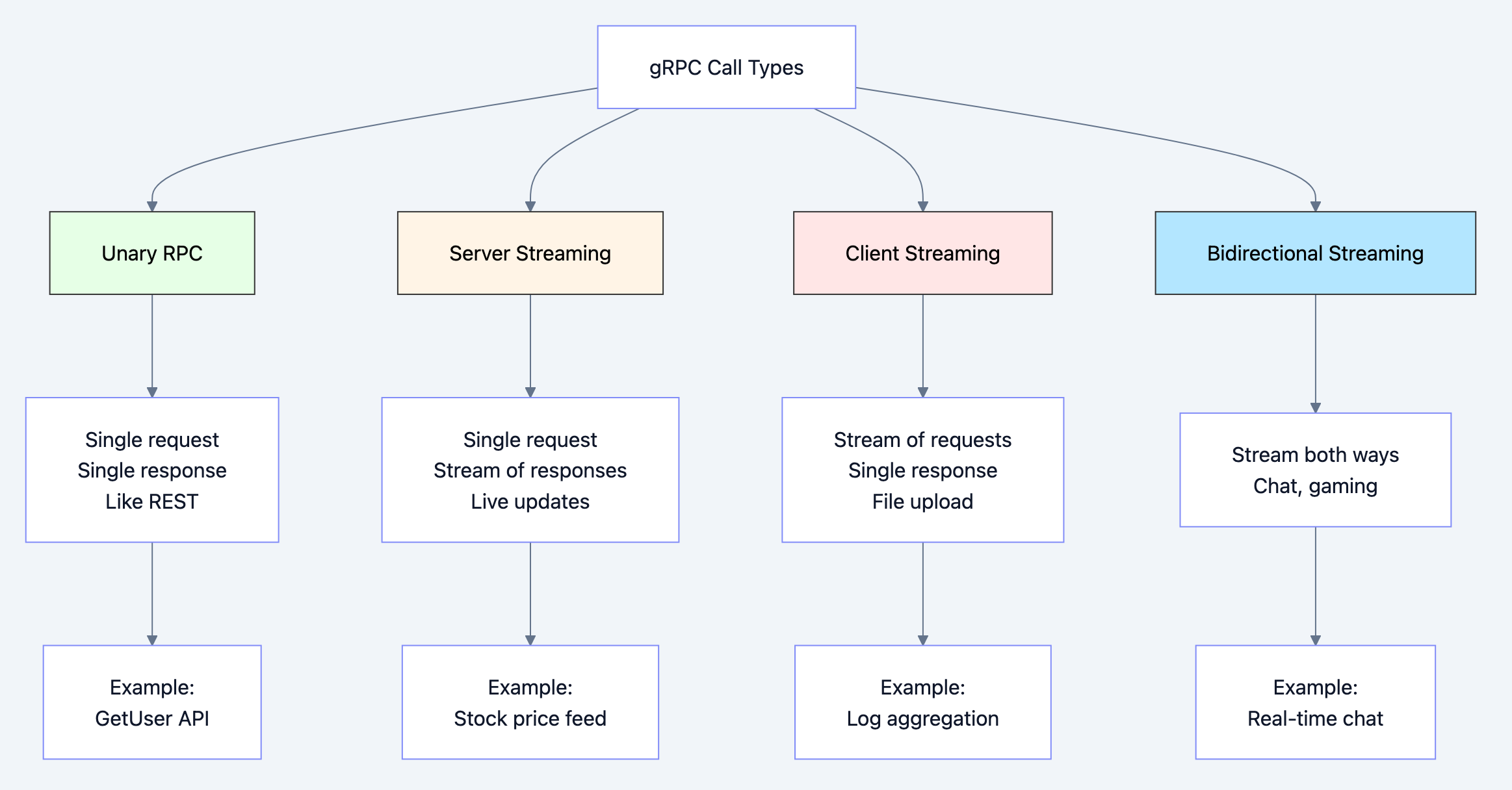
Diagram 1
The Remote Function Call
Think of gRPC as calling a function on a remote machine as if it were local:
Traditional REST:
go// Manual HTTP client code
resp, _ := http.Get("https://api.example.com/users/123")
body, _ := ioutil.ReadAll(resp.Body)
var user User
json.Unmarshal(body, &user)
gRPC:
go// Looks like a local function call!
user, err := client.GetUser(ctx, &pb.GetUserRequest{UserId: 123})
Under the hood:
- Request is serialized to binary (Protobuf)
- Sent over HTTP/2 connection
- Server deserializes, calls actual function
- Response is serialized back
- Client receives and deserializes automatically
The beauty: All serialization, networking, and error handling is abstracted away.
Deep Technical Dive
1. Code Example: Defining a gRPC Service
Let's build a simple user service. First, define the API in
user.proto:protobufsyntax = "proto3"; package user; option go_package = "github.com/example/userservice/pb"; // User service definition service UserService { // Unary RPC: Get single user rpc GetUser(GetUserRequest) returns (GetUserResponse); // Server streaming: List users with pagination rpc ListUsers(ListUsersRequest) returns (stream User); // Client streaming: Batch create users rpc BatchCreateUsers(stream CreateUserRequest) returns (BatchCreateResponse); // Bidirectional streaming: Real-time user updates rpc StreamUserUpdates(stream UserUpdateRequest) returns (stream UserUpdateResponse); } // Message types message User { int64 id = 1; string email = 2; string name = 3; bool is_active = 4; int64 created_at = 5; } message GetUserRequest { int64 user_id = 1; } message GetUserResponse { User user = 1; string error = 2; } message ListUsersRequest { int32 page_size = 1; string page_token = 2; } message CreateUserRequest { string email = 1; string name = 2; } message BatchCreateResponse { int32 created_count = 1; repeated int64 user_ids = 2; } message UserUpdateRequest { int64 user_id = 1; string field = 2; string value = 3; } message UserUpdateResponse { bool success = 1; User updated_user = 2; }
Generate Go code:
bashprotoc --go_out=. --go-grpc_out=. user.proto
This creates:
user.pb.go- Message typesuser_grpc.pb.go- Service interface and client
2. Code Example: Implementing the gRPC Server
Now implement the server in Go:
gopackage main

import (
    "context"
    "fmt"
    "log"
    "net"
    "sync"
    "time"

    pb "github.com/example/userservice/pb"
    "google.golang.org/grpc"
    "google.golang.org/grpc/codes"
    "google.golang.org/grpc/status"
)

// UserServiceServer implements the gRPC service
type UserServiceServer struct {
    pb.UnimplementedUserServiceServer
    users map[int64]*pb.User
    mu    sync.RWMutex
    nextID int64
}

func NewUserServiceServer() *UserServiceServer {
    return &UserServiceServer{
        users: make(map[int64]*pb.User),
        nextID: 1,
    }
}

// Unary RPC: Get single user
func (s *UserServiceServer) GetUser(ctx context.Context, req *pb.GetUserRequest) (*pb.GetUserResponse, error) {
    s.mu.RLock()
    defer s.mu.RUnlock()

    user, exists := s.users[req.UserId]
    if !exists {
        return nil, status.Errorf(codes.NotFound, "user %d not found", req.UserId)
    }

    return &pb.GetUserResponse{User: user}, nil
}

// Server streaming: Stream all users to client
func (s *UserServiceServer) ListUsers(req *pb.ListUsersRequest, stream pb.UserService_ListUsersServer) error {
    s.mu.RLock()
    defer s.mu.RUnlock()

    pageSize := req.PageSize
    if pageSize == 0 {
        pageSize = 10 // Default page size
    }

    count := 0
    for _, user := range s.users {
        // Send user to client stream
        if err := stream.Send(user); err != nil {
            return err
        }

        count++
        if count >= int(pageSize) {
            break
        }

        // Simulate streaming delay
        time.Sleep(100 * time.Millisecond)
    }

    return nil
}

// Client streaming: Receive multiple users from client
func (s *UserServiceServer) BatchCreateUsers(stream pb.UserService_BatchCreateUsersServer) error {
    var createdIDs []int64

    // Receive stream of users from client
    for {
        req, err := stream.Recv()
        if err == io.EOF {
            // Client finished sending
            return stream.SendAndClose(&pb.BatchCreateResponse{
                CreatedCount: int32(len(createdIDs)),
                UserIds:      createdIDs,
            })
        }
        if err != nil {
            return err
        }

        // Create user
        s.mu.Lock()
        userID := s.nextID
        s.nextID++
        user := &pb.User{
            Id:        userID,
            Email:     req.Email,
            Name:      req.Name,
            IsActive:  true,
            CreatedAt: time.Now().Unix(),
        }
        s.users[userID] = user
        s.mu.Unlock()

        createdIDs = append(createdIDs, userID)
        log.Printf("Created user: %d - %s", userID, req.Email)
    }
}

// Bidirectional streaming: Real-time updates
func (s *UserServiceServer) StreamUserUpdates(stream pb.UserService_StreamUserUpdatesServer) error {
    for {
        // Receive update from client
        req, err := stream.Recv()
        if err == io.EOF {
            return nil
        }
        if err != nil {
            return err
        }

        // Apply update
        s.mu.Lock()
        user, exists := s.users[req.UserId]
        if !exists {
            s.mu.Unlock()
            stream.Send(&pb.UserUpdateResponse{Success: false})
            continue
        }

        // Update field (simplified example)
        switch req.Field {
        case "name":
            user.Name = req.Value
        case "email":
            user.Email = req.Value
        }
        s.mu.Unlock()

        // Send confirmation back
        stream.Send(&pb.UserUpdateResponse{
            Success:     true,
            UpdatedUser: user,
        })

        log.Printf("Updated user %d: %s = %s", req.UserId, req.Field, req.Value)
    }
}

func main() {
    // Create TCP listener
    listener, err := net.Listen("tcp", ":50051")
    if err != nil {
        log.Fatalf("Failed to listen: %v", err)
    }

    // Create gRPC server
    grpcServer := grpc.NewServer(
        grpc.MaxRecvMsgSize(10 * 1024 * 1024), // 10MB max message
        grpc.MaxSendMsgSize(10 * 1024 * 1024),
    )

    // Register service
    userService := NewUserServiceServer()
    pb.RegisterUserServiceServer(grpcServer, userService)

    log.Println("gRPC server listening on :50051")
    if err := grpcServer.Serve(listener); err != nil {
        log.Fatalf("Failed to serve: %v", err)
    }
}
3. Code Example: gRPC Client with All Four Call Types
gopackage main

import (
    "context"
    "io"
    "log"
    "time"

    pb "github.com/example/userservice/pb"
    "google.golang.org/grpc"
    "google.golang.org/grpc/credentials/insecure"
)

func main() {
    // Connect to gRPC server
    conn, err := grpc.Dial("localhost:50051",
        grpc.WithTransportCredentials(insecure.NewCredentials()),
        grpc.WithBlock(),
        grpc.WithTimeout(5*time.Second),
    )
    if err != nil {
        log.Fatalf("Failed to connect: %v", err)
    }
    defer conn.Close()

    client := pb.NewUserServiceClient(conn)
    ctx := context.Background()

    // 1. UNARY RPC: Single request, single response
    log.Println("--- Unary RPC Example ---")
    userResp, err := client.GetUser(ctx, &pb.GetUserRequest{UserId: 1})
    if err != nil {
        log.Printf("GetUser failed: %v", err)
    } else {
        log.Printf("Got user: %v", userResp.User)
    }

    // 2. SERVER STREAMING: Single request, stream of responses
    log.Println("\n--- Server Streaming Example ---")
    stream, err := client.ListUsers(ctx, &pb.ListUsersRequest{PageSize: 5})
    if err != nil {
        log.Fatalf("ListUsers failed: %v", err)
    }

    for {
        user, err := stream.Recv()
        if err == io.EOF {
            break // Stream ended
        }
        if err != nil {
            log.Fatalf("Stream error: %v", err)
        }
        log.Printf("Received user: %d - %s", user.Id, user.Email)
    }

    // 3. CLIENT STREAMING: Stream of requests, single response
    log.Println("\n--- Client Streaming Example ---")
    batchStream, err := client.BatchCreateUsers(ctx)
    if err != nil {
        log.Fatalf("BatchCreateUsers failed: %v", err)
    }

    // Send multiple users
    users := []struct{ email, name string }{
        {"alice@example.com", "Alice"},
        {"bob@example.com", "Bob"},
        {"charlie@example.com", "Charlie"},
    }

    for _, u := range users {
        if err := batchStream.Send(&pb.CreateUserRequest{
            Email: u.email,
            Name:  u.name,
        }); err != nil {
            log.Fatalf("Send failed: %v", err)
        }
        log.Printf("Sent user: %s", u.email)
    }

    // Close stream and get response
    batchResp, err := batchStream.CloseAndRecv()
    if err != nil {
        log.Fatalf("CloseAndRecv failed: %v", err)
    }
    log.Printf("Created %d users: %v", batchResp.CreatedCount, batchResp.UserIds)

    // 4. BIDIRECTIONAL STREAMING: Stream both ways
    log.Println("\n--- Bidirectional Streaming Example ---")
    biStream, err := client.StreamUserUpdates(ctx)
    if err != nil {
        log.Fatalf("StreamUserUpdates failed: %v", err)
    }

    // Goroutine to receive responses
    go func() {
        for {
            resp, err := biStream.Recv()
            if err == io.EOF {
                return
            }
            if err != nil {
                log.Fatalf("Receive error: %v", err)
            }
            log.Printf("Update confirmed: %v", resp.Success)
            if resp.UpdatedUser != nil {
                log.Printf("Updated user: %v", resp.UpdatedUser)
            }
        }
    }()

    // Send updates
    updates := []struct{ userID int64; field, value string }{
        {1, "name", "Alice Updated"},
        {2, "email", "bob.new@example.com"},
    }

    for _, u := range updates {
        if err := biStream.Send(&pb.UserUpdateRequest{
            UserId: u.userID,
            Field:  u.field,
            Value:  u.value,
        }); err != nil {
            log.Fatalf("Send failed: %v", err)
        }
        time.Sleep(500 * time.Millisecond)
    }

    biStream.CloseSend()
    time.Sleep(1 * time.Second) // Wait for responses
    log.Println("Done!")
}
4. Protocol Buffers: Binary Serialization
How Protobuf Encodes Data:
protobufmessage User {
  int64 id = 1;        // Field number 1
  string email = 2;    // Field number 2
  string name = 3;     // Field number 3
}
Binary encoding (wire format):
Field 1 (id): [field_number << 3 | wire_type][value]
Field 2 (email): [field_number << 3 | wire_type][length][bytes]
Field 3 (name): [field_number << 3 | wire_type][length][bytes]
Comparison: JSON vs Protobuf
json// JSON: 89 bytes
{
  "id": 12345,
  "email": "alice@example.com",
  "name": "Alice Smith"
}
// Protobuf: 37 bytes (58% smaller)
08 B9 60 12 13 61 6C 69 63 65 40 65 78 61 6D 70
6C 65 2E 63 6F 6D 1A 0B 41 6C 69 63 65 20 53 6D
69 74 68
Performance Benefits:
- Serialization: 5-10x faster than JSON
- Deserialization: 3-5x faster
- Payload size: 30-70% smaller
- Type safety: Compile-time validation
5. gRPC Over HTTP/2
gRPC leverages HTTP/2 features:
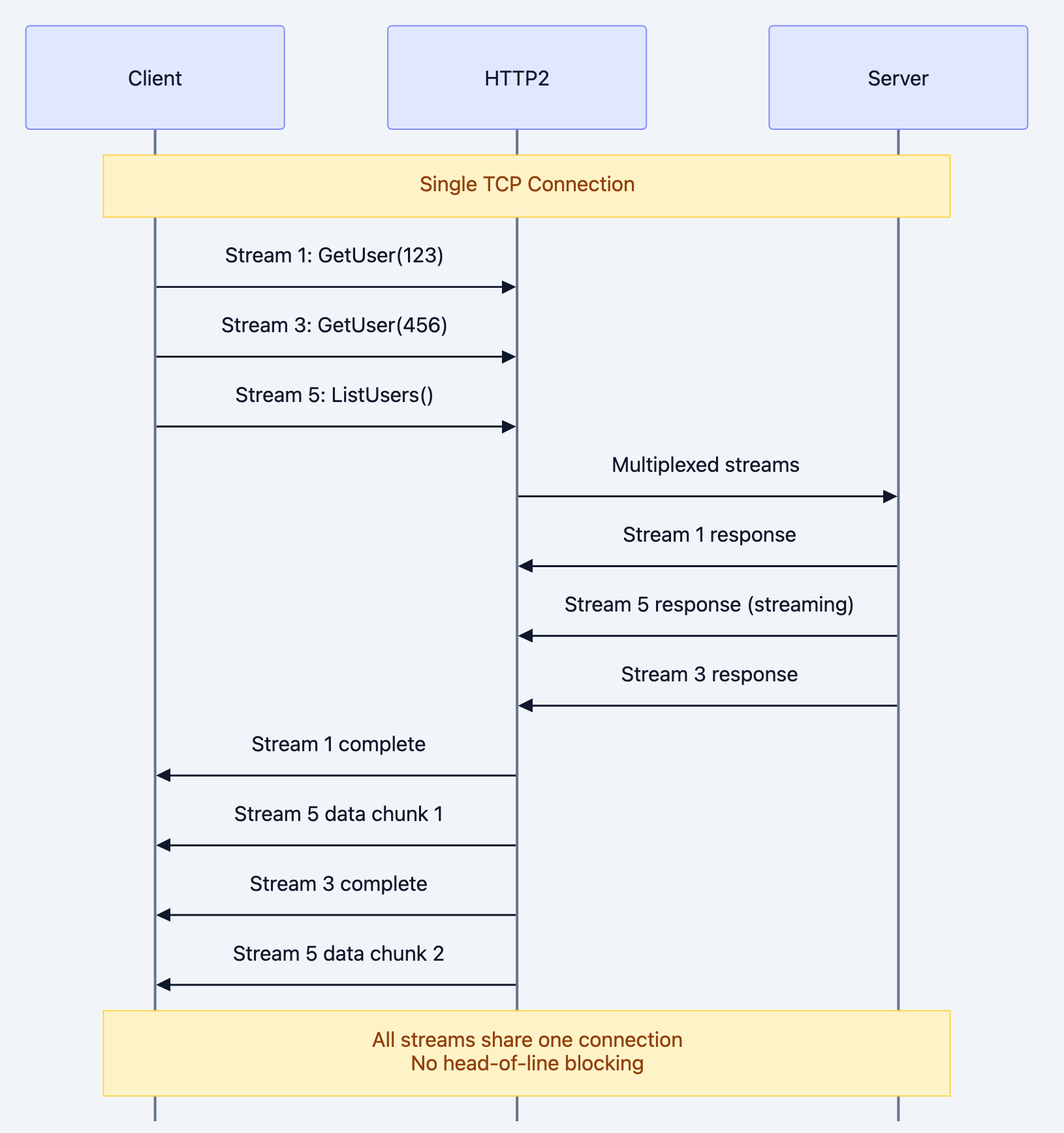
Note over Client,Server: Single TCP Connection
HTTP/2 Benefits for gRPC:
- Multiplexing: Multiple RPCs over one connection
- Header compression: HPACK reduces metadata overhead
- Flow control: Prevents buffer overflow
- Server push: Not used by gRPC, but available
When to Use: Decision Framework
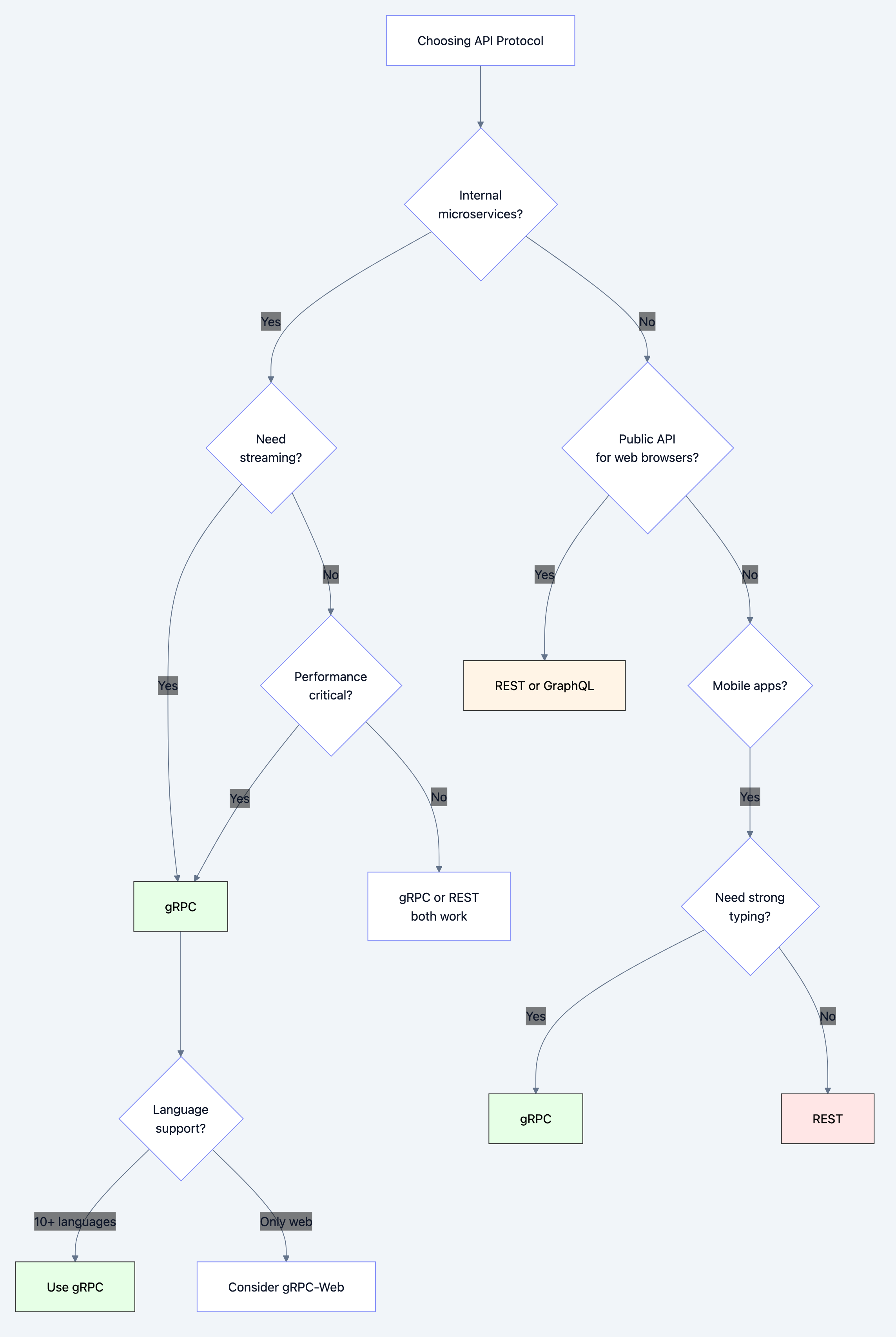
Diagram 3
Use gRPC When:
- Building microservices architecture
- Need high-performance service-to-service communication
- Want type-safe APIs with code generation
- Need streaming (server, client, or bidirectional)
- Working in polyglot environment (Go, Java, Python, etc.)
- Mobile clients (efficient battery usage)
Use REST When:
- Public APIs for third-party developers
- Browser-based clients (though gRPC-Web exists)
- Simple CRUD operations
- Need human-readable API (debugging, curl commands)
- Wide ecosystem compatibility required
Use GraphQL When:
- Flexible querying needed (mobile apps with varying data needs)
- Frontend-driven API evolution
- Need to aggregate data from multiple services
- Public API with complex data relationships
Common Pitfalls and How to Avoid Them
Pitfall 1: Breaking Proto File Changes
The Mistake:
protobuf// Before
message User {
  int64 id = 1;
  string email = 2;
}

// After - BREAKING CHANGE!
message User {
  int64 id = 1;
  string username = 2;  // Renamed field, same number!
}
Why It's Dangerous:
- Old clients will parse
usernameasemail - No compile error, silent data corruption
The Fix:
Follow Protobuf's evolution rules:
protobuf// Correct way to add field
message User {
  int64 id = 1;
  string email = 2;
  string username = 3;  // New field, new number
}

// Or deprecate old field
message User {
  int64 id = 1;
  string email = 2 [deprecated = true];
  string username = 3;
}
Rules:
- Never change field numbers
- Never change field types
- Use
reservedfor deleted fields:
protobufreserved 4, 5;  // Don't reuse these numbers
reserved "old_field_name";
Pitfall 2: No Error Handling
The Mistake:
gouser, _ := client.GetUser(ctx, req)  // Ignoring errors!
fmt.Println(user.Email)  // Panics if error occurred
The Fix:
Always check errors and status codes:
gouser, err := client.GetUser(ctx, req)
if err != nil {
    // Check gRPC status code
    st, ok := status.FromError(err)
    if ok {
        switch st.Code() {
        case codes.NotFound:
            log.Println("User not found")
        case codes.Unavailable:
            log.Println("Service unavailable, retry")
        case codes.DeadlineExceeded:
            log.Println("Request timeout")
        default:
            log.Printf("Error: %v", st.Message())
        }
    }
    return
}
Pitfall 3: No Timeouts/Deadlines
The Mistake:
go// Request waits forever if server hangs
ctx := context.Background()
client.GetUser(ctx, req)
The Fix:
Always use context with timeout:
goctx, cancel := context.WithTimeout(context.Background(), 5*time.Second)
defer cancel()

user, err := client.GetUser(ctx, req)
if err != nil {
    if ctx.Err() == context.DeadlineExceeded {
        log.Println("Request timed out after 5 seconds")
    }
    return
}
Pitfall 4: Not Handling Stream Errors
The Mistake:
gostream, _ := client.ListUsers(ctx, req)
for {
    user, _ := stream.Recv()  // Ignoring EOF and errors
    fmt.Println(user)
}
The Fix:
Properly handle EOF and errors:
gostream, err := client.ListUsers(ctx, req)
if err != nil {
    log.Fatal(err)
}

for {
    user, err := stream.Recv()
    if err == io.EOF {
        break  // Stream ended normally
    }
    if err != nil {
        log.Fatalf("Stream error: %v", err)
    }
    fmt.Println(user)
}
Pitfall 5: Large Message Sizes
The Problem:
Default max message size is 4MB. Large messages fail:
error: received message larger than max (5242880 vs 4194304)
The Fix:
Configure max message size:
go// Server
grpcServer := grpc.NewServer(
    grpc.MaxRecvMsgSize(10 * 1024 * 1024),  // 10MB
    grpc.MaxSendMsgSize(10 * 1024 * 1024),
)

// Client
conn, _ := grpc.Dial(address,
    grpc.WithDefaultCallOptions(
        grpc.MaxCallRecvMsgSize(10 * 1024 * 1024),
        grpc.MaxCallSendMsgSize(10 * 1024 * 1024),
    ),
)
Better Solution: Use streaming for large data instead of increasing limits.
Performance Implications
gRPC vs REST Performance
Benchmarks (approximate):
| Metric | gRPC | REST/JSON |
|---|---|---|
| Serialization | 5-10x faster | Baseline |
| Payload size | 30-70% smaller | Baseline |
| Latency (LAN) | 0.5-1ms | 2-5ms |
| Throughput | 2-5x higher | Baseline |
| Memory usage | 50% lower | Baseline |
Real-world example:
- REST: 1000 req/sec at 50ms latency
- gRPC: 5000 req/sec at 10ms latency
Optimization Strategies
1. Connection Pooling:
go// Reuse connections instead of dial per request
var clientConn *grpc.ClientConn

func init() {
    conn, _ := grpc.Dial(address, options...)
    clientConn = conn
}

func makeRequest() {
    client := pb.NewUserServiceClient(clientConn)
    // Use client...
}
2. Streaming for Large Datasets:
protobuf// Instead of returning huge list
rpc GetAllUsers() returns (UserList);  // BAD: 10MB response

// Use server streaming
rpc GetAllUsers(Empty) returns (stream User);  // GOOD: chunks
3. Compression:
go// Enable gzip compression
conn, _ := grpc.Dial(address,
    grpc.WithDefaultCallOptions(grpc.UseCompressor(gzip.Name)),
)
4. Multiplexing:
HTTP/2 multiplexing is automatic, but ensure you're not creating new connections unnecessarily.
5. Load Balancing:
go// Client-side load balancing
conn, _ := grpc.Dial(
    "dns:///my-service:50051",  // DNS-based discovery
    grpc.WithDefaultServiceConfig(`{"loadBalancingPolicy":"round_robin"}`),
)
Testing and Debugging
Testing gRPC Services
Unit Testing with Mock:
goimport (
    "testing"
    "github.com/stretchr/testify/mock"
)

// Mock client
type MockUserServiceClient struct {
    mock.Mock
}

func (m *MockUserServiceClient) GetUser(ctx context.Context, req *pb.GetUserRequest, opts ...grpc.CallOption) (*pb.GetUserResponse, error) {
    args := m.Called(ctx, req)
    return args.Get(0).(*pb.GetUserResponse), args.Error(1)
}

func TestGetUser(t *testing.T) {
    mockClient := new(MockUserServiceClient)

    expectedUser := &pb.User{Id: 1, Email: "test@example.com"}
    mockClient.On("GetUser", mock.Anything, mock.Anything).
        Return(&pb.GetUserResponse{User: expectedUser}, nil)

    // Test your code using mockClient
    resp, err := mockClient.GetUser(context.Background(), &pb.GetUserRequest{UserId: 1})

    assert.NoError(t, err)
    assert.Equal(t, expectedUser.Email, resp.User.Email)
}
Debugging with grpcurl
grpcurl is like curl for gRPC:bash# List services grpcurl -plaintext localhost:50051 list # Describe service grpcurl -plaintext localhost:50051 describe user.UserService # Make request grpcurl -plaintext -d '{"user_id": 1}' \ localhost:50051 user.UserService/GetUser # Server streaming grpcurl -plaintext -d '{"page_size": 5}' \ localhost:50051 user.UserService/ListUsers
Interceptors for Logging/Monitoring
go// Unary interceptor for logging
func loggingInterceptor(ctx context.Context, req interface{}, info *grpc.UnaryServerInfo, handler grpc.UnaryHandler) (interface{}, error) {
    start := time.Now()

    resp, err := handler(ctx, req)

    duration := time.Since(start)
    log.Printf("Method: %s, Duration: %v, Error: %v", info.FullMethod, duration, err)

    return resp, err
}

// Register interceptor
grpcServer := grpc.NewServer(
    grpc.UnaryInterceptor(loggingInterceptor),
)
Real-World Use Cases
Use Case 1: Netflix - Content Recommendation Engine
Netflix replaced REST APIs with gRPC for internal microservices:
Before (REST):
- 50ms average latency
- 10,000 req/sec per service
- JSON parsing overhead on every request
After (gRPC):
- 25ms average latency (50% reduction)
- 20,000 req/sec per service (100% increase)
- Binary serialization, no parsing overhead
Implementation:
protobufservice RecommendationService {
  rpc GetRecommendations(UserPreferences) returns (stream Movie);
}
Use Case 2: Square - Payment Processing
Square uses gRPC for real-time payment processing:
Requirements:
- Sub-50ms latency for authorization
- Strong typing (money must be exact)
- Streaming for transaction monitoring
Implementation:
protobufservice PaymentService {
  rpc AuthorizePayment(PaymentRequest) returns (PaymentResponse);
  rpc StreamTransactions(AccountRequest) returns (stream Transaction);
}

message Money {
  int64 amount = 1;  // Cents, not float!
  string currency = 2;
}
Use Case 3: Uber - Ride Matching
Uber uses bidirectional streaming for real-time ride matching:
protobufservice RideMatchingService {
  rpc StreamRideRequests(stream DriverLocation) returns (stream RideRequest);
}
Flow:
- Driver app streams location updates
- Server streams nearby ride requests
- Both directions happen simultaneously
- Low latency critical for user experience
Interview Questions: What You Should Know
Junior Level
Q: What is gRPC and how is it different from REST?
A: gRPC is a high-performance RPC framework using Protocol Buffers and HTTP/2. Unlike REST (text-based JSON over HTTP/1.1), gRPC uses binary serialization (faster, smaller) and supports streaming natively.
Q: What are Protocol Buffers?
A: Protocol Buffers (Protobuf) is a language-neutral binary serialization format. You define data structures in .proto files, then generate code for multiple languages. It's faster and smaller than JSON.
Q: What are the four types of gRPC calls?
A:
- Unary: Single request, single response (like REST)
- Server streaming: Single request, stream of responses
- Client streaming: Stream of requests, single response
- Bidirectional streaming: Stream both ways simultaneously
Mid Level
Q: How does gRPC achieve better performance than REST?
A:
- Binary serialization (Protobuf) is 5-10x faster than JSON parsing
- HTTP/2 multiplexing eliminates connection overhead
- Smaller payloads (30-70% smaller than JSON)
- No runtime reflection for serialization
- Connection reuse and header compression
Q: Explain how Protobuf field numbers work and why they matter.
A: Field numbers are used in binary encoding to identify fields. They must never change because old clients depend on them. Rules:
- Use numbers 1-15 for frequent fields (1 byte encoding)
- Never reuse deleted field numbers
- Use
reservedto prevent accidental reuse
Q: What happens if you change a Protobuf field type?
A: It breaks wire compatibility. Old clients will misinterpret the data, causing silent corruption or errors. Always add new fields instead of changing existing ones.
Senior Level
Q: Design a gRPC-based microservices architecture with load balancing and service discovery.
A:
- Service Discovery: Use Kubernetes DNS or Consul
- Load Balancing: Client-side with
grpc.WithBalancerName("round_robin") - Health Checks: Implement
grpc.health.v1.Healthservice - Circuit Breaking: Use interceptors with timeout/retry logic
- Observability: Interceptors for logging, metrics (Prometheus), tracing (Jaeger)
- Security: mTLS for service-to-service auth
- Deployment: Use service mesh (Istio) for advanced features
Q: How would you handle backward compatibility when evolving a gRPC API?
A:
- Add, don't modify: Always add new fields/methods, never change existing ones
- Use
oneofcarefully: Adding fields tooneofcan break clients - Versioning: Include version in package name (
user.v1,user.v2) - Deprecation: Mark old fields as
deprecated = true - Testing: Maintain integration tests with old client versions
- Documentation: Clearly document breaking changes
Q: What are the trade-offs of using gRPC for public APIs?
A:
Cons:
- Browser support requires grpc-web (proxy needed)
- Not human-readable (can't use curl easily)
- Steeper learning curve for API consumers
- Tooling less mature than REST
Cons:
- Much faster performance
- Strong typing and code generation
- Built-in streaming
- Better for mobile clients (battery efficiency)
Recommendation: Use REST for public APIs, gRPC for internal microservices.
Key Takeaways
-
gRPC is 5-10x faster than REST due to binary serialization and HTTP/2
-
Protocol Buffers provide type safety and code generation for 10+ languages
-
Four call types: Unary, server streaming, client streaming, bidirectional
-
HTTP/2 multiplexing allows multiple RPCs over one connection
-
Never change Protobuf field numbers or types - only add new fields
-
Always use timeouts and error handling - context.WithTimeout is essential
-
Streaming is powerful for real-time features and large datasets
-
Best for internal microservices - REST still better for public APIs
-
Load balancing and service discovery are critical for production
-
Use interceptors for cross-cutting concerns (logging, auth, metrics)
Further Learning
- Practice: Build a chat application with bidirectional streaming
- Read: gRPC official documentation and best practices
- Experiment: Compare REST vs gRPC performance with benchmarks
- Advanced: Study gRPC internals (HTTP/2 framing, flow control)
- Production: Learn Istio or Linkerd for service mesh patterns
gRPC isn't just a faster REST it's a fundamentally different approach to building distributed systems. Master it, and you'll build services that scale to billions of requests.