Go Pointers: When, Why, and How to Use Them
The Value That Wouldn't Change
You write a function to update a user's name. You call it. You print the user. The name is unchanged. You stare at the code. The logic is correct. The function runs. But the change doesn't stick.
This is the classic "pass by value" confusion. Go copies values when passing to functions. Your function updated a copy. The original never knew. Understanding pointers is understanding when you want the original and when a copy is fine.
What Is a Pointer
A pointer is a variable that stores the memory address of another variable. Instead of holding a value directly, it holds the location where a value lives.
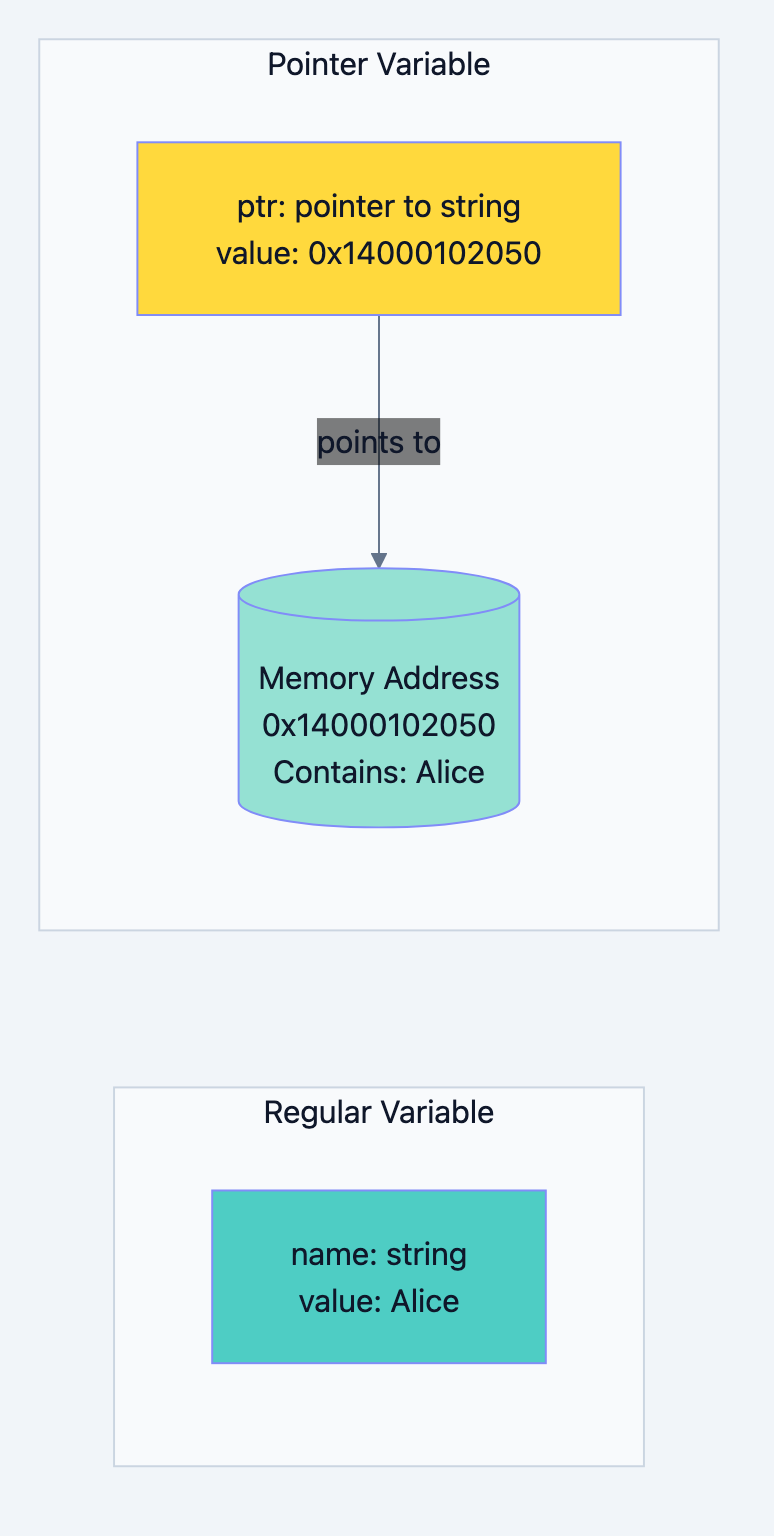
Go blog diagram 1
go// Filename: pointer_basics.go
package main

import "fmt"

func main() {
    name := "Alice"

    // & gets the address of a variable
    ptr := &name

    fmt.Println("Value:", name)
    fmt.Println("Address:", ptr)
    fmt.Println("Value at address:", *ptr)

    // * dereferences - gets value at address
    *ptr = "Bob" // Changes the original

    fmt.Println("After change:", name)
}
Expected Output:
Value: Alice
Address: 0x14000102050
Value at address: Alice
After change: Bob
The Home Address Analogy
Think of it like this: When you give someone your home address instead of a photo of your house, they can visit and make changes. If you give them just a photo (a copy), they can look but can't change your actual house. A pointer is like giving the address. A value is like giving a copy.
Pass by Value: The Default
Go passes everything by value. When you call a function with a struct, the entire struct is copied.
go// Filename: pass_by_value.go
package main

import "fmt"

type User struct {
    Name  string
    Email string
}

// This receives a COPY of the user
func updateNameValue(u User, newName string) {
    u.Name = newName
    fmt.Println("Inside function:", u.Name)
}

func main() {
    user := User{Name: "Alice", Email: "alice@example.com"}

    updateNameValue(user, "Bob")

    // Original unchanged!
    fmt.Println("After function:", user.Name)
}
Expected Output:
Inside function: Bob
After function: Alice
Pass by Pointer: Modifying the Original
To modify the original, pass a pointer.
go// Filename: pass_by_pointer.go
package main

import "fmt"

type User struct {
    Name  string
    Email string
}

// This receives a pointer to the user
func updateNamePointer(u *User, newName string) {
    u.Name = newName // Go automatically dereferences
    fmt.Println("Inside function:", u.Name)
}

func main() {
    user := User{Name: "Alice", Email: "alice@example.com"}

    updateNamePointer(&user, "Bob")

    // Original changed!
    fmt.Println("After function:", user.Name)
}
Expected Output:
Inside function: Bob
After function: Bob

Go blog diagram 2
The *string Question: When to Use Pointer Types
The infamous
*string. When should a field be *string instead of string?Use Case 1: Optional Values (nil vs empty)
go// Filename: optional_values.go
package main

import "fmt"

// With string: empty and "not provided" are the same
type ConfigBad struct {
    Host    string
    Port    int
    Timeout string // Is "" intentional or not set?
}

// With *string: nil means "not set", "" means "intentionally empty"
type ConfigGood struct {
    Host    string
    Port    int
    Timeout *string // nil = use default, "" = explicitly empty
}

func printConfig(c ConfigGood) {
    if c.Timeout == nil {
        fmt.Println("Timeout: using default")
    } else if *c.Timeout == "" {
        fmt.Println("Timeout: explicitly disabled")
    } else {
        fmt.Println("Timeout:", *c.Timeout)
    }
}

func main() {
    // Timeout not specified
    c1 := ConfigGood{Host: "localhost", Port: 8080}
    printConfig(c1)

    // Timeout explicitly set
    timeout := "30s"
    c2 := ConfigGood{Host: "localhost", Port: 8080, Timeout: &timeout}
    printConfig(c2)
}
Expected Output:
Timeout: using default
Timeout: 30s
Use Case 2: JSON with omitempty
go// Filename: json_optional.go
package main

import (
    "encoding/json"
    "fmt"
)

type User struct {
    Name     string  `json:"name"`
    Nickname *string `json:"nickname,omitempty"` // Won't appear if nil
    Age      *int    `json:"age,omitempty"`
}

func main() {
    // User without optional fields
    u1 := User{Name: "Alice"}
    data1, _ := json.Marshal(u1)
    fmt.Println("Without optionals:", string(data1))

    // User with optional fields
    nickname := "Ally"
    age := 30
    u2 := User{Name: "Alice", Nickname: &nickname, Age: &age}
    data2, _ := json.Marshal(u2)
    fmt.Println("With optionals:", string(data2))
}
Expected Output:
Without optionals: {"name":"Alice"}
With optionals: {"name":"Alice","nickname":"Ally","age":30}
Performance: Pointer vs Value
Small Structs: Value is Often Faster
go// Filename: small_struct_perf.go
package main

import "fmt"

// Small struct (24 bytes on 64-bit)
type Point struct {
    X, Y, Z float64
}

// Value receiver - no indirection, cache friendly
func (p Point) DistanceValue() float64 {
    return p.X*p.X + p.Y*p.Y + p.Z*p.Z
}

// Pointer receiver - indirection, potential cache miss
func (p *Point) DistancePointer() float64 {
    return p.X*p.X + p.Y*p.Y + p.Z*p.Z
}
For structs under ~64 bytes, value receivers often perform better because:
- No heap allocation
- No pointer dereferencing
- Better cache locality
Large Structs: Pointer Avoids Copying
go// Filename: large_struct_perf.go
package main

// Large struct (thousands of bytes)
type BigData struct {
    Records [1000]Record
    Index   map[string]int
}

type Record struct {
    ID    int
    Data  [256]byte
}

// WRONG: Copies entire struct on every call
func ProcessValue(b BigData) {
    // 256KB+ copied each call!
}

// RIGHT: Only 8 bytes (pointer) passed
func ProcessPointer(b *BigData) {
    // Fast, regardless of struct size
}
Pointer Decision Guide
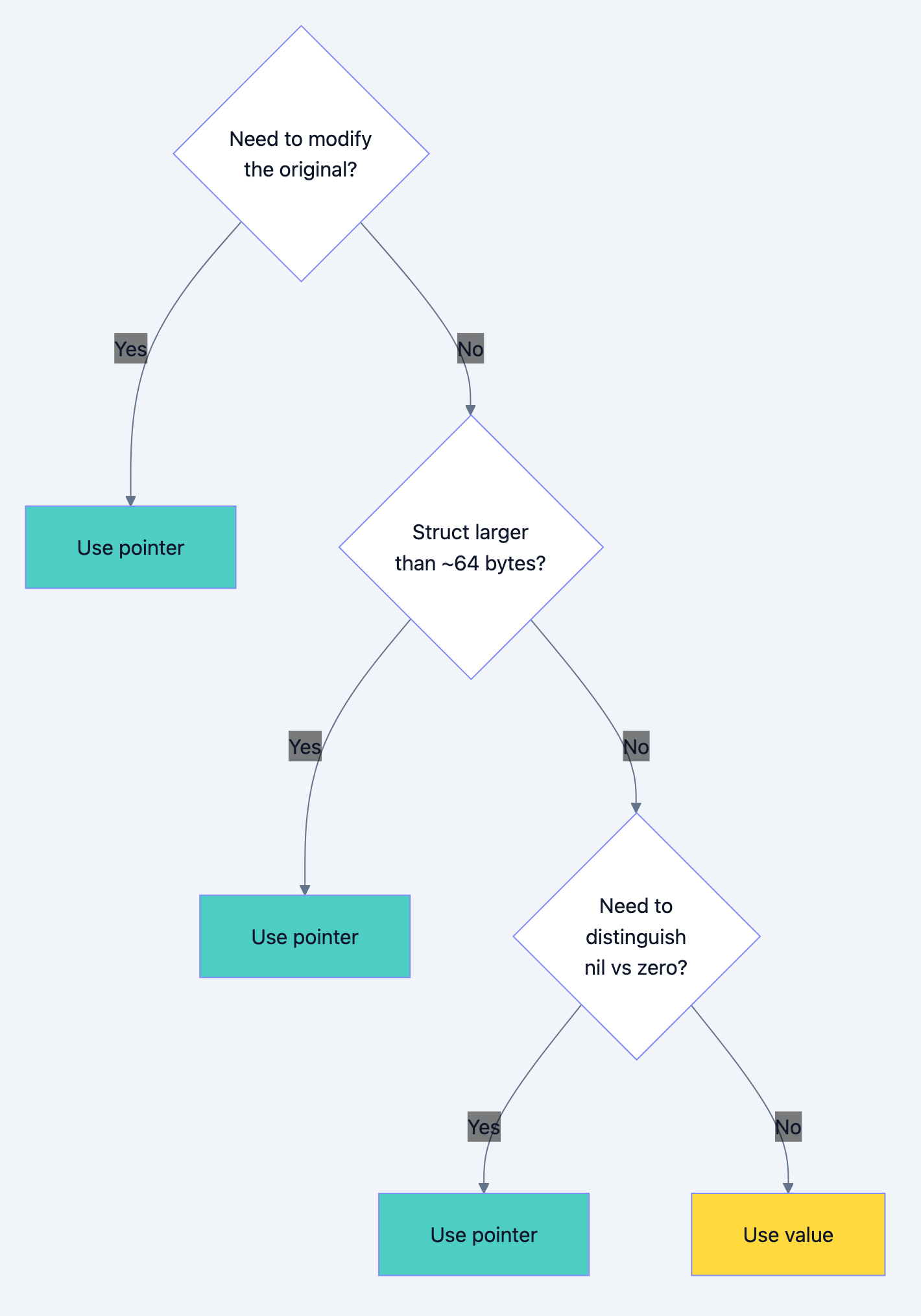
Go blog diagram 3
| Scenario | Use Pointer | Use Value |
|---|---|---|
| Modify original | Yes | No |
| Large struct (>64 bytes) | Yes | No |
| Optional field (nil matters) | Yes | No |
| Small struct, read only | No | Yes |
| Primitive types (int, bool) | Rarely | Usually |
| Slice, map, channel | Built-in pointer | N/A |
Nil Pointer Danger
Dereferencing a nil pointer causes a panic.
go// Filename: nil_pointer.go
package main

import "fmt"

type User struct {
    Name string
}

func main() {
    var u *User // nil pointer

    // This panics!
    // fmt.Println(u.Name) // panic: runtime error: invalid memory address

    // Always check for nil
    if u != nil {
        fmt.Println(u.Name)
    } else {
        fmt.Println("User is nil")
    }

    // Or use a safe getter
    fmt.Println("Name:", getName(u))
}

func getName(u *User) string {
    if u == nil {
        return ""
    }
    return u.Name
}
Expected Output:
User is nil
Name:
Pointer vs Value Receivers
Choose receiver type based on these rules:
go// Filename: receiver_types.go
package main

import "fmt"

type Counter struct {
    count int
}

// Value receiver: doesn't modify original
func (c Counter) GetCount() int {
    return c.count
}

// Pointer receiver: modifies original
func (c *Counter) Increment() {
    c.count++
}

// Pointer receiver: for consistency (other methods use pointer)
func (c *Counter) Reset() {
    c.count = 0
}

func main() {
    counter := Counter{}

    counter.Increment()
    counter.Increment()
    fmt.Println("Count:", counter.GetCount())

    counter.Reset()
    fmt.Println("After reset:", counter.GetCount())
}
Expected Output:
Count: 2
After reset: 0
Rules for Receiver Choice
- If any method needs pointer receiver, use pointer for all methods (consistency)
- If method modifies receiver, use pointer
- If struct is large, use pointer (avoid copying)
- For small, immutable structs, value is fine
Memory and Escape Analysis
Go's compiler decides whether variables live on stack (fast) or heap (slower, needs GC).
go// Filename: escape_analysis.go
package main

// Returns pointer to local variable - escapes to heap
func createUserHeap() *User {
    u := User{Name: "Alice"} // Escapes to heap
    return &u
}

// Returns value - stays on stack
func createUserStack() User {
    u := User{Name: "Bob"} // Stays on stack
    return u
}

type User struct {
    Name string
}
Check with:
go build -gcflags="-m" main.go./main.go:5: moved to heap: uImplications:
- Heap allocation requires garbage collection
- Stack is faster (automatic cleanup)
- Returning pointers forces heap allocation
Common Mistakes
Mistake 1: Modifying loop variable pointer
go// WRONG: All point to same memory
var users []*User
for _, u := range userList {
    users = append(users, &u) // u is reused each iteration!
}

// RIGHT: Create new variable
var users []*User
for _, u := range userList {
    u := u // Shadow with local copy
    users = append(users, &u)
}
Mistake 2: Nil pointer on optional struct field
go// WRONG: Panics if Address is nil
func PrintCity(u *User) {
    fmt.Println(u.Address.City)
}

// RIGHT: Check for nil
func PrintCity(u *User) {
    if u != nil && u.Address != nil {
        fmt.Println(u.Address.City)
    }
}
Mistake 3: Pointer to interface
go// WRONG: Interface is already a pointer internally
func process(r *io.Reader) { ... }

// RIGHT: Interface directly
func process(r io.Reader) { ... }
When NOT to Use Pointers
go// Slices, maps, channels are reference types
// They already point to underlying data

// WRONG: Unnecessary pointer
func processSlice(items *[]int) { ... }

// RIGHT: Slice header is small, copy is cheap
func processSlice(items []int) { ... }

// Note: To grow the slice in function, you need pointer
func appendItem(items *[]int, item int) {
    *items = append(*items, item)
}
Summary: The Pointer Cheat Sheet
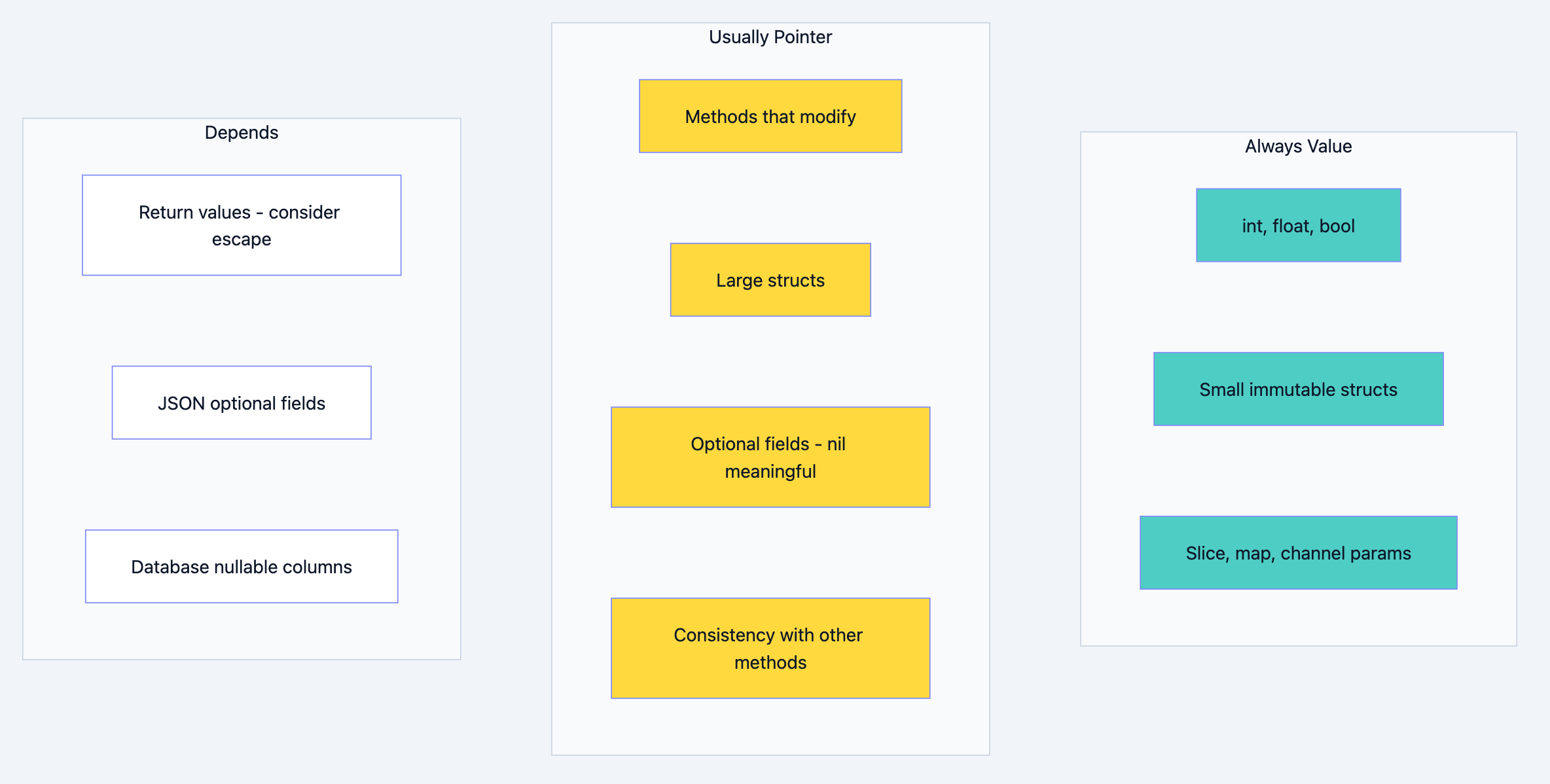
Go blog diagram 4
What You Learned
You now understand that:
- Pointers store memory addresses: & gets address, * dereferences
- Go passes by value: Functions get copies unless you use pointers
- *string distinguishes nil from empty: Useful for optional fields
- Small structs copy cheaply: Pointers aren't always faster
- Large structs should use pointers: Avoid copying overhead
- Nil pointers panic on dereference: Always check before accessing
Your Next Steps
- Benchmark: Compare pointer vs value for your specific structs
- Read Next: Learn about escape analysis with
go build -gcflags="-m" - Practice: Refactor a function to use pointer receivers where appropriate
Pointers in Go are simpler than in C. No pointer arithmetic. Automatic dereferencing for struct fields. But you still need to understand when to use them. Now you know the rules. Apply them, and your code will be both correct and efficient.