Go Context Package: Controlling Cancellation and Deadlines
The Request That Never Ends
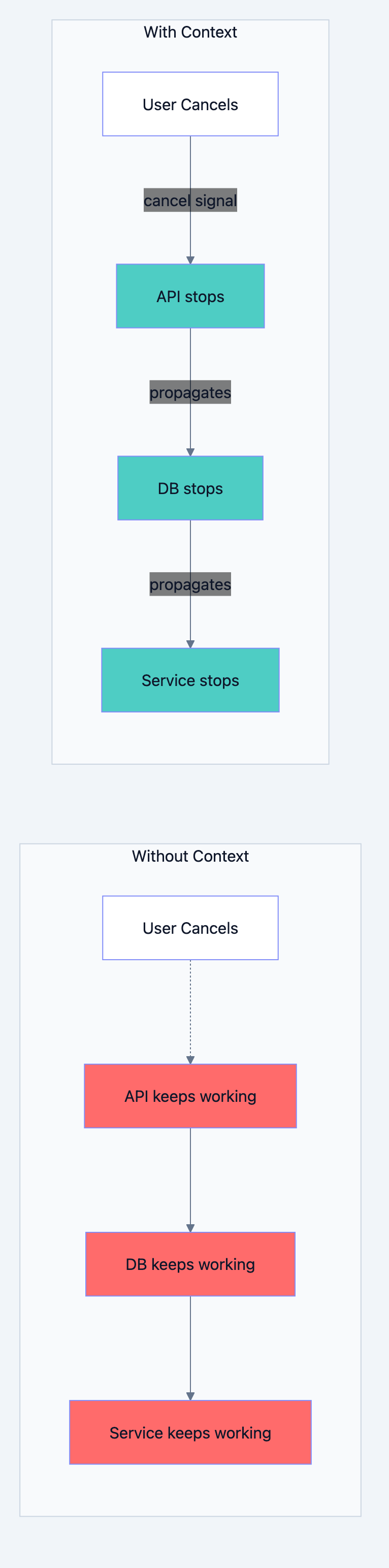
A user sends a request to your API. Your service calls a database, which calls another service, which calls another. Somewhere deep in this chain, something hangs. The user gave up and closed their browser 30 seconds ago. But your services keep working, waiting, consuming resources for a response that nobody wants.
Without context, there's no way to tell downstream operations "stop, nobody cares anymore." They run until completion or timeout, wasting resources and potentially causing cascading failures.
Why Context Exists
Context solves the problem of request-scoped data and cancellation across API boundaries. It answers:
- When should this operation stop?
- What deadline is this operation working against?
- What request-specific data should be available?
Go blog diagram 1
The Radio Broadcast Analogy
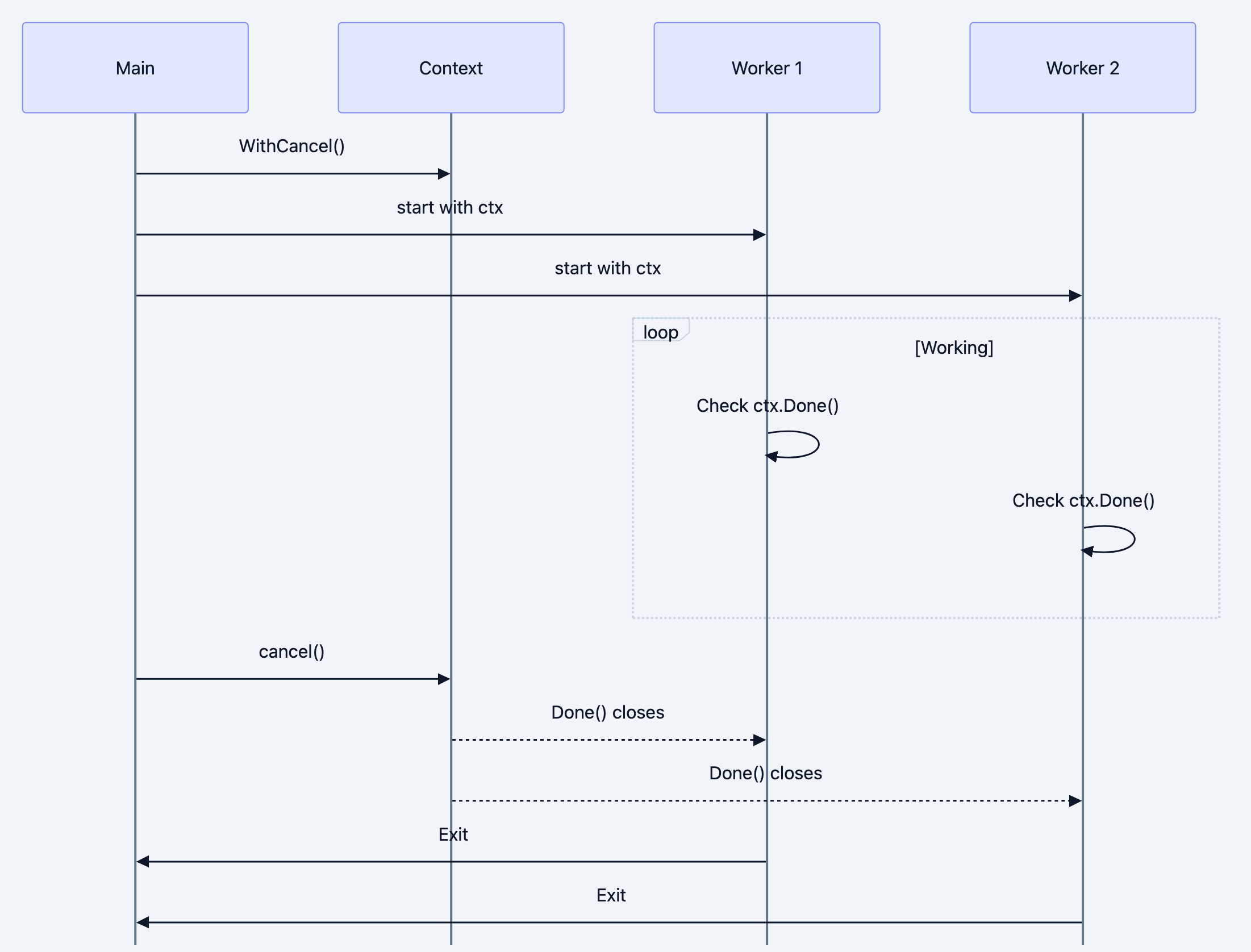
Think of it like this: Context is like a radio broadcast to all workers on a construction site. The foreman can announce "stop work" and everyone hears it instantly. Each worker checks their radio periodically. When they hear "stop," they clean up and quit. Without the radio, the foreman would have to run to each worker individually. Some might never get the message.
Creating and Using Context
The Root Context
Every context chain starts from
context.Background() or context.TODO().go// Filename: context_basics.go package main import ( "context" "fmt" ) func main() { // Background: the root context, never cancelled ctx := context.Background() fmt.Println("Background context:", ctx) // TODO: placeholder when unsure which context to use ctx2 := context.TODO() fmt.Println("TODO context:", ctx2) }
Context with Cancellation
go// Filename: context_cancel.go
package main

import (
    "context"
    "fmt"
    "time"
)

func worker(ctx context.Context, name string) {
    for {
        select {
        case <-ctx.Done():
            fmt.Printf("%s: received cancel signal, stopping\n", name)
            return
        default:
            fmt.Printf("%s: working...\n", name)
            time.Sleep(500 * time.Millisecond)
        }
    }
}

func main() {
    // Create cancellable context
    ctx, cancel := context.WithCancel(context.Background())

    // Start workers
    go worker(ctx, "Worker-1")
    go worker(ctx, "Worker-2")

    // Let them work for 2 seconds
    time.Sleep(2 * time.Second)

    // Cancel all workers
    fmt.Println("Main: cancelling all workers")
    cancel()

    // Wait for workers to finish
    time.Sleep(500 * time.Millisecond)
    fmt.Println("Main: done")
}
Expected Output:
Worker-1: working...
Worker-2: working...
Worker-1: working...
Worker-2: working...
Worker-1: working...
Worker-2: working...
Worker-1: working...
Worker-2: working...
Main: cancelling all workers
Worker-2: received cancel signal, stopping
Worker-1: received cancel signal, stopping
Main: done
Go blog diagram 2
Context with Timeout
go// Filename: context_timeout.go
package main

import (
    "context"
    "fmt"
    "time"
)

func slowOperation(ctx context.Context) error {
    select {
    case <-time.After(5 * time.Second):
        return nil // Operation completed
    case <-ctx.Done():
        return ctx.Err() // Cancelled or timed out
    }
}

func main() {
    // Context that cancels after 2 seconds
    ctx, cancel := context.WithTimeout(context.Background(), 2*time.Second)
    defer cancel() // Always call cancel to release resources

    fmt.Println("Starting slow operation...")
    err := slowOperation(ctx)

    if err != nil {
        fmt.Println("Operation failed:", err)
    } else {
        fmt.Println("Operation succeeded")
    }
}
Expected Output:
Starting slow operation...
Operation failed: context deadline exceeded
Context with Deadline
go// Filename: context_deadline.go
package main

import (
    "context"
    "fmt"
    "time"
)

func main() {
    // Set absolute deadline
    deadline := time.Now().Add(3 * time.Second)
    ctx, cancel := context.WithDeadline(context.Background(), deadline)
    defer cancel()

    // Check the deadline
    if d, ok := ctx.Deadline(); ok {
        fmt.Printf("Deadline: %v\n", d)
        fmt.Printf("Time until deadline: %v\n", time.Until(d))
    }

    // Wait for deadline
    <-ctx.Done()
    fmt.Println("Deadline reached:", ctx.Err())
}
Expected Output:
Deadline: 2024-01-28 10:00:03 +0000 UTC
Time until deadline: 2.999s
Deadline reached: context deadline exceeded
Context Values: Request Scoped Data
Context can carry request-scoped values. Use this sparingly for data like request IDs, not for passing function parameters.
go// Filename: context_values.go
package main

import (
    "context"
    "fmt"
)

// Define custom types for context keys to avoid collisions
type contextKey string

const (
    requestIDKey contextKey = "requestID"
    userIDKey    contextKey = "userID"
)

func handleRequest(ctx context.Context) {
    // Retrieve values
    requestID := ctx.Value(requestIDKey)
    userID := ctx.Value(userIDKey)

    fmt.Printf("Handling request %v for user %v\n", requestID, userID)

    // Call downstream with same context
    processData(ctx)
}

func processData(ctx context.Context) {
    requestID := ctx.Value(requestIDKey)
    fmt.Printf("Processing data for request %v\n", requestID)
}

func main() {
    // Create context with values
    ctx := context.Background()
    ctx = context.WithValue(ctx, requestIDKey, "req-12345")
    ctx = context.WithValue(ctx, userIDKey, 42)

    handleRequest(ctx)
}
Expected Output:
Handling request req-12345 for user 42
Processing data for request req-12345
Real World Example: HTTP Handler with Timeout
go// Filename: http_context.go
package main

import (
    "context"
    "fmt"
    "net/http"
    "time"
)

func fetchFromDatabase(ctx context.Context, query string) (string, error) {
    // Simulate slow database query
    select {
    case <-time.After(2 * time.Second):
        return "data from db", nil
    case <-ctx.Done():
        return "", ctx.Err()
    }
}

func fetchFromAPI(ctx context.Context, url string) (string, error) {
    // Simulate slow API call
    select {
    case <-time.After(1 * time.Second):
        return "data from api", nil
    case <-ctx.Done():
        return "", ctx.Err()
    }
}

func handler(w http.ResponseWriter, r *http.Request) {
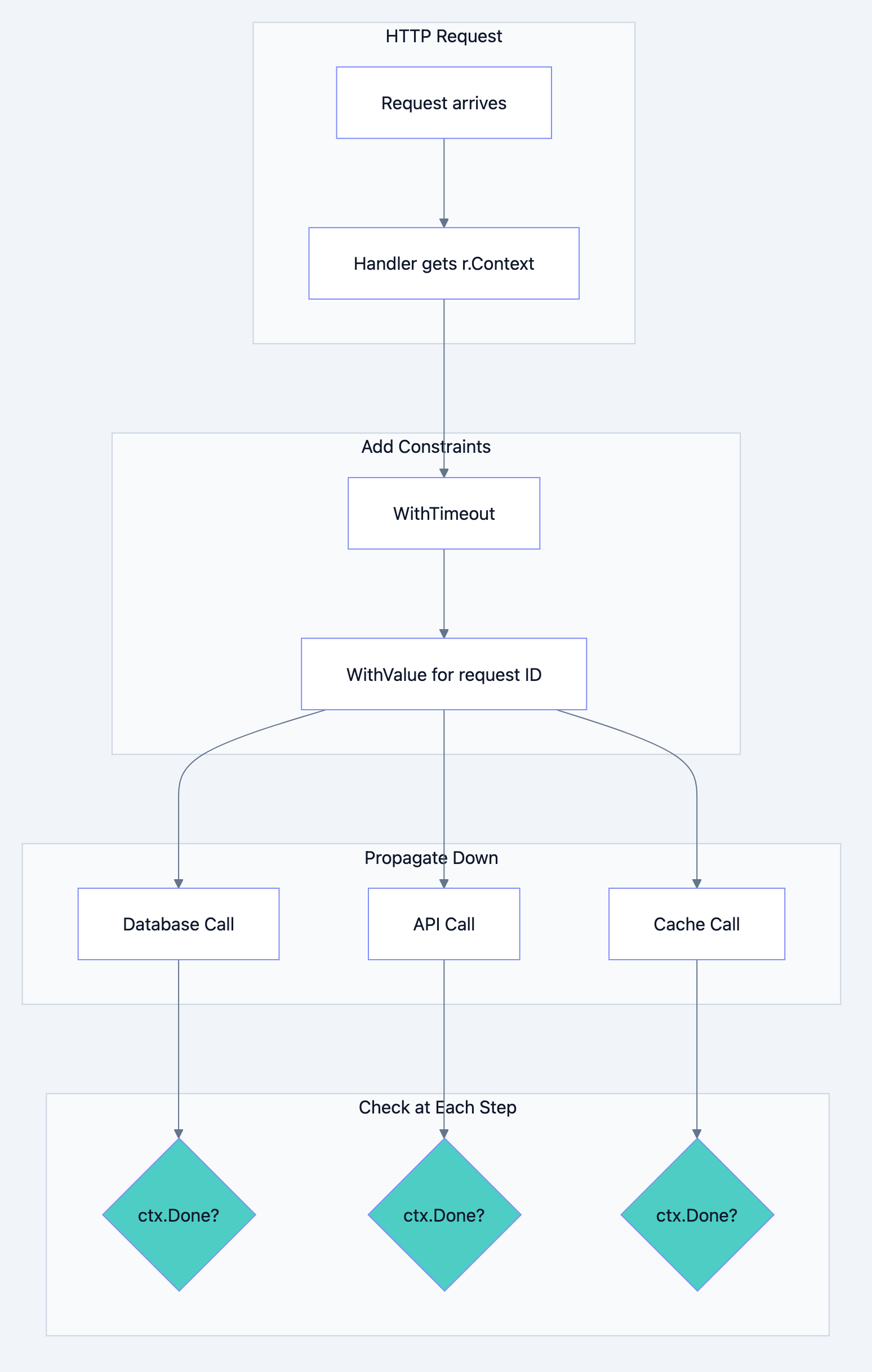
    // Request context is cancelled when client disconnects
    ctx := r.Context()

    // Add timeout
    ctx, cancel := context.WithTimeout(ctx, 3*time.Second)
    defer cancel()

    // Parallel calls with shared context
    type result struct {
        data string
        err  error
    }

    dbCh := make(chan result, 1)
    apiCh := make(chan result, 1)

    go func() {
        data, err := fetchFromDatabase(ctx, "SELECT * FROM users")
        dbCh <- result{data, err}
    }()

    go func() {
        data, err := fetchFromAPI(ctx, "http://api.example.com/data")
        apiCh <- result{data, err}
    }()

    // Collect results
    var dbResult, apiResult result

    for i := 0; i < 2; i++ {
        select {
        case dbResult = <-dbCh:
        case apiResult = <-apiCh:
        case <-ctx.Done():
            http.Error(w, "Request timeout", http.StatusGatewayTimeout)
            return
        }
    }

    if dbResult.err != nil || apiResult.err != nil {
        http.Error(w, "Internal error", http.StatusInternalServerError)
        return
    }

    fmt.Fprintf(w, "DB: %s, API: %s", dbResult.data, apiResult.data)
}

func main() {
    http.HandleFunc("/", handler)
    fmt.Println("Server starting on :8080")
    http.ListenAndServe(":8080", nil)
}
Context Propagation Pattern
Go blog diagram 3
Best Practices
Always Pass Context First
go// RIGHT: Context is first parameter
func FetchUser(ctx context.Context, id int) (*User, error) {
    // ...
}

// WRONG: Context buried in parameters
func FetchUser(id int, ctx context.Context) (*User, error) {
    // ...
}
Always Call Cancel
go// RIGHT: defer cancel immediately
ctx, cancel := context.WithTimeout(parentCtx, 5*time.Second)
defer cancel() // Resources released even if we return early
Check Done in Loops
gofunc process(ctx context.Context, items []Item) error {
    for _, item := range items {
        // Check before each iteration
        select {
        case <-ctx.Done():
            return ctx.Err()
        default:
        }

        if err := processItem(item); err != nil {
            return err
        }
    }
    return nil
}
Use Values Sparingly
go// WRONG: Using context for function parameters
ctx = context.WithValue(ctx, "username", "alice")
ctx = context.WithValue(ctx, "password", "secret") // Never!

// RIGHT: Only for request-scoped metadata
ctx = context.WithValue(ctx, requestIDKey, uuid.New().String())
ctx = context.WithValue(ctx, traceIDKey, traceID)
Common Mistakes
Mistake 1: Ignoring context in long operations
go// WRONG: Doesn't respect context
func longOperation(ctx context.Context) {
    time.Sleep(10 * time.Second) // Ignores cancellation
}

// RIGHT: Checks context
func longOperation(ctx context.Context) error {
    select {
    case <-time.After(10 * time.Second):
        return nil
    case <-ctx.Done():
        return ctx.Err()
    }
}
Mistake 2: Creating new background context
go// WRONG: Breaks cancellation chain
func handler(ctx context.Context) {
    newCtx := context.Background() // Parent cancellation ignored!
    callDownstream(newCtx)
}

// RIGHT: Derive from parent
func handler(ctx context.Context) {
    childCtx, cancel := context.WithTimeout(ctx, 5*time.Second)
    defer cancel()
    callDownstream(childCtx)
}
Mistake 3: Storing context in struct
go// WRONG: Context stored in struct
type Service struct {
    ctx context.Context // Don't do this
}

// RIGHT: Pass context to methods
type Service struct{}

func (s *Service) Process(ctx context.Context) error {
    // Use ctx here
}
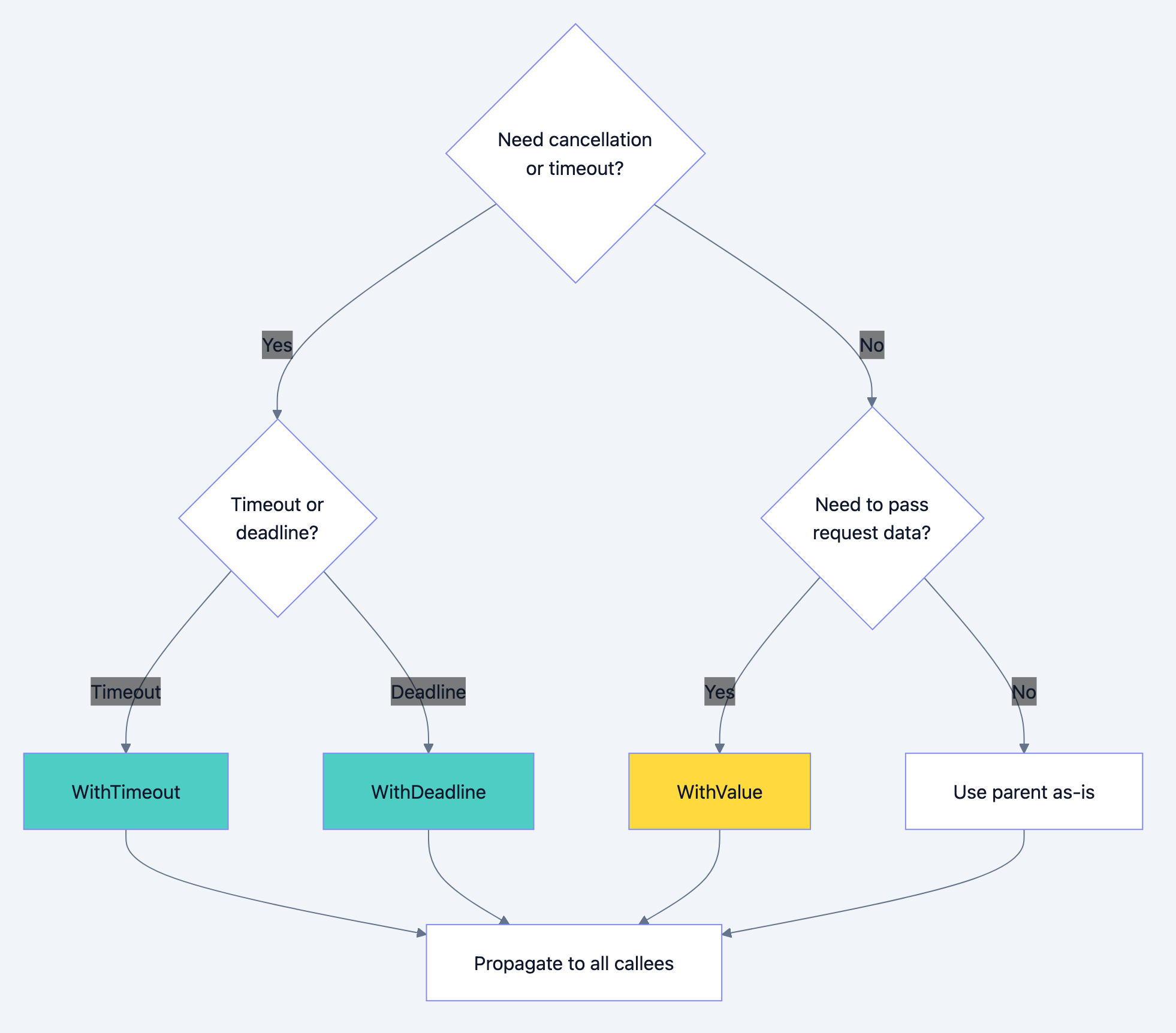
Context Decision Tree
Go blog diagram 4
Context Comparison
| Function | Use Case | Cancellation |
|---|---|---|
Background() | Root context for main, init | Never |
TODO() | Placeholder during development | Never |
WithCancel() | Manual cancellation control | On cancel() call |
WithTimeout() | Operation time limit | After duration |
WithDeadline() | Absolute time limit | At deadline time |
WithValue() | Pass request-scoped data | Inherits from parent |
What You Learned
You now understand that:
- Context enables cancellation: Signal all operations to stop
- Timeout and deadline limit operations: Prevent runaway work
- Values carry request metadata: Not for function parameters
- Always propagate context: Don't break the chain
- Check Done regularly: In loops and long operations
- Always call cancel: Release resources
Your Next Steps
- Audit: Add context to functions that do I/O or may block
- Read Next: Learn about goroutine leaks and how context prevents them
- Practice: Add request tracing using context values
Context is Go's answer to request-scoped work. It prevents resource waste, enables timeouts, and carries metadata. When you master context, your applications become responsive and resource-efficient. Every operation knows when to stop.