Goroutine Leaks: Finding and Fixing the Silent Memory Killer
The Memory That Keeps Growing
Your Go service starts with 50MB of memory. A week later, it's using 2GB. No obvious allocations. Profiling shows minimal heap usage. Yet memory grows steadily. Eventually, Kubernetes kills your pod. OOM Killed.
The culprit? Goroutine leaks. Thousands of goroutines stuck forever, each holding a small stack. They never complete. They never get garbage collected. They accumulate silently until your service dies.
What Is a Goroutine Leak
A goroutine leak occurs when a goroutine is created but never terminates. The goroutine sits there, waiting forever for something that will never happen.

Go blog diagram 1
Unlike memory leaks where you lose reference to allocated memory, goroutine leaks are worse. The goroutine is still reachable. The runtime tracks it. It just never finishes.
The Abandoned Worker Analogy
Think of it like this: You hire workers to complete tasks. Each worker waits for instructions. But you forget about some workers. They stand in the corner waiting forever. They still get paid (memory). They still count as employees (goroutines). But they do nothing useful. Eventually, you can't afford new workers because all your budget goes to idle ones.
Common Causes of Goroutine Leaks
Cause 1: Blocked Channel Send
go// Filename: leak_channel_send.go
package main

import (
    "fmt"
    "runtime"
    "time"
)

func leakyChannelSend() {
    ch := make(chan int) // Unbuffered

    go func() {
        ch <- 42 // Blocks forever - no receiver!
        fmt.Println("This never prints")
    }()

    // We never receive from ch
    // Goroutine is stuck forever
}

func main() {
    for i := 0; i < 10; i++ {
        leakyChannelSend()
    }

    time.Sleep(time.Second)
    fmt.Println("Goroutines:", runtime.NumGoroutine())
    // Prints 11 (1 main + 10 leaked)
}
Expected Output:
Goroutines: 11Cause 2: Blocked Channel Receive
go// Filename: leak_channel_receive.go
package main

import (
    "fmt"
    "runtime"
    "time"
)

func leakyChannelReceive() {
    ch := make(chan int)

    go func() {
        <-ch // Blocks forever - no sender, channel never closed!
        fmt.Println("This never prints")
    }()

    // We never send to ch or close it
}

func main() {
    for i := 0; i < 10; i++ {
        leakyChannelReceive()
    }

    time.Sleep(time.Second)
    fmt.Println("Goroutines:", runtime.NumGoroutine())
}
Cause 3: Forgotten Goroutines in Loop
go// Each request spawns a goroutine that might never complete
func handleRequest(w http.ResponseWriter, r *http.Request) {
    go func() {
        // If this external call times out or hangs
        // The goroutine leaks
        result := callExternalAPI(r.Context())
        processResult(result) // Never reached if API hangs
    }()

    // Response sent, but goroutine might still run
    w.WriteHeader(http.StatusAccepted)
}
Cause 4: Missing Context Cancellation
go// Filename: leak_no_context.go
func fetchForever(url string) <-chan []byte {
    ch := make(chan []byte)

    go func() {
        for {
            // No way to stop this!
            data := fetchData(url)
            ch <- data
            time.Sleep(time.Second)
        }
    }()

    return ch
}

// If caller stops reading from channel, goroutine still runs
Detecting Goroutine Leaks
Method 1: Runtime Checks
go// Filename: detect_leaks.go
package main

import (
    "fmt"
    "runtime"
    "time"
)

func main() {
    initial := runtime.NumGoroutine()
    fmt.Println("Initial goroutines:", initial)

    // Do work that might leak
    doSomeWork()

    // Force GC and wait for goroutines to settle
    runtime.GC()
    time.Sleep(100 * time.Millisecond)

    final := runtime.NumGoroutine()
    fmt.Println("Final goroutines:", final)

    if final > initial {
        fmt.Printf("WARNING: %d goroutines may be leaked\n", final-initial)
    }
}

func doSomeWork() {
    // Your code here
}
Method 2: pprof Goroutine Profile
// Filename: pprof_server.go package main import ( "net/http" _ "net/http/pprof" // Import for side effects ) func main() { // Start pprof server go func() { http.ListenAndServe("localhost:6060", nil) }() // Your application here select {} }
Method 3: goleak Package (Testing)
go// Filename: leak_test.go
package main

import (
    "testing"

    "go.uber.org/goleak"
)

func TestMain(m *testing.M) {
    goleak.VerifyTestMain(m)
}

func TestNoLeak(t *testing.T) {
    defer goleak.VerifyNone(t)

    // Test code here
    // goleak will fail if goroutines leak
}
Fixing Goroutine Leaks
Fix 1: Use Buffered Channels
go// LEAKY: Unbuffered channel, goroutine blocks if no receiver
ch := make(chan int)
go func() {
    ch <- result // Blocks forever
}()

// FIXED: Buffered channel, send succeeds even without receiver
ch := make(chan int, 1)
go func() {
    ch <- result // Succeeds immediately
}()
Fix 2: Use Context for Cancellation
go// Filename: fix_context.go
package main

import (
    "context"
    "fmt"
    "time"
)

func fetchWithContext(ctx context.Context, url string) <-chan string {
    ch := make(chan string)

    go func() {
        defer close(ch)

        for {
            select {
            case <-ctx.Done():
                fmt.Println("Fetch cancelled, exiting gracefully")
                return
            default:
                // Simulate fetch
                time.Sleep(100 * time.Millisecond)

                select {
                case ch <- "data from " + url:
                case <-ctx.Done():
                    return
                }
            }
        }
    }()

    return ch
}

func main() {
    ctx, cancel := context.WithTimeout(context.Background(), 500*time.Millisecond)
    defer cancel()

    ch := fetchWithContext(ctx, "http://example.com")

    for data := range ch {
        fmt.Println("Received:", data)
    }

    fmt.Println("Done - no leak!")
}
Expected Output:
Received: data from http://example.com
Received: data from http://example.com
Received: data from http://example.com
Received: data from http://example.com
Fetch cancelled, exiting gracefully
Done - no leak!
Fix 3: Done Channel Pattern
go// Filename: fix_done_channel.go
package main

import (
    "fmt"
    "time"
)

func worker(done <-chan struct{}, jobs <-chan int) {
    for {
        select {
        case <-done:
            fmt.Println("Worker shutting down")
            return
        case job := <-jobs:
            fmt.Println("Processing job:", job)
            time.Sleep(100 * time.Millisecond)
        }
    }
}

func main() {
    done := make(chan struct{})
    jobs := make(chan int)

    go worker(done, jobs)

    // Send some jobs
    jobs <- 1
    jobs <- 2
    jobs <- 3

    // Signal shutdown
    close(done)

    time.Sleep(200 * time.Millisecond)
    fmt.Println("Main exiting")
}
Expected Output:
Processing job: 1
Processing job: 2
Processing job: 3
Worker shutting down
Main exiting
Fix 4: Timeout Pattern
go// Filename: fix_timeout.go
package main

import (
    "fmt"
    "time"
)

func fetchWithTimeout(url string) (string, error) {
    resultCh := make(chan string, 1)
    errCh := make(chan error, 1)

    go func() {
        // Simulate slow operation
        time.Sleep(2 * time.Second)
        resultCh <- "data"
    }()

    select {
    case result := <-resultCh:
        return result, nil
    case err := <-errCh:
        return "", err
    case <-time.After(1 * time.Second):
        return "", fmt.Errorf("timeout after 1 second")
    }
}

func main() {
    result, err := fetchWithTimeout("http://slow.example.com")
    if err != nil {
        fmt.Println("Error:", err)
        return
    }
    fmt.Println("Result:", result)
}
Expected Output:
Error: timeout after 1 secondProduction Patterns
Pattern 1: Graceful Shutdown
go// Filename: graceful_shutdown.go
package main

import (
    "context"
    "fmt"
    "os"
    "os/signal"
    "sync"
    "syscall"
    "time"
)

type Server struct {
    wg     sync.WaitGroup
    ctx    context.Context
    cancel context.CancelFunc
}

func NewServer() *Server {
    ctx, cancel := context.WithCancel(context.Background())
    return &Server{ctx: ctx, cancel: cancel}
}

func (s *Server) StartWorker(id int) {
    s.wg.Add(1)
    go func() {
        defer s.wg.Done()
        for {
            select {
            case <-s.ctx.Done():
                fmt.Printf("Worker %d: shutting down\n", id)
                return
            default:
                fmt.Printf("Worker %d: working\n", id)
                time.Sleep(500 * time.Millisecond)
            }
        }
    }()
}

func (s *Server) Shutdown() {
    s.cancel()
    s.wg.Wait()
    fmt.Println("All workers stopped")
}

func main() {
    server := NewServer()

    // Start workers
    for i := 1; i <= 3; i++ {
        server.StartWorker(i)
    }

    // Wait for interrupt
    sigCh := make(chan os.Signal, 1)
    signal.Notify(sigCh, syscall.SIGINT, syscall.SIGTERM)

    <-sigCh
    fmt.Println("\nReceived shutdown signal")

    server.Shutdown()
}
Pattern 2: Worker Pool with Cleanup
go// Filename: worker_pool_cleanup.go
package main

import (
    "context"
    "fmt"
    "sync"
)

type Pool struct {
    workers int
    jobs    chan func()
    wg      sync.WaitGroup
    ctx     context.Context
    cancel  context.CancelFunc
}

func NewPool(workers int) *Pool {
    ctx, cancel := context.WithCancel(context.Background())
    p := &Pool{
        workers: workers,
        jobs:    make(chan func(), 100),
        ctx:     ctx,
        cancel:  cancel,
    }
    p.start()
    return p
}

func (p *Pool) start() {
    for i := 0; i < p.workers; i++ {
        p.wg.Add(1)
        go func(id int) {
            defer p.wg.Done()
            for {
                select {
                case <-p.ctx.Done():
                    return
                case job, ok := <-p.jobs:
                    if !ok {
                        return
                    }
                    job()
                }
            }
        }(i)
    }
}

func (p *Pool) Submit(job func()) {
    select {
    case p.jobs <- job:
    case <-p.ctx.Done():
    }
}

func (p *Pool) Stop() {
    p.cancel()
    close(p.jobs)
    p.wg.Wait()
}

func main() {
    pool := NewPool(3)

    for i := 0; i < 5; i++ {
        i := i
        pool.Submit(func() {
            fmt.Printf("Job %d executed\n", i)
        })
    }

    pool.Stop()
    fmt.Println("Pool stopped cleanly - no leaks")
}
Detection Checklist
Go blog diagram 2
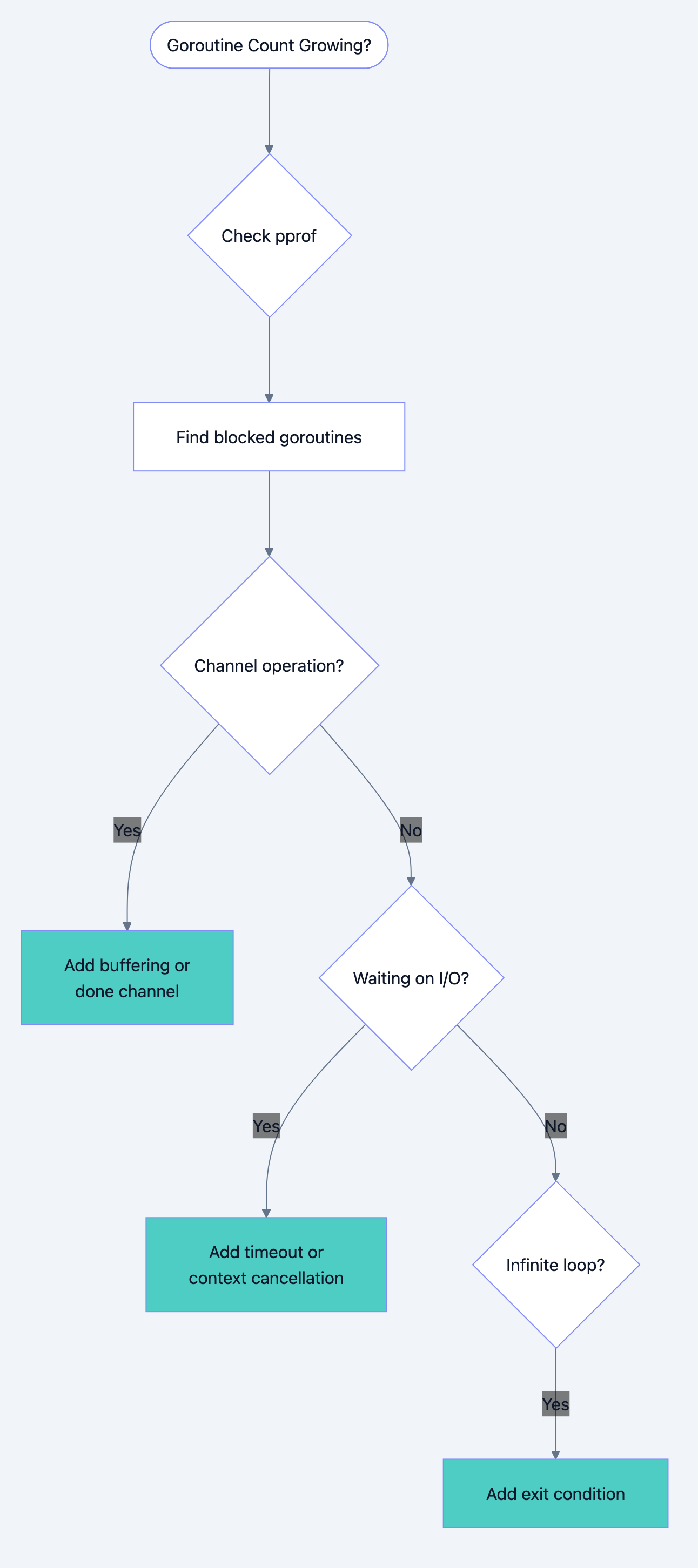
| Symptom | Likely Cause | Fix |
|---|---|---|
Goroutine blocked on chan send | No receiver | Buffer channel or add receiver |
Goroutine blocked on chan receive | No sender, not closed | Close channel when done |
Goroutine in select {} | No exit case | Add context or done channel |
Goroutine in time.Sleep loop | No stop signal | Add done channel |
What You Learned
You now understand that:
- Goroutine leaks are silent: They don't trigger errors
- Common causes are channel operations: Unbuffered channels without receivers
- Context enables cancellation: Always propagate context
- pprof reveals leaks: Use goroutine profiles to detect
- goleak catches leaks in tests: Automated leak detection
- Cleanup requires patterns: Done channels, graceful shutdown
Your Next Steps
- Audit: Run pprof on your services and check goroutine counts
- Read Next: Learn about the context package for proper cancellation
- Test: Add goleak to your test suite
Goroutine leaks are sneaky. They don't crash your program immediately. They slowly consume resources until something breaks. Now you know how to find them, fix them, and prevent them. Your services will thank you.