Go Concurrency Patterns: Battle Tested Solutions for Real Problems
When Simple Goroutines Aren't Enough
You've learned goroutines and channels. You can spin up concurrent tasks. But real problems need more structure. How do you limit concurrent database connections? How do you process a million items without exhausting memory? How do you gracefully handle partial failures?
Concurrency patterns are proven solutions to these common problems. They're the recipes that experienced Go developers reach for daily.
The Assembly Line Vision
Think of it like this: A car factory doesn't have one worker building entire cars. It's an assembly line where specialists handle specific tasks. One team installs engines, another handles electronics, another does painting. Work flows through stages, each optimized for its task. Go concurrency patterns create similar assembly lines for data.
Pattern 1: Worker Pool
When you have many tasks but limited resources (database connections, API rate limits, memory), a worker pool controls concurrency.
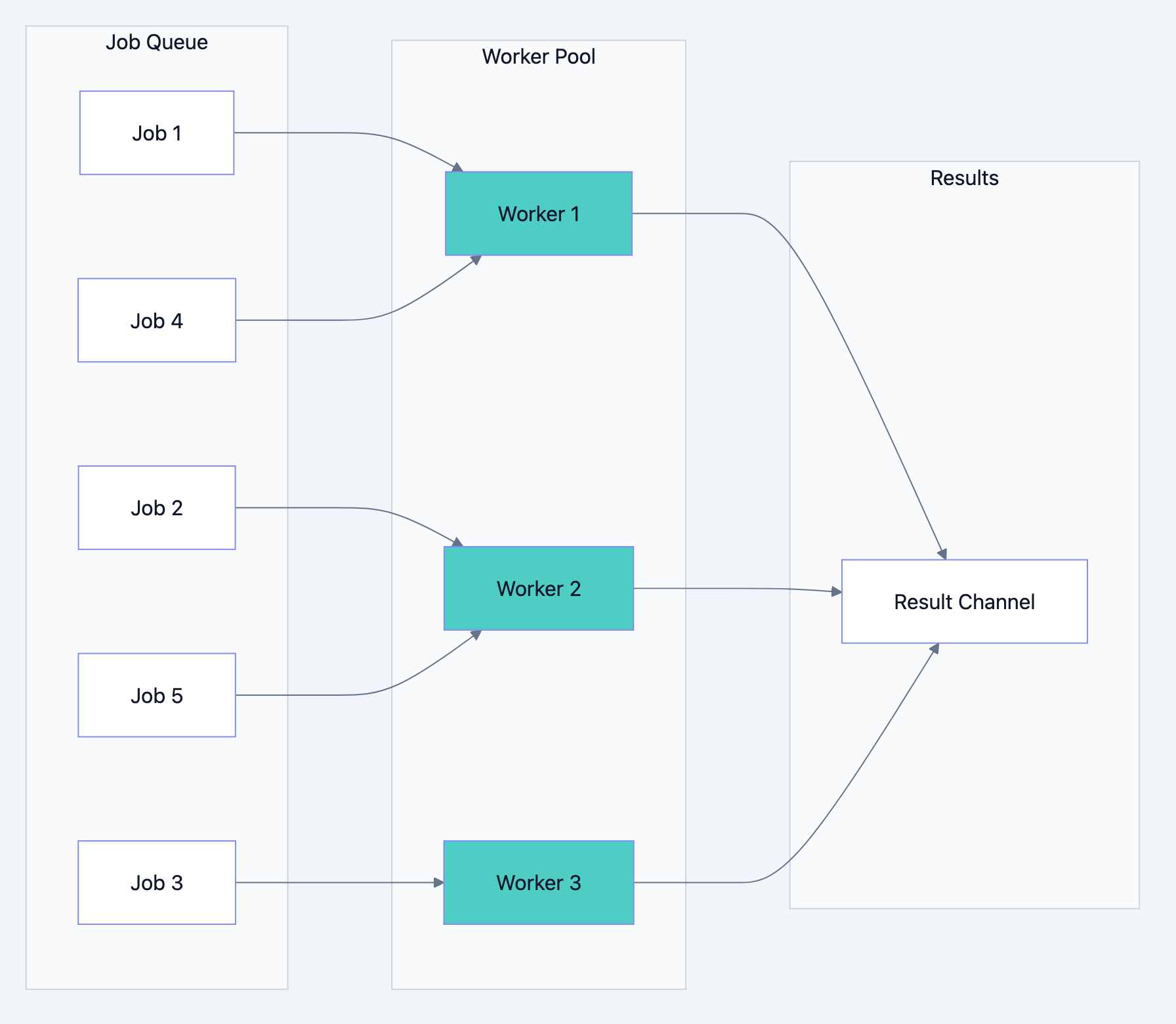
Go blog diagram 1
go// Filename: worker_pool.go
package main

import (
    "fmt"
    "sync"
    "time"
)

// Job represents work to be done
type Job struct {
    ID   int
    Data string
}

// Result represents completed work
type Result struct {
    JobID  int
    Output string
}

// Worker processes jobs from the jobs channel
// Why: Fixed number of workers limits concurrent operations
func Worker(id int, jobs <-chan Job, results chan<- Result, wg *sync.WaitGroup) {
    defer wg.Done()

    for job := range jobs {
        // Simulate processing time
        time.Sleep(100 * time.Millisecond)

        results <- Result{
            JobID:  job.ID,
            Output: fmt.Sprintf("Worker %d processed: %s", id, job.Data),
        }
    }
}

func main() {
    const numWorkers = 3
    const numJobs = 10

    jobs := make(chan Job, numJobs)
    results := make(chan Result, numJobs)

    // Start worker pool
    var wg sync.WaitGroup
    for w := 1; w <= numWorkers; w++ {
        wg.Add(1)
        go Worker(w, jobs, results, &wg)
    }

    // Send jobs
    for j := 1; j <= numJobs; j++ {
        jobs <- Job{ID: j, Data: fmt.Sprintf("Task-%d", j)}
    }
    close(jobs)

    // Wait for workers and close results
    go func() {
        wg.Wait()
        close(results)
    }()

    // Collect results
    for result := range results {
        fmt.Println(result.Output)
    }
}
Expected Output:
Worker 1 processed: Task-1
Worker 2 processed: Task-2
Worker 3 processed: Task-3
Worker 1 processed: Task-4
...
Pattern 2: Fan Out, Fan In
Split work across multiple goroutines (fan out), then combine results (fan in). Great for CPU intensive tasks.
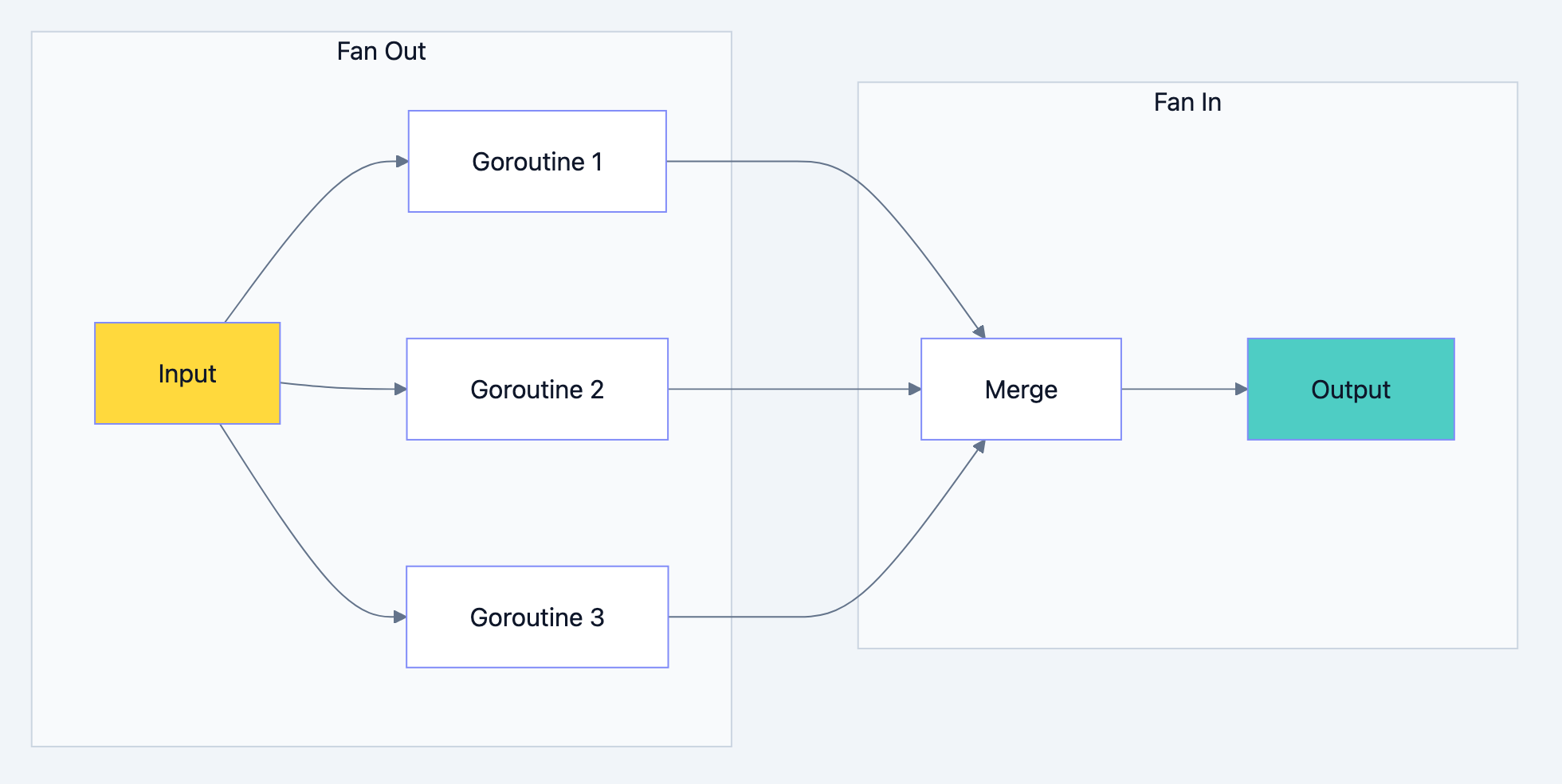
Go blog diagram 2
go// Filename: fan_out_fan_in.go
package main

import (
    "fmt"
    "sync"
)

// Generator creates a channel of numbers
// Why: Produces work items
func Generator(nums ...int) <-chan int {
    out := make(chan int)
    go func() {
        for _, n := range nums {
            out <- n
        }
        close(out)
    }()
    return out
}

// Square computes the square of numbers
// Why: CPU-bound work that benefits from parallelization
func Square(in <-chan int) <-chan int {
    out := make(chan int)
    go func() {
        for n := range in {
            out <- n * n
        }
        close(out)
    }()
    return out
}

// Merge combines multiple channels into one
// Why: Fan-in pattern collects results from parallel workers
func Merge(channels ...<-chan int) <-chan int {
    out := make(chan int)
    var wg sync.WaitGroup

    // Start a goroutine for each input channel
    for _, ch := range channels {
        wg.Add(1)
        go func(c <-chan int) {
            defer wg.Done()
            for n := range c {
                out <- n
            }
        }(ch)
    }

    // Close output when all inputs are done
    go func() {
        wg.Wait()
        close(out)
    }()

    return out
}

func main() {
    // Generate numbers
    numbers := Generator(1, 2, 3, 4, 5, 6, 7, 8, 9, 10)

    // Fan out: distribute work to multiple squarers
    // Why: Each squarer runs in parallel
    sq1 := Square(numbers)
    sq2 := Square(numbers)
    sq3 := Square(numbers)

    // Fan in: merge results
    for result := range Merge(sq1, sq2, sq3) {
        fmt.Println("Squared:", result)
    }
}
Pattern 3: Pipeline
Chain processing stages where each stage transforms data and passes it to the next. Each stage runs concurrently.
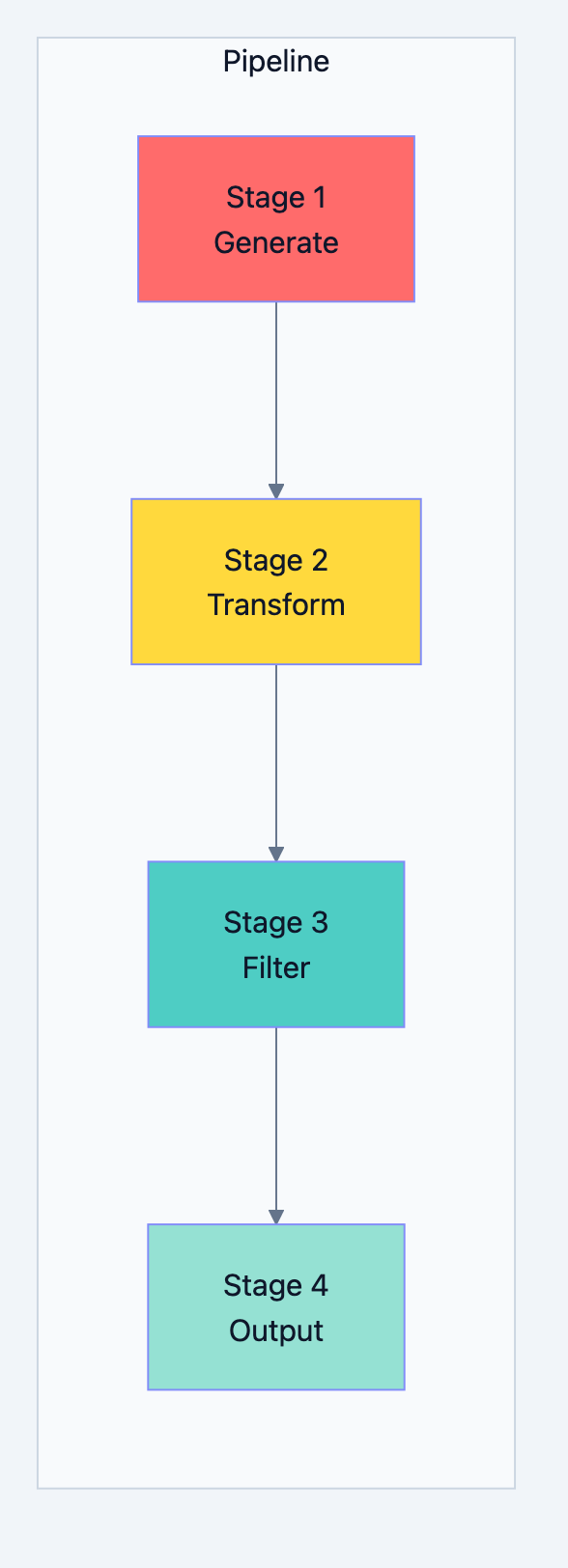
Go blog diagram 3
go// Filename: pipeline.go
package main

import "fmt"

// Stage 1: Generate numbers
func Generate(start, end int) <-chan int {
    out := make(chan int)
    go func() {
        for i := start; i <= end; i++ {
            out <- i
        }
        close(out)
    }()
    return out
}

// Stage 2: Double each number
func Double(in <-chan int) <-chan int {
    out := make(chan int)
    go func() {
        for n := range in {
            out <- n * 2
        }
        close(out)
    }()
    return out
}

// Stage 3: Filter even numbers
func FilterEven(in <-chan int) <-chan int {
    out := make(chan int)
    go func() {
        for n := range in {
            if n%4 == 0 { // divisible by 4 after doubling
                out <- n
            }
        }
        close(out)
    }()
    return out
}

// Stage 4: Add prefix
func Format(in <-chan int) <-chan string {
    out := make(chan string)
    go func() {
        for n := range in {
            out <- fmt.Sprintf("Result: %d", n)
        }
        close(out)
    }()
    return out
}

func main() {
    // Build pipeline: Generate -> Double -> Filter -> Format
    // Why: Each stage runs concurrently, processing flows through
    numbers := Generate(1, 20)
    doubled := Double(numbers)
    filtered := FilterEven(doubled)
    formatted := Format(filtered)

    // Consume final output
    for result := range formatted {
        fmt.Println(result)
    }
}
Expected Output:
Result: 4
Result: 8
Result: 12
Result: 16
Result: 20
Result: 24
Result: 28
Result: 32
Result: 36
Result: 40
Pattern 4: Semaphore
Limit the number of concurrent operations. Unlike worker pools, semaphores don't require pre created workers.
go// Filename: semaphore.go
package main

import (
    "fmt"
    "sync"
    "time"
)

// Semaphore limits concurrent operations
// Why: Control resource usage without worker pool overhead
type Semaphore struct {
    ch chan struct{}
}

func NewSemaphore(max int) *Semaphore {
    return &Semaphore{
        ch: make(chan struct{}, max),
    }
}

func (s *Semaphore) Acquire() {
    s.ch <- struct{}{} // Block if channel is full
}

func (s *Semaphore) Release() {
    <-s.ch // Free one slot
}

func main() {
    sem := NewSemaphore(3) // Max 3 concurrent
    var wg sync.WaitGroup

    // Launch 10 tasks, but only 3 run at a time
    for i := 1; i <= 10; i++ {
        wg.Add(1)
        go func(id int) {
            defer wg.Done()

            sem.Acquire()
            defer sem.Release()

            fmt.Printf("Task %d starting\n", id)
            time.Sleep(500 * time.Millisecond)
            fmt.Printf("Task %d done\n", id)
        }(i)
    }

    wg.Wait()
    fmt.Println("All tasks completed")
}
Pattern 5: Or Channel (First Winner)
Wait for the first of multiple operations to complete. Useful for timeouts, cancellation, or racing requests.
go// Filename: or_channel.go
package main

import (
    "fmt"
    "time"
)

// Or returns a channel that closes when any input channel closes
// Why: Wait for any one of multiple events
func Or(channels ...<-chan struct{}) <-chan struct{} {
    switch len(channels) {
    case 0:
        return nil
    case 1:
        return channels[0]
    }

    orDone := make(chan struct{})

    go func() {
        defer close(orDone)

        switch len(channels) {
        case 2:
            select {
            case <-channels[0]:
            case <-channels[1]:
            }
        default:
            select {
            case <-channels[0]:
            case <-channels[1]:
            case <-channels[2]:
            case <-Or(append(channels[3:], orDone)...):
            }
        }
    }()

    return orDone
}

// After returns a channel that closes after duration
func After(d time.Duration) <-chan struct{} {
    done := make(chan struct{})
    go func() {
        time.Sleep(d)
        close(done)
    }()
    return done
}

func main() {
    start := time.Now()

    // First one to complete wins
    <-Or(
        After(2*time.Second),
        After(3*time.Second),
        After(500*time.Millisecond), // This wins
        After(1*time.Second),
    )

    fmt.Printf("Done after: %v\n", time.Since(start))
}
Expected Output:
Done after: 500.123msPattern 6: Error Handling in Pipelines
Handle errors gracefully without stopping the entire pipeline.
go// Filename: error_pipeline.go
package main

import (
    "errors"
    "fmt"
)

// Result wraps value and error
type Result struct {
    Value int
    Err   error
}

// Process simulates work that might fail
func Process(in <-chan int) <-chan Result {
    out := make(chan Result)

    go func() {
        defer close(out)
        for n := range in {
            if n == 5 {
                out <- Result{Err: errors.New("unlucky number 5")}
                continue
            }
            out <- Result{Value: n * 2}
        }
    }()

    return out
}

func main() {
    // Generate numbers
    input := make(chan int)
    go func() {
        for i := 1; i <= 10; i++ {
            input <- i
        }
        close(input)
    }()

    // Process with error handling
    for result := range Process(input) {
        if result.Err != nil {
            fmt.Printf("Error: %v\n", result.Err)
            continue
        }
        fmt.Printf("Success: %d\n", result.Value)
    }
}
Expected Output:
Success: 2
Success: 4
Success: 6
Success: 8
Error: unlucky number 5
Success: 12
Success: 14
Success: 16
Success: 18
Success: 20
Pattern 7: Bounded Parallelism with errgroup
Use golang.org/x/sync/errgroup for cleaner error handling.
go// Filename: errgroup_example.go
package main

import (
    "context"
    "fmt"
    "golang.org/x/sync/errgroup"
)

func main() {
    urls := []string{
        "https://example.com/1",
        "https://example.com/2",
        "https://example.com/3",
        "https://example.com/4",
        "https://example.com/5",
    }

    g, ctx := errgroup.WithContext(context.Background())

    // Limit to 2 concurrent fetches
    g.SetLimit(2)

    for _, url := range urls {
        url := url // Capture for closure
        g.Go(func() error {
            select {
            case <-ctx.Done():
                return ctx.Err()
            default:
                fmt.Printf("Fetching: %s\n", url)
                // Simulated fetch
                return nil
            }
        })
    }

    if err := g.Wait(); err != nil {
        fmt.Printf("Error: %v\n", err)
        return
    }

    fmt.Println("All fetches complete")
}
Pattern Comparison
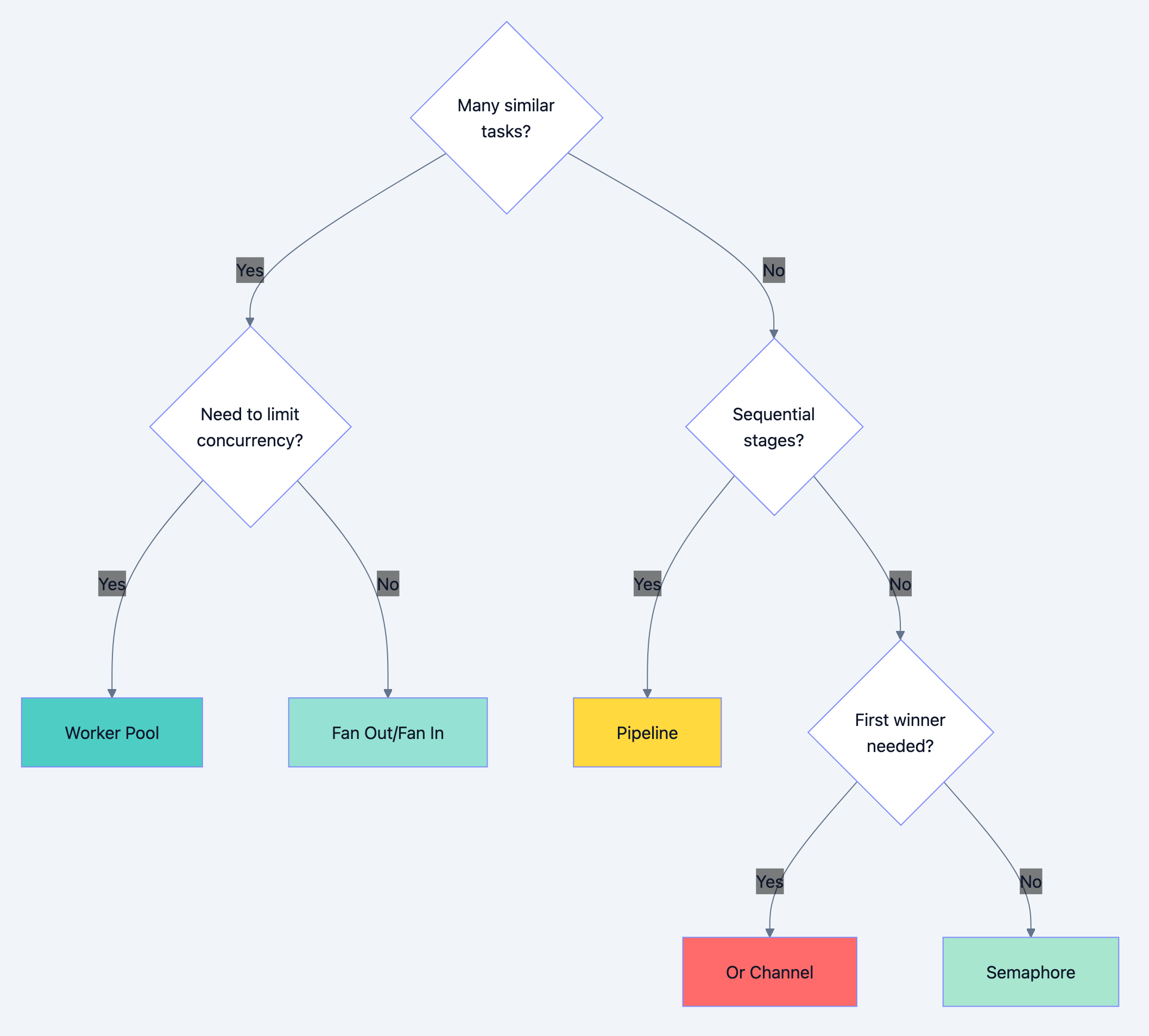
Go blog diagram 4
| Pattern | Use Case | Pros | Cons |
|---|---|---|---|
| Worker Pool | Limited resources | Resource control | Fixed workers |
| Fan Out/In | CPU bound parallel | Max parallelism | Memory for results |
| Pipeline | Multi-stage processing | Clean stages | Complexity |
| Semaphore | Dynamic limiting | Flexible | Less structured |
| Or Channel | Race conditions | First wins | Complex for many |
Common Mistakes
Mistake 1: Forgetting to close channels
go// WRONG: Range never ends
results := make(chan int)
go func() {
    results <- 1
    results <- 2
    // Missing close(results)
}()

for r := range results { // Blocks forever!
    fmt.Println(r)
}

// RIGHT: Always close when done sending
go func() {
    results <- 1
    results <- 2
    close(results)
}()
Mistake 2: Goroutine leaks in pipelines
go// WRONG: Goroutine leaks if consumer stops early
func Generate() <-chan int {
    out := make(chan int)
    go func() {
        for i := 0; ; i++ {
            out <- i // Blocks forever if no consumer
        }
    }()
    return out
}

// RIGHT: Accept done channel for cancellation
func Generate(done <-chan struct{}) <-chan int {
    out := make(chan int)
    go func() {
        defer close(out)
        for i := 0; ; i++ {
            select {
            case <-done:
                return
            case out <- i:
            }
        }
    }()
    return out
}
What You Learned
You now understand that:
- Worker pools limit concurrency: Fixed workers, controlled resources
- Fan out/in maximizes parallelism: Split work, merge results
- Pipelines chain stages: Each stage runs concurrently
- Semaphores are flexible limiters: No pre created workers needed
- Or channel races operations: First completion wins
- Error handling needs structure: Wrap results with errors
Your Next Steps
- Build: Create a web scraper using worker pool pattern
- Read Next: Learn about context for cancellation propagation
- Experiment: Combine patterns for complex workflows
These patterns are your toolkit for concurrent Go. Mix and match them to solve real problems. Start with the simplest pattern that fits your needs, and evolve as requirements grow.