SOLID Principles in Go: Writing Code That Lasts
The Nightmare Codebase
Every developer knows it. The codebase where changing one line breaks three unrelated features. Where adding a feature requires modifying files across ten packages. Where testing means testing everything because nothing is isolated.
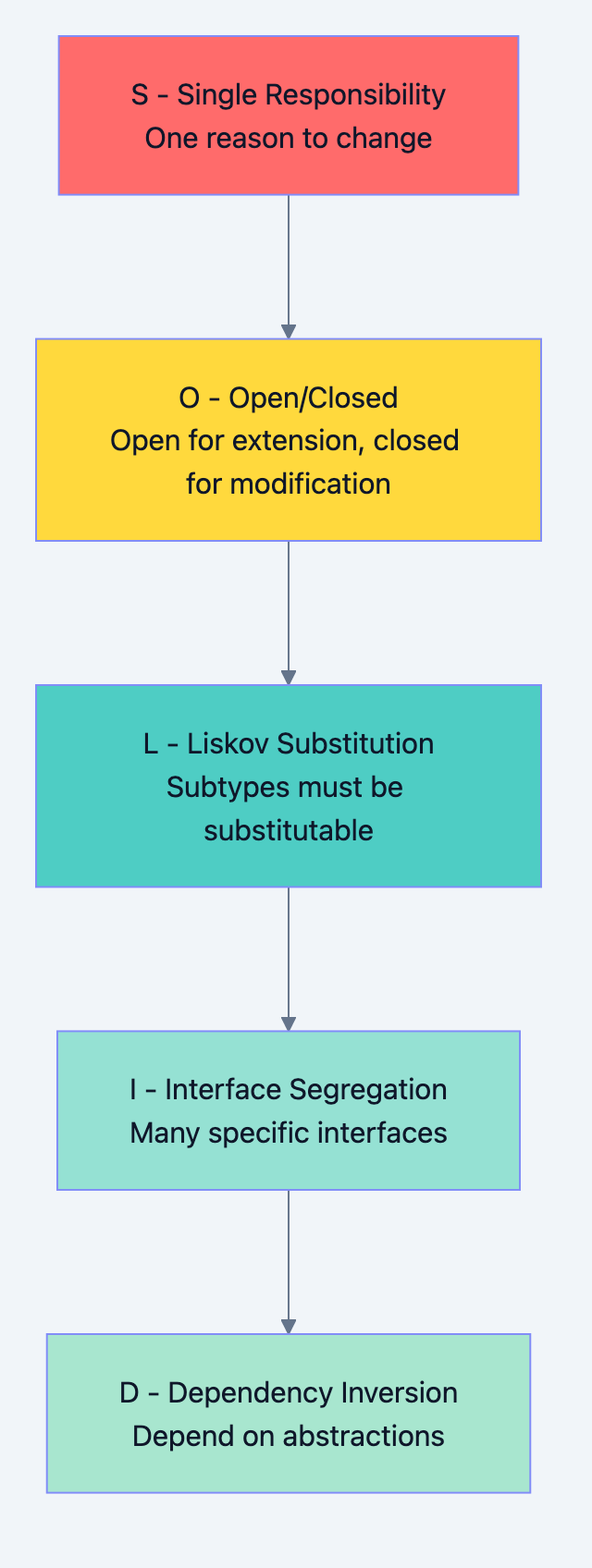
SOLID principles prevent this nightmare. They're five guidelines for writing code that's easy to understand, extend, and maintain. Go's design makes some of these principles feel natural. Others require conscious effort.
What SOLID Stands For
Go blog diagram 1
Single Responsibility Principle (SRP)
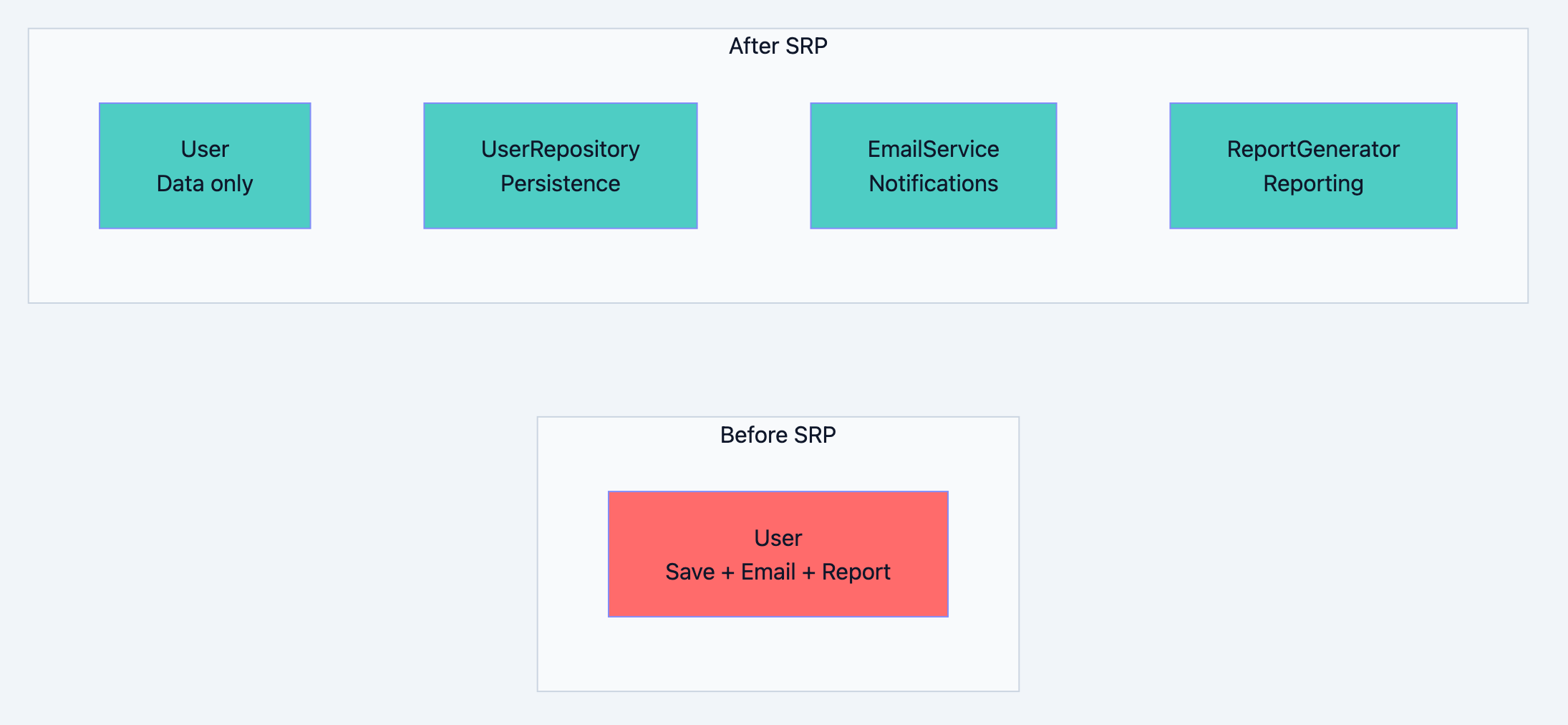
A type should have only one reason to change. If a struct does multiple unrelated things, changes to one affect the other.
The Problem
go// WRONG: User struct does too many things
type User struct {
    ID    int
    Name  string
    Email string
}

func (u *User) Save() error {
    // Database logic here
    return nil
}

func (u *User) SendWelcomeEmail() error {
    // Email logic here
    return nil
}

func (u *User) GenerateReport() string {
    // Reporting logic here
    return ""
}
This User struct has three reasons to change: database changes, email changes, and report format changes.
The Solution
go// Filename: srp_example.go
package main

import "fmt"

// User only holds user data
// Why: Single responsibility - represent a user
type User struct {
    ID    int
    Name  string
    Email string
}

// UserRepository handles database operations
// Why: Single responsibility - data persistence
type UserRepository struct {
    // database connection would be here
}

func (r *UserRepository) Save(u *User) error {
    fmt.Printf("Saving user %s to database\n", u.Name)
    return nil
}

func (r *UserRepository) Find(id int) (*User, error) {
    return &User{ID: id, Name: "Found User"}, nil
}

// EmailService handles email operations
// Why: Single responsibility - sending emails
type EmailService struct {
    // SMTP config would be here
}

func (e *EmailService) SendWelcome(u *User) error {
    fmt.Printf("Sending welcome email to %s\n", u.Email)
    return nil
}

// ReportGenerator handles report creation
// Why: Single responsibility - generating reports
type ReportGenerator struct{}

func (r *ReportGenerator) UserReport(u *User) string {
    return fmt.Sprintf("Report for %s (ID: %d)", u.Name, u.ID)
}

func main() {
    user := &User{ID: 1, Name: "Alice", Email: "alice@example.com"}

    repo := &UserRepository{}
    repo.Save(user)

    email := &EmailService{}
    email.SendWelcome(user)

    reports := &ReportGenerator{}
    fmt.Println(reports.UserReport(user))
}
Expected Output:
Saving user Alice to database
Sending welcome email to alice@example.com
Report for Alice (ID: 1)
Go blog diagram 2
Open/Closed Principle (OCP)
Types should be open for extension but closed for modification. Add new behavior without changing existing code.
The Problem
go// WRONG: Adding new notification type requires modifying this
func SendNotification(notificationType string, message string) {
    switch notificationType {
    case "email":
        // send email
    case "sms":
        // send sms
    case "push":
        // send push - had to modify this function!
    }
}
The Solution
go// Filename: ocp_example.go
package main

import "fmt"

// Notifier interface defines behavior
// Why: New notifiers extend without modifying existing code
type Notifier interface {
    Notify(message string) error
}

// EmailNotifier sends emails
type EmailNotifier struct {
    Address string
}

func (e *EmailNotifier) Notify(message string) error {
    fmt.Printf("Email to %s: %s\n", e.Address, message)
    return nil
}

// SMSNotifier sends SMS
type SMSNotifier struct {
    Phone string
}

func (s *SMSNotifier) Notify(message string) error {
    fmt.Printf("SMS to %s: %s\n", s.Phone, message)
    return nil
}

// SlackNotifier sends Slack messages - ADDED WITHOUT MODIFYING ABOVE
type SlackNotifier struct {
    Channel string
}

func (s *SlackNotifier) Notify(message string) error {
    fmt.Printf("Slack to #%s: %s\n", s.Channel, message)
    return nil
}

// NotificationService uses any Notifier
// Why: Closed for modification, open for extension
type NotificationService struct {
    notifiers []Notifier
}

func (n *NotificationService) Add(notifier Notifier) {
    n.notifiers = append(n.notifiers, notifier)
}

func (n *NotificationService) NotifyAll(message string) {
    for _, notifier := range n.notifiers {
        notifier.Notify(message)
    }
}

func main() {
    service := &NotificationService{}

    service.Add(&EmailNotifier{Address: "user@example.com"})
    service.Add(&SMSNotifier{Phone: "+1234567890"})
    service.Add(&SlackNotifier{Channel: "alerts"})

    service.NotifyAll("System alert!")
}
Expected Output:
Email to user@example.com: System alert!
SMS to +1234567890: System alert!
Slack to #alerts: System alert!
Liskov Substitution Principle (LSP)
If S is a subtype of T, then objects of type T may be replaced with objects of type S without breaking the program.
In Go, this means any type implementing an interface must behave as expected.
The Problem
go// WRONG: Square breaks expectations of Rectangle behavior
type Rectangle interface {
    SetWidth(w int)
    SetHeight(h int)
    Area() int
}

type Square struct {
    side int
}

func (s *Square) SetWidth(w int) {
    s.side = w // Also changes height - breaks expectations!
}

func (s *Square) SetHeight(h int) {
    s.side = h // Also changes width - breaks expectations!
}
The Solution
go// Filename: lsp_example.go
package main

import "fmt"

// Shape interface defines what shapes can do
// Why: Focus on common behavior, not implementation details
type Shape interface {
    Area() float64
}

// Rectangle is a shape
type Rectangle struct {
    Width  float64
    Height float64
}

func (r Rectangle) Area() float64 {
    return r.Width * r.Height
}

// Square is a shape (not a special rectangle)
type Square struct {
    Side float64
}

func (s Square) Area() float64 {
    return s.Side * s.Side
}

// Circle is a shape
type Circle struct {
    Radius float64
}

func (c Circle) Area() float64 {
    return 3.14159 * c.Radius * c.Radius
}

// TotalArea works with any shapes
// Why: All shapes are interchangeable for Area calculation
func TotalArea(shapes []Shape) float64 {
    var total float64
    for _, shape := range shapes {
        total += shape.Area()
    }
    return total
}

func main() {
    shapes := []Shape{
        Rectangle{Width: 10, Height: 5},
        Square{Side: 4},
        Circle{Radius: 3},
    }

    fmt.Printf("Total area: %.2f\n", TotalArea(shapes))
}
Expected Output:
Total area: 94.27Interface Segregation Principle (ISP)
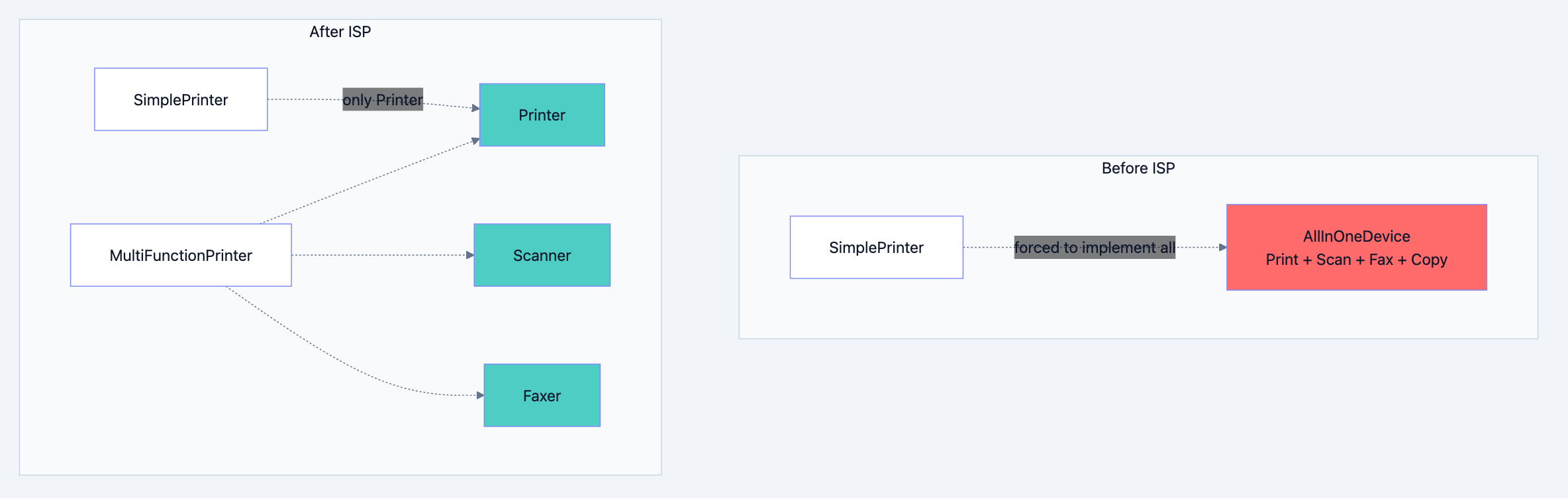
Clients should not be forced to depend on interfaces they don't use. Many small interfaces are better than one large one.
The Problem
go// WRONG: Printers shouldn't need Scan or Fax
type AllInOneDevice interface {
    Print(doc string) error
    Scan(doc string) error
    Fax(doc string) error
    Copy(doc string) error
}

// SimplePrinter can only print but must implement all methods
type SimplePrinter struct{}

func (p *SimplePrinter) Print(doc string) error { return nil }
func (p *SimplePrinter) Scan(doc string) error  { return errors.New("not supported") } // Awkward!
func (p *SimplePrinter) Fax(doc string) error   { return errors.New("not supported") } // Awkward!
func (p *SimplePrinter) Copy(doc string) error  { return errors.New("not supported") } // Awkward!
The Solution
go// Filename: isp_example.go
package main

import "fmt"

// Printer interface - just printing
type Printer interface {
    Print(doc string) error
}

// Scanner interface - just scanning
type Scanner interface {
    Scan() (string, error)
}

// Faxer interface - just faxing
type Faxer interface {
    Fax(doc string, number string) error
}

// SimplePrinter only needs Printer
type SimplePrinter struct {
    Name string
}

func (p *SimplePrinter) Print(doc string) error {
    fmt.Printf("[%s] Printing: %s\n", p.Name, doc)
    return nil
}

// MultiFunctionPrinter implements all interfaces
type MultiFunctionPrinter struct {
    Name string
}

func (m *MultiFunctionPrinter) Print(doc string) error {
    fmt.Printf("[%s] Printing: %s\n", m.Name, doc)
    return nil
}

func (m *MultiFunctionPrinter) Scan() (string, error) {
    fmt.Printf("[%s] Scanning...\n", m.Name)
    return "scanned document", nil
}

func (m *MultiFunctionPrinter) Fax(doc string, number string) error {
    fmt.Printf("[%s] Faxing to %s: %s\n", m.Name, number, doc)
    return nil
}

// PrintDocument only requires Printer
// Why: Function uses only what it needs
func PrintDocument(p Printer, doc string) {
    p.Print(doc)
}

// ScanAndPrint requires both Printer and Scanner
// Why: Compose interfaces for specific needs
type PrinterScanner interface {
    Printer
    Scanner
}

func ScanAndPrint(ps PrinterScanner) {
    doc, _ := ps.Scan()
    ps.Print(doc)
}

func main() {
    simple := &SimplePrinter{Name: "HP Basic"}
    multi := &MultiFunctionPrinter{Name: "Canon Pro"}

    // Both work for printing
    PrintDocument(simple, "Invoice.pdf")
    PrintDocument(multi, "Report.pdf")

    // Only multi works for scan and print
    ScanAndPrint(multi)
}
Expected Output:
[HP Basic] Printing: Invoice.pdf
[Canon Pro] Printing: Report.pdf
[Canon Pro] Scanning...
[Canon Pro] Printing: scanned document
Go blog diagram 3
Dependency Inversion Principle (DIP)
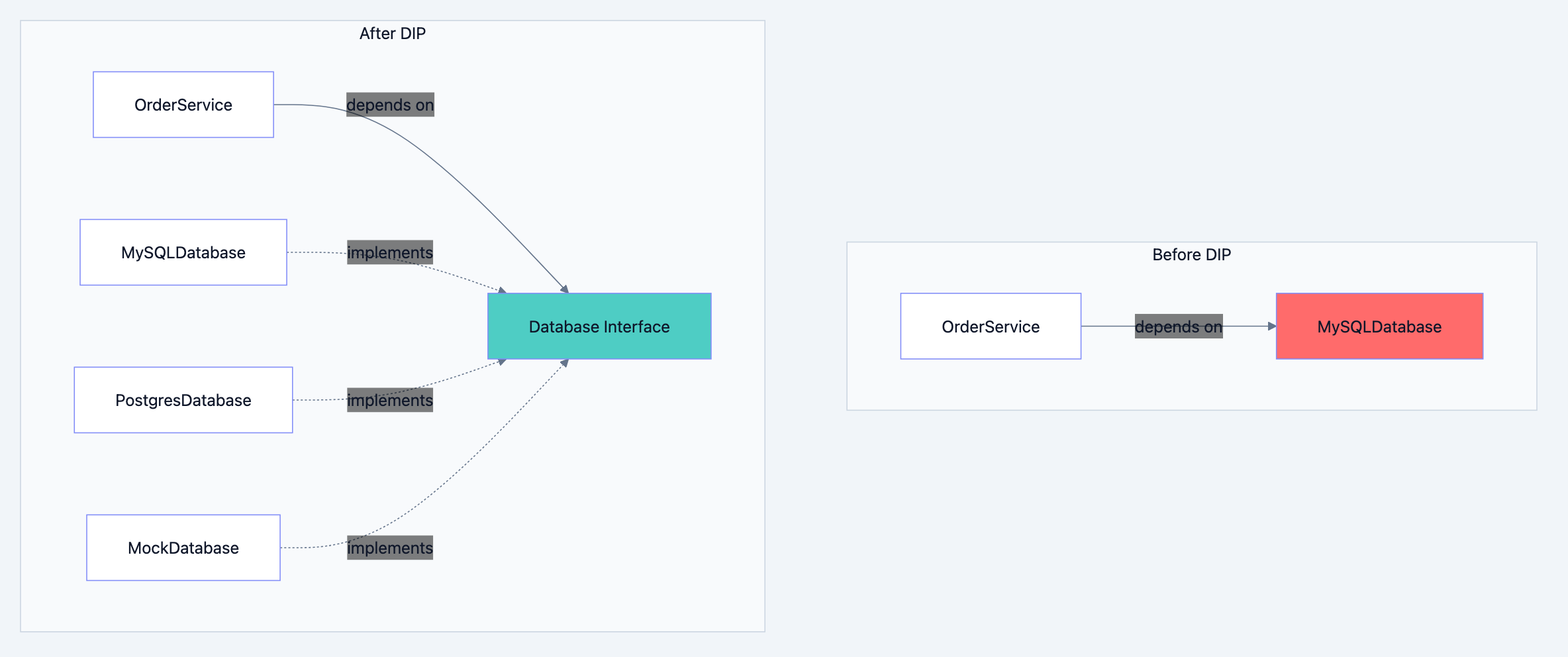
High level modules should not depend on low level modules. Both should depend on abstractions.
The Problem
go// WRONG: OrderService directly depends on MySQLDatabase
type MySQLDatabase struct{}

func (db *MySQLDatabase) Save(data string) error {
    // MySQL specific code
    return nil
}

type OrderService struct {
    db *MySQLDatabase // Tight coupling!
}

func (o *OrderService) CreateOrder(order string) error {
    return o.db.Save(order) // Can't use any other database
}
The Solution
go// Filename: dip_example.go
package main

import "fmt"

// Database is an abstraction
// Why: High-level code depends on this, not concrete databases
type Database interface {
    Save(data string) error
    Find(id string) (string, error)
}

// MySQLDatabase is a concrete implementation
type MySQLDatabase struct{}

func (m *MySQLDatabase) Save(data string) error {
    fmt.Println("MySQL: Saving", data)
    return nil
}

func (m *MySQLDatabase) Find(id string) (string, error) {
    return "MySQL result for " + id, nil
}

// PostgresDatabase is another implementation
type PostgresDatabase struct{}

func (p *PostgresDatabase) Save(data string) error {
    fmt.Println("Postgres: Saving", data)
    return nil
}

func (p *PostgresDatabase) Find(id string) (string, error) {
    return "Postgres result for " + id, nil
}

// MockDatabase for testing
type MockDatabase struct {
    SavedData []string
}

func (m *MockDatabase) Save(data string) error {
    m.SavedData = append(m.SavedData, data)
    return nil
}

func (m *MockDatabase) Find(id string) (string, error) {
    return "Mock result", nil
}

// OrderService depends on abstraction, not concrete database
type OrderService struct {
    db Database // Interface, not concrete type
}

func NewOrderService(db Database) *OrderService {
    return &OrderService{db: db}
}

func (o *OrderService) CreateOrder(orderID string, details string) error {
    return o.db.Save(fmt.Sprintf("Order %s: %s", orderID, details))
}

func main() {
    // Production: use MySQL
    mysqlDB := &MySQLDatabase{}
    orderService := NewOrderService(mysqlDB)
    orderService.CreateOrder("001", "Widget x 5")

    // Development: use Postgres
    postgresDB := &PostgresDatabase{}
    devService := NewOrderService(postgresDB)
    devService.CreateOrder("002", "Gadget x 3")

    // Testing: use Mock
    mockDB := &MockDatabase{}
    testService := NewOrderService(mockDB)
    testService.CreateOrder("003", "Test item")
    fmt.Println("Mock saved:", mockDB.SavedData)
}
Expected Output:
MySQL: Saving Order 001: Widget x 5
Postgres: Saving Order 002: Gadget x 3
Mock saved: [Order 003: Test item]
Go blog diagram 4
SOLID in Practice: Complete Example
go// Filename: solid_complete.go
package main

import "fmt"

// --- Interfaces (Abstractions) ---

type UserRepository interface {
    Save(user User) error
    FindByID(id int) (User, error)
}

type Notifier interface {
    Notify(user User, message string) error
}

type Logger interface {
    Log(message string)
}

// --- Domain ---

type User struct {
    ID    int
    Name  string
    Email string
}

// --- Implementations ---

type InMemoryUserRepo struct {
    users map[int]User
}

func NewInMemoryUserRepo() *InMemoryUserRepo {
    return &InMemoryUserRepo{users: make(map[int]User)}
}

func (r *InMemoryUserRepo) Save(user User) error {
    r.users[user.ID] = user
    return nil
}

func (r *InMemoryUserRepo) FindByID(id int) (User, error) {
    return r.users[id], nil
}

type EmailNotifier struct{}

func (e *EmailNotifier) Notify(user User, message string) error {
    fmt.Printf("Email to %s: %s\n", user.Email, message)
    return nil
}

type ConsoleLogger struct{}

func (c *ConsoleLogger) Log(message string) {
    fmt.Println("[LOG]", message)
}

// --- Service (High-level module) ---

type UserService struct {
    repo     UserRepository
    notifier Notifier
    logger   Logger
}

func NewUserService(repo UserRepository, notifier Notifier, logger Logger) *UserService {
    return &UserService{
        repo:     repo,
        notifier: notifier,
        logger:   logger,
    }
}

func (s *UserService) RegisterUser(user User) error {
    s.logger.Log(fmt.Sprintf("Registering user: %s", user.Name))

    if err := s.repo.Save(user); err != nil {
        return err
    }

    s.notifier.Notify(user, "Welcome to our platform!")
    s.logger.Log(fmt.Sprintf("User %s registered successfully", user.Name))

    return nil
}

func main() {
    // Wire dependencies
    repo := NewInMemoryUserRepo()
    notifier := &EmailNotifier{}
    logger := &ConsoleLogger{}

    service := NewUserService(repo, notifier, logger)

    // Use service
    user := User{ID: 1, Name: "Alice", Email: "alice@example.com"}
    service.RegisterUser(user)
}
Expected Output:
[LOG] Registering user: Alice
Email to alice@example.com: Welcome to our platform!
[LOG] User Alice registered successfully
SOLID Summary
| Principle | Key Idea | Go Implementation |
|---|---|---|
| SRP | One reason to change | Separate structs for different responsibilities |
| OCP | Extend without modifying | Interfaces for extensibility |
| LSP | Substitutable types | Consistent interface implementations |
| ISP | Small focused interfaces | Many small interfaces, composed as needed |
| DIP | Depend on abstractions | Accept interfaces, inject dependencies |
What You Learned
You now understand that:
- SRP keeps code focused: One type, one responsibility
- OCP enables extension: Add features without modifying existing code
- LSP ensures reliability: Implementations behave as expected
- ISP avoids bloat: Small interfaces clients actually need
- DIP enables flexibility: High level code doesn't know low level details
Your Next Steps
- Refactor: Apply SRP to a complex struct in your codebase
- Read Next: Learn about design patterns that build on SOLID
- Practice: Create an interface for a dependency and write a mock implementation
SOLID principles aren't rules to follow blindly. They're guidelines that, when applied thoughtfully, lead to code that's easier to understand, test, and maintain. In Go, interfaces make most of these principles feel natural. Start applying them today.