Go Interfaces: The Power of Implicit Contracts
The Plugin Problem
You're building a notification system. Today you need email. Tomorrow your boss wants SMS. Next month, Slack integration. Each has different APIs, different configurations, different everything.
Without interfaces, you'd end up with a switch statement that grows with every new notification type. Adding a new channel means modifying core code. Testing requires real services or complex mocks.
Interfaces flip this problem on its head. Define what you need. Let implementations figure out how.
Contracts Without the Paperwork
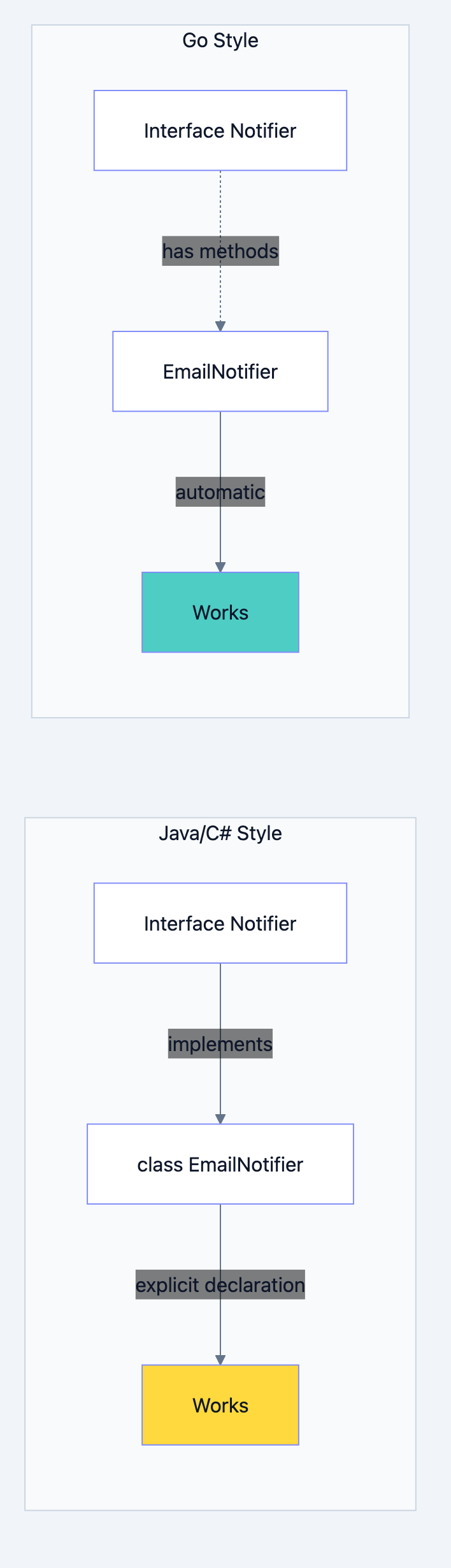
Traditional object oriented languages require explicit implementation declarations. You must say "class EmailNotifier implements Notifier". Forget the declaration? Compile error. Change the interface? Update every implementor.
Go does it differently. If your type has the right methods, it implements the interface. No declaration needed. The compiler figures it out.
Go blog diagram 1
The USB Analogy
Think of it like this: A USB port doesn't care what device you plug in. Phone, keyboard, hard drive, it works if the device follows the USB specification. The port defines what signals it sends and receives. Any device that speaks USB can connect. Go interfaces work the same way. Define what methods you need. Any type with those methods can plug in.
Your First Interface
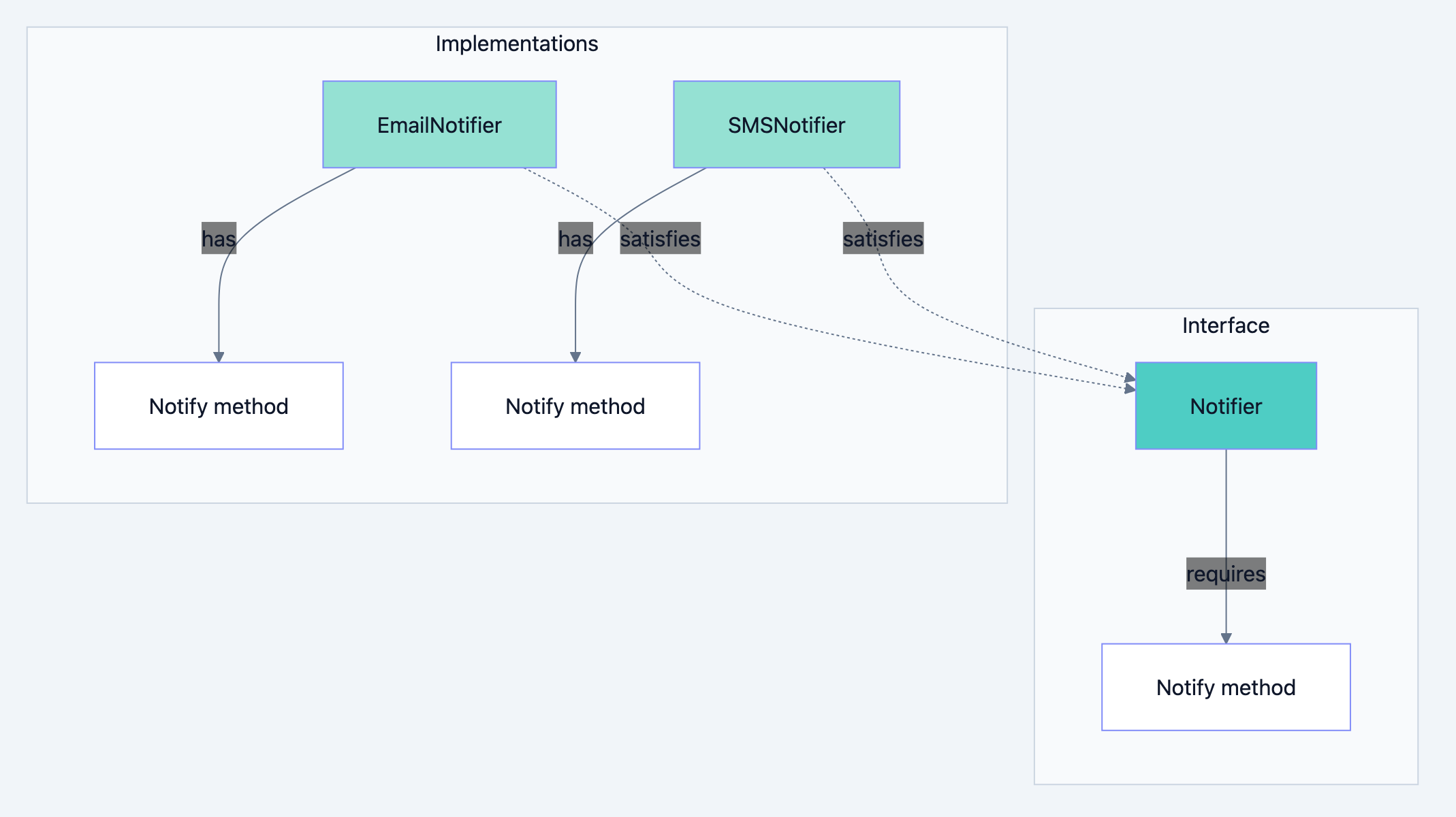
An interface is a set of method signatures. Nothing more.
go// Filename: first_interface.go
package main

import "fmt"

// Notifier is what we need: a way to send notifications
// Why: Defines behavior without specifying implementation
type Notifier interface {
    Notify(message string) error
}

// EmailNotifier sends notifications via email
type EmailNotifier struct {
    Address string
}

// Notify implements the Notifier interface
// Why: EmailNotifier now satisfies Notifier automatically
func (e EmailNotifier) Notify(message string) error {
    fmt.Printf("Sending email to %s: %s\n", e.Address, message)
    return nil
}

// SMSNotifier sends notifications via SMS
type SMSNotifier struct {
    Phone string
}

// Notify implements the Notifier interface
func (s SMSNotifier) Notify(message string) error {
    fmt.Printf("Sending SMS to %s: %s\n", s.Phone, message)
    return nil
}

// SendAlert works with ANY Notifier
// Why: Function doesn't care about implementation details
func SendAlert(n Notifier, message string) {
    if err := n.Notify(message); err != nil {
        fmt.Println("Failed to send:", err)
    }
}

func main() {
    email := EmailNotifier{Address: "user@example.com"}
    sms := SMSNotifier{Phone: "+1234567890"}

    SendAlert(email, "Server is down!")
    SendAlert(sms, "Server is down!")
}
Expected Output:
Sending email to user@example.com: Server is down!
Sending SMS to +1234567890: Server is down!
Go blog diagram 2
The Empty Interface
The interface with zero methods is special. Every type implements it.
go// any is an alias for interface{}
var anything any

anything = 42
anything = "hello"
anything = []int{1, 2, 3}
anything = struct{ Name string }{"Alice"}
Use empty interfaces when you truly don't know the type. But be careful. You lose type safety.
go// Filename: empty_interface.go
package main

import "fmt"

// PrintAnything accepts any value
// Why: Useful for logging, debugging, or generic containers
func PrintAnything(v any) {
    fmt.Printf("Type: %T, Value: %v\n", v, v)
}

func main() {
    PrintAnything(42)
    PrintAnything("hello")
    PrintAnything([]int{1, 2, 3})
    PrintAnything(map[string]int{"a": 1})
}
Expected Output:
Type: int, Value: 42
Type: string, Value: hello
Type: []int, Value: [1 2 3]
Type: map[string]int, Value: map[a:1]
Type Assertions: Getting the Concrete Type Back
When you have an interface, sometimes you need the underlying type.
go// Filename: type_assertions.go
package main

import "fmt"

func process(v any) {
    // Type assertion with comma-ok idiom
    // Why: Safe way to check and extract type
    if str, ok := v.(string); ok {
        fmt.Printf("It's a string: %s\n", str)
        return
    }

    if num, ok := v.(int); ok {
        fmt.Printf("It's an int: %d\n", num)
        return
    }

    fmt.Printf("Unknown type: %T\n", v)
}

func main() {
    process("hello")
    process(42)
    process(3.14)
}
Expected Output:
It's a string: hello
It's an int: 42
Unknown type: float64
Type Switches: Multiple Type Checks
For multiple types, use a type switch.
go// Filename: type_switch.go
package main

import "fmt"

// Describe explains what type we got
func Describe(v any) string {
    // Type switch: cleaner than multiple assertions
    switch x := v.(type) {
    case string:
        return fmt.Sprintf("string of length %d", len(x))
    case int:
        return fmt.Sprintf("integer: %d", x)
    case bool:
        if x {
            return "boolean: true"
        }
        return "boolean: false"
    case nil:
        return "nil value"
    default:
        return fmt.Sprintf("unknown type: %T", x)
    }
}

func main() {
    fmt.Println(Describe("hello"))
    fmt.Println(Describe(42))
    fmt.Println(Describe(true))
    fmt.Println(Describe(nil))
    fmt.Println(Describe([]int{1, 2}))
}
Expected Output:
string of length 5
integer: 42
boolean: true
nil value
unknown type: []int
Interface Composition
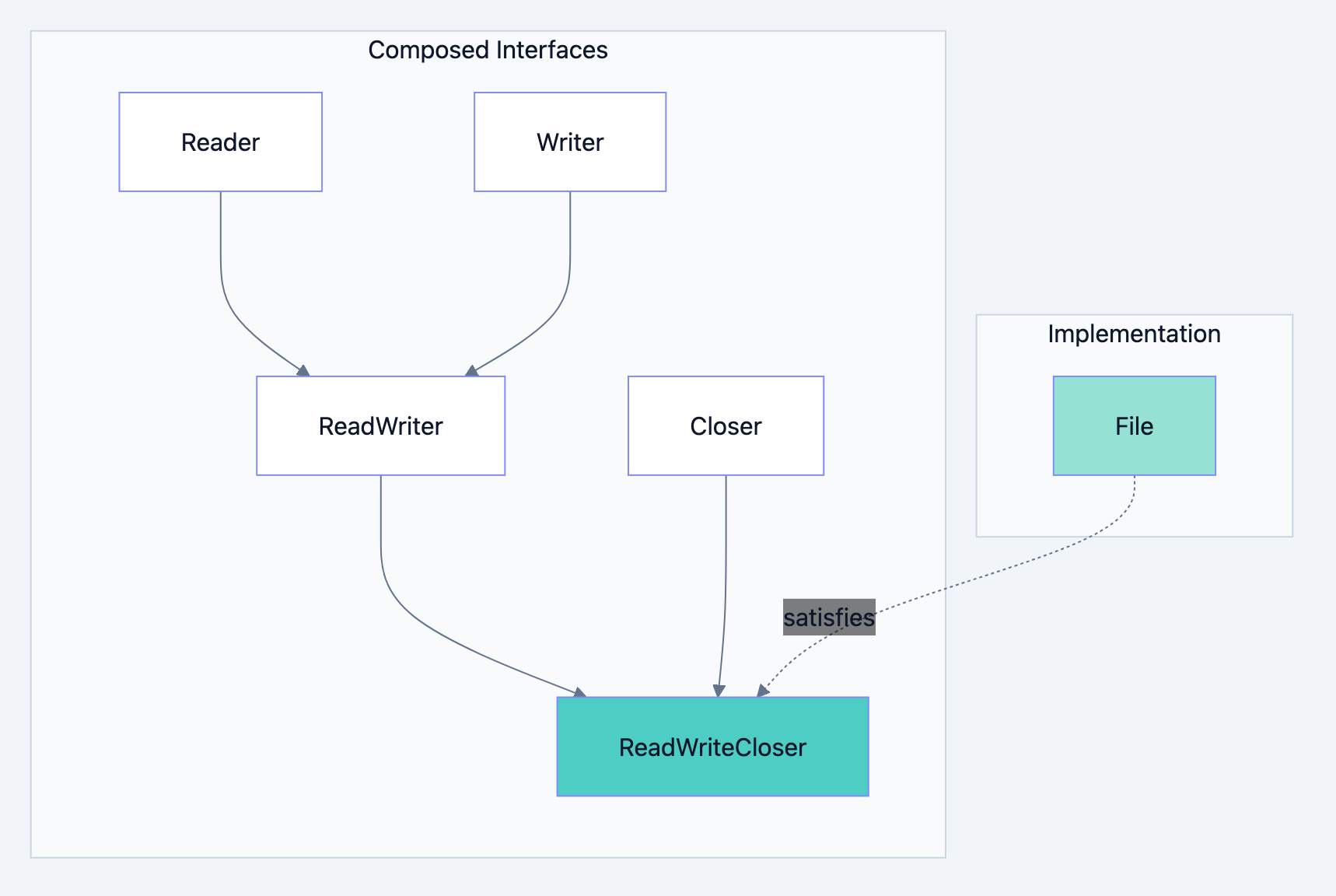
Small interfaces can combine to form larger ones. This is more flexible than large interfaces.
go// Filename: interface_composition.go
package main

import "fmt"

// Reader can read data
type Reader interface {
    Read(p []byte) (n int, err error)
}

// Writer can write data
type Writer interface {
    Write(p []byte) (n int, err error)
}

// Closer can close a resource
type Closer interface {
    Close() error
}

// ReadWriter combines Reader and Writer
// Why: Compose interfaces instead of creating large ones
type ReadWriter interface {
    Reader
    Writer
}

// ReadWriteCloser combines all three
type ReadWriteCloser interface {
    Reader
    Writer
    Closer
}

// File implements all interfaces
type File struct {
    Name string
}

func (f *File) Read(p []byte) (int, error) {
    fmt.Printf("Reading from %s\n", f.Name)
    return len(p), nil
}

func (f *File) Write(p []byte) (int, error) {
    fmt.Printf("Writing to %s: %s\n", f.Name, string(p))
    return len(p), nil
}

func (f *File) Close() error {
    fmt.Printf("Closing %s\n", f.Name)
    return nil
}

// Works with just Reader
func ReadData(r Reader) {
    buf := make([]byte, 100)
    r.Read(buf)
}

// Works with ReadWriter
func CopyData(rw ReadWriter) {
    buf := make([]byte, 100)
    rw.Read(buf)
    rw.Write([]byte("copied"))
}

func main() {
    file := &File{Name: "data.txt"}

    ReadData(file)  // File satisfies Reader
    CopyData(file)  // File satisfies ReadWriter
}
Expected Output:
Reading from data.txt
Reading from data.txt
Writing to data.txt: copied
Go blog diagram 3
Real World Example: Plugin System
go// Filename: plugin_system.go
package main

import (
    "fmt"
    "strings"
)

// TextProcessor defines what a text plugin must do
type TextProcessor interface {
    Process(text string) string
    Name() string
}

// UppercasePlugin converts to uppercase
type UppercasePlugin struct{}

func (u UppercasePlugin) Process(text string) string {
    return strings.ToUpper(text)
}

func (u UppercasePlugin) Name() string {
    return "Uppercase"
}

// ReversePlugin reverses the text
type ReversePlugin struct{}

func (r ReversePlugin) Process(text string) string {
    runes := []rune(text)
    for i, j := 0, len(runes)-1; i < j; i, j = i+1, j-1 {
        runes[i], runes[j] = runes[j], runes[i]
    }
    return string(runes)
}

func (r ReversePlugin) Name() string {
    return "Reverse"
}

// Pipeline runs text through multiple processors
type Pipeline struct {
    processors []TextProcessor
}

func (p *Pipeline) Add(processor TextProcessor) {
    p.processors = append(p.processors, processor)
}

func (p *Pipeline) Execute(text string) string {
    result := text
    for _, proc := range p.processors {
        fmt.Printf("Applying %s...\n", proc.Name())
        result = proc.Process(result)
    }
    return result
}

func main() {
    pipeline := &Pipeline{}
    pipeline.Add(UppercasePlugin{})
    pipeline.Add(ReversePlugin{})

    input := "hello world"
    output := pipeline.Execute(input)

    fmt.Printf("\nInput:  %s\n", input)
    fmt.Printf("Output: %s\n", output)
}
Expected Output:
Applying Uppercase...
Applying Reverse...

Input:  hello world
Output: DLROW OLLEH
Interface Best Practices
Keep Interfaces Small
go// WRONG: Too many methods
type UserService interface {
    Create(user User) error
    Update(user User) error
    Delete(id int) error
    Find(id int) (User, error)
    List() ([]User, error)
    Validate(user User) error
    Notify(user User) error
}

// RIGHT: Focused interfaces
type UserCreator interface {
    Create(user User) error
}

type UserFinder interface {
    Find(id int) (User, error)
}
Accept Interfaces, Return Structs
go// WRONG: Return interface
func NewNotifier() Notifier {
    return &EmailNotifier{}
}

// RIGHT: Return concrete type
func NewEmailNotifier() *EmailNotifier {
    return &EmailNotifier{}
}
Define Interfaces Where Used
go// WRONG: Define interface in implementation package
package email

type Notifier interface {
    Notify(msg string) error
}

// RIGHT: Define interface in consumer package
package alerts

type Notifier interface {
    Notify(msg string) error
}
Nil Interface Gotcha
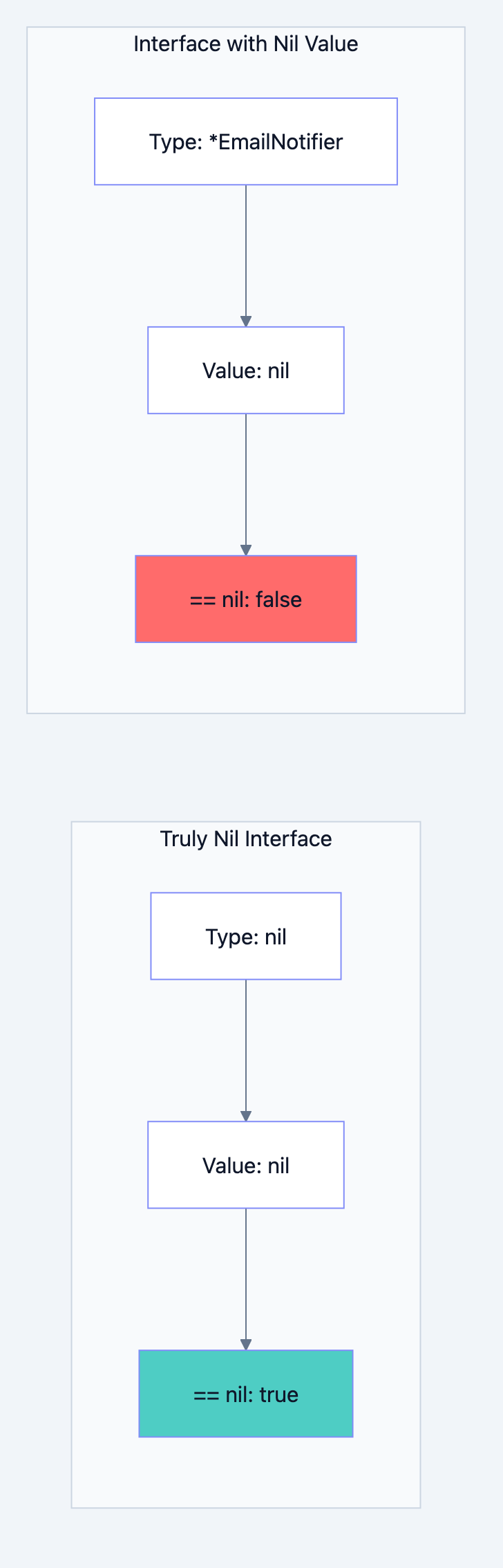
An interface is nil only when both type and value are nil.
go// Filename: nil_interface.go
package main

import "fmt"

type Notifier interface {
    Notify(string) error
}

type EmailNotifier struct{}

func (e *EmailNotifier) Notify(msg string) error {
    return nil
}

func getNotifier(enabled bool) Notifier {
    var email *EmailNotifier // nil pointer

    if enabled {
        email = &EmailNotifier{}
    }

    return email // Returns interface with nil value but non-nil type!
}

func main() {
    n := getNotifier(false)

    // This is false! Interface has type *EmailNotifier (not nil)
    fmt.Printf("n == nil: %v\n", n == nil)
    fmt.Printf("n type: %T\n", n)
}
Expected Output:
n == nil: false
n type: *main.EmailNotifier
Go blog diagram 4
Common Mistakes
Mistake 1: Pointer vs Value Receivers
go// If method has pointer receiver
func (e *EmailNotifier) Notify(msg string) error { ... }

// Value doesn't satisfy interface!
var n Notifier = EmailNotifier{} // Error!

// Pointer does
var n Notifier = &EmailNotifier{} // OK
Mistake 2: Overusing empty interface
go// WRONG: Loses all type safety
func Process(data any) any { ... }

// RIGHT: Use specific interface or generics
func Process[T Processable](data T) Result { ... }
What You Learned
You now understand that:
- Interfaces are implicit: No "implements" keyword needed
- Small interfaces are better: Easier to implement and compose
- Empty interface accepts anything: But you lose type safety
- Type assertions recover types: Use comma-ok for safety
- Composition over inheritance: Combine small interfaces
- Accept interfaces, return structs: Best practice pattern
Your Next Steps
- Build: Create a storage interface with file and memory implementations
- Read Next: Learn about the io.Reader and io.Writer interfaces
- Experiment: Refactor existing code to use interfaces for testing
Interfaces in Go are simple but powerful. They enable clean abstractions without complex inheritance hierarchies. Master them, and you'll write code that's flexible, testable, and easy to extend.