Chapter 6: Go Generics - Write Once, Use With Any Type
Introduction
You write a function to find the maximum value in a slice of integers. It works perfectly. The next week, you need the same logic for floats. You copy, paste, and change
int to float64. A month later, strings. Copy, paste again.Now you have three nearly identical functions. A bug lurks in one version the fix you applied to the int version never made it to the others. Duplicated code is a maintenance nightmare waiting to happen.
This is the problem generics solve. One function. Any type. Zero duplication.
Why generics matter in real Go systems:
- Data structures: Stacks, queues, trees that work with any element type
- Utility functions: Map, filter, reduce operations across different collections
- Type-safe containers: Caches, pools, registries without
interface{}casts - Algorithm libraries: Sorting, searching, transforming for multiple types
Before Go 1.18, developers chose between code duplication and type safety. Generics eliminate that false choice.
Core Concepts
Go blog diagram 1
Life Before Generics
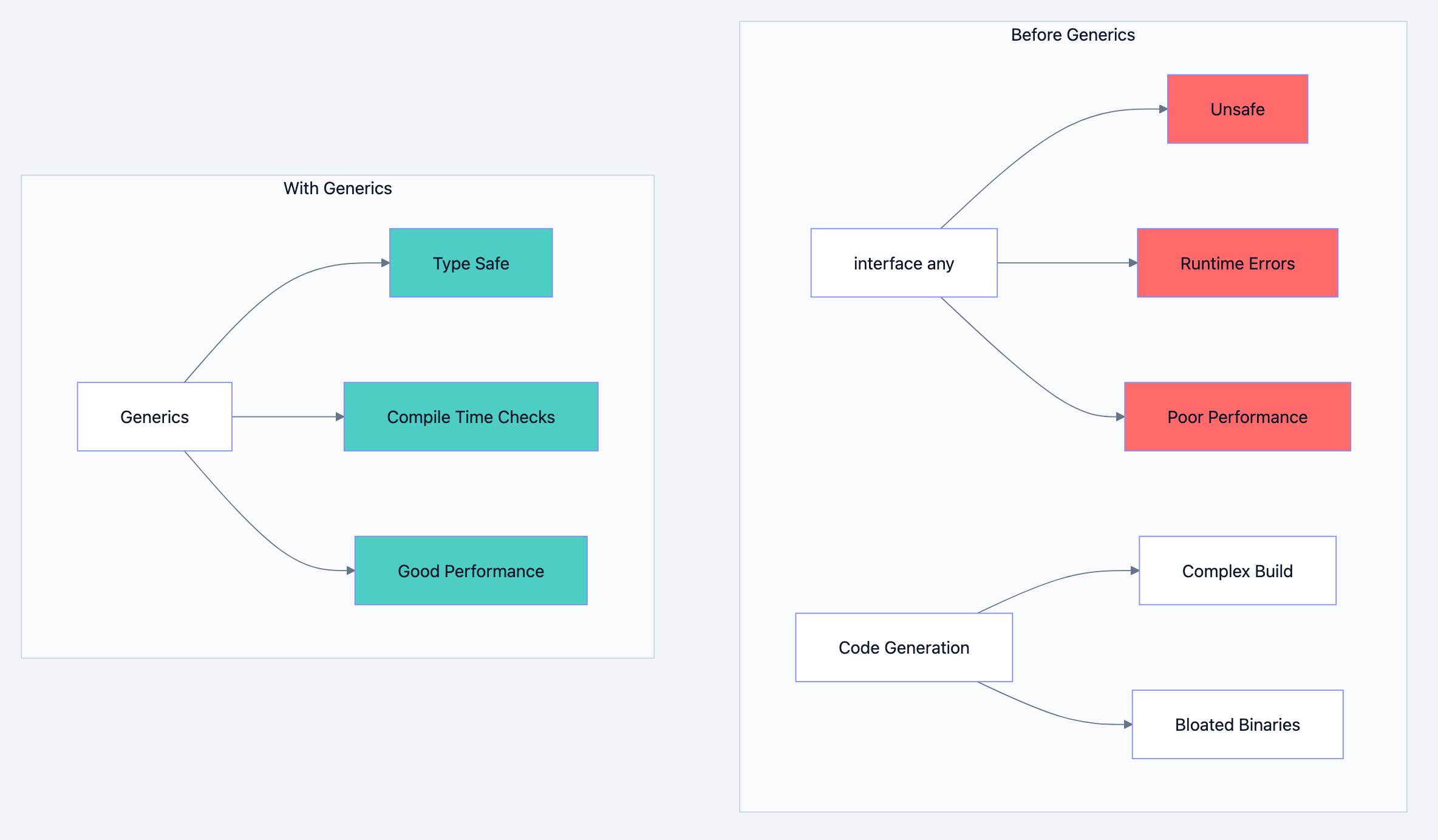
Pre-1.18 Go developers had two options for type-flexible code:
Option 1: The
interface{} approachgofunc Max(a, b interface{}) interface{} { // How do you compare interface{} values? // Type assertions everywhere, panics at runtime switch av := a.(type) { case int: if bv, ok := b.(int); ok { if av > bv { return av } return bv } // ... repeat for every type ... } return nil }
Problems:
- No compile-time type safety
- Runtime panics on type mismatches
- Verbose, error-prone code
- Performance overhead from type assertions
Option 2: Code generation
go//go:generate genny -in=max.go -out=max_int.go gen "T=int"
//go:generate genny -in=max.go -out=max_float64.go gen "T=float64"
Problems:
- Complex build process
- Bloated binaries
- Harder to maintain
- External tooling required
The Generic Solution
Go blog diagram 2
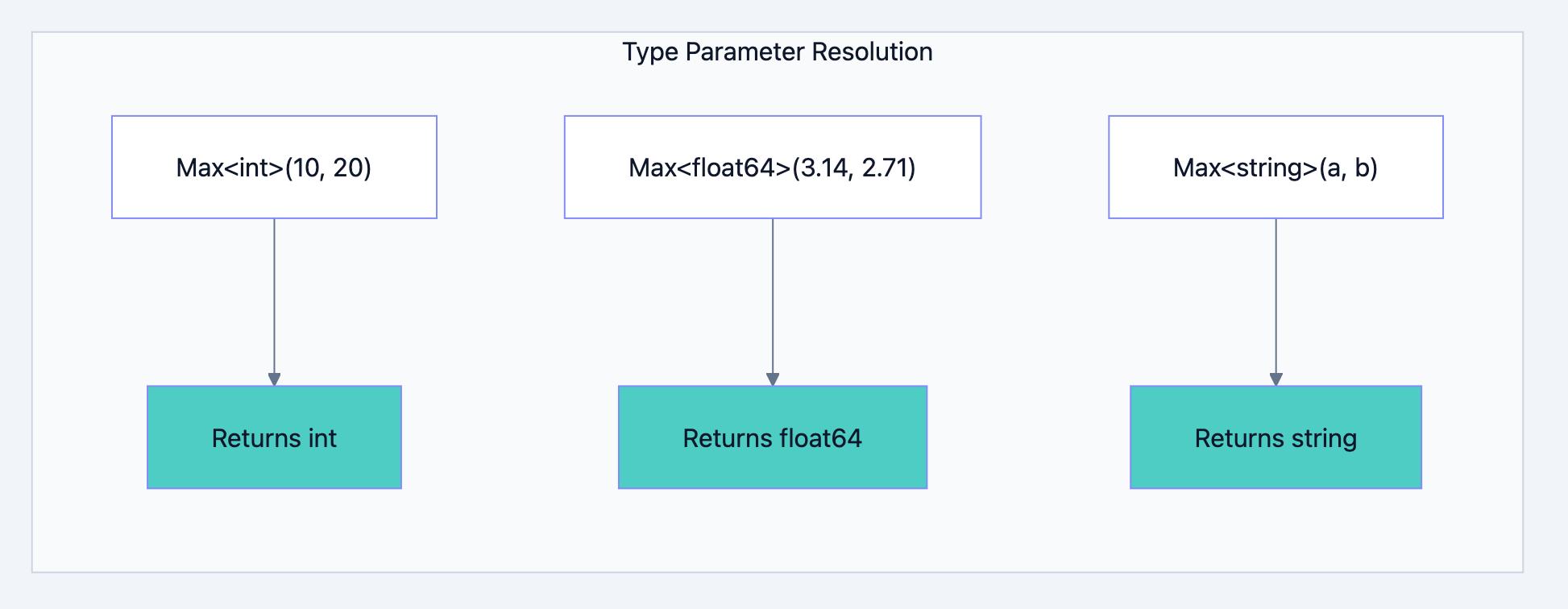
Generics let you write type-parameterized code that the compiler specializes for each type used:
gofunc Max[T int | float64 | string](a, b T) T {
    if a > b {
        return a
    }
    return b
}

// Usage:
maxInt := Max(10, 20)           // Compiler infers T = int
maxFloat := Max(3.14, 2.71)     // Compiler infers T = float64
maxString := Max("abc", "xyz")  // Compiler infers T = string
Benefits:
- Type safety at compile time
- No runtime overhead (types resolved at compile time)
- Single implementation for multiple types
- Clear, readable code
Detailed Explanation: Type Parameters
Anatomy of a Generic Function
gofunc FunctionName[TypeParam Constraint](regularParams) ReturnType {
    // function body
}
- Square brackets
[]: Contain type parameters - Type parameter: A placeholder for a concrete type (commonly
T,K,V) - Constraint: Specifies what types are allowed
Your First Generic Function
go// Filename: first_generic.go
package main

import "fmt"

// Max returns the larger of two ordered values.
// T is a type parameter constrained to types that support comparison.
func Max[T int | float64 | string](a, b T) T {
    if a > b {
        return a
    }
    return b
}

func main() {
    // The compiler infers T from the arguments
    fmt.Println("Max int:", Max(10, 20))
    fmt.Println("Max float:", Max(3.14, 2.71))
    fmt.Println("Max string:", Max("apple", "banana"))

    // Explicit type parameter (rarely needed)
    fmt.Println("Explicit:", Max[int](5, 3))
}
Output:
Max int: 20
Max float: 3.14
Max string: banana
Explicit: 5
Understanding Type Inference
Go usually infers type parameters from arguments:
go// These are equivalent:
result := Max(10, 20)       // T inferred as int
result := Max[int](10, 20)  // T explicit

// Sometimes explicit is needed:
var x interface{} = 10
var y interface{} = 20
// Max(x, y) won't compile - can't infer T from interface{}
Detailed Explanation: Constraints
What Are Constraints?
A constraint is an interface that specifies what a type parameter must support. The type argument must implement the constraint.
Built-in Constraints
Go provides several built-in constraints:
goimport "golang.org/x/exp/constraints"

// any - allows any type
func Print[T any](v T) { fmt.Println(v) }

// comparable - types that support == and !=
func Contains[T comparable](slice []T, target T) bool {
    for _, v := range slice {
        if v == target {
            return true
        }
    }
    return false
}

// constraints.Ordered - types that support < > <= >=
func Min[T constraints.Ordered](a, b T) T {
    if a < b {
        return a
    }
    return b
}

// constraints.Integer - all integer types
// constraints.Float - all float types
// constraints.Signed - signed integers
// constraints.Unsigned - unsigned integers
Constraint Reference Table
| Constraint | Description | Example Types |
|---|---|---|
any | Any type | Everything |
comparable | Supports ==, != | int, string, pointers, arrays |
constraints.Ordered | Supports <, >, <=, >= | int, float64, string |
constraints.Integer | All integer types | int, int8, int16, uint, etc. |
constraints.Float | All float types | float32, float64 |
constraints.Complex | Complex numbers | complex64, complex128 |
Creating Custom Constraints
Define constraints as interfaces with type elements:
go// Filename: custom_constraints.go
package main

import "fmt"

// Number allows any numeric type
type Number interface {
    int | int8 | int16 | int32 | int64 |
    uint | uint8 | uint16 | uint32 | uint64 |
    float32 | float64
}

// Sum adds all numbers in a slice
func Sum[T Number](values []T) T {
    var total T
    for _, v := range values {
        total += v
    }
    return total
}

// Stringer constraint using method
type Stringer interface {
    String() string
}

// PrintAll prints items that have a String method
func PrintAll[T Stringer](items []T) {
    for _, item := range items {
        fmt.Println(item.String())
    }
}

// Combined constraint: both comparable and has method
type ComparableStringer interface {
    comparable
    String() string
}

func main() {
    ints := []int{1, 2, 3, 4, 5}
    fmt.Println("Sum of ints:", Sum(ints))

    floats := []float64{1.1, 2.2, 3.3}
    fmt.Println("Sum of floats:", Sum(floats))
}
The Tilde (~) Operator
The
~ operator includes types whose underlying type matches:gotype MyInt int // Without ~: MyInt is NOT allowed type IntOnly interface { int } // With ~: MyInt IS allowed (its underlying type is int) type IntLike interface { ~int } func Double[T IntLike](v T) T { return v * 2 } func main() { var x MyInt = 5 result := Double(x) // Works! MyInt has underlying type int fmt.Println(result) // 10 }
Detailed Explanation: Generic Types
Generic Structs
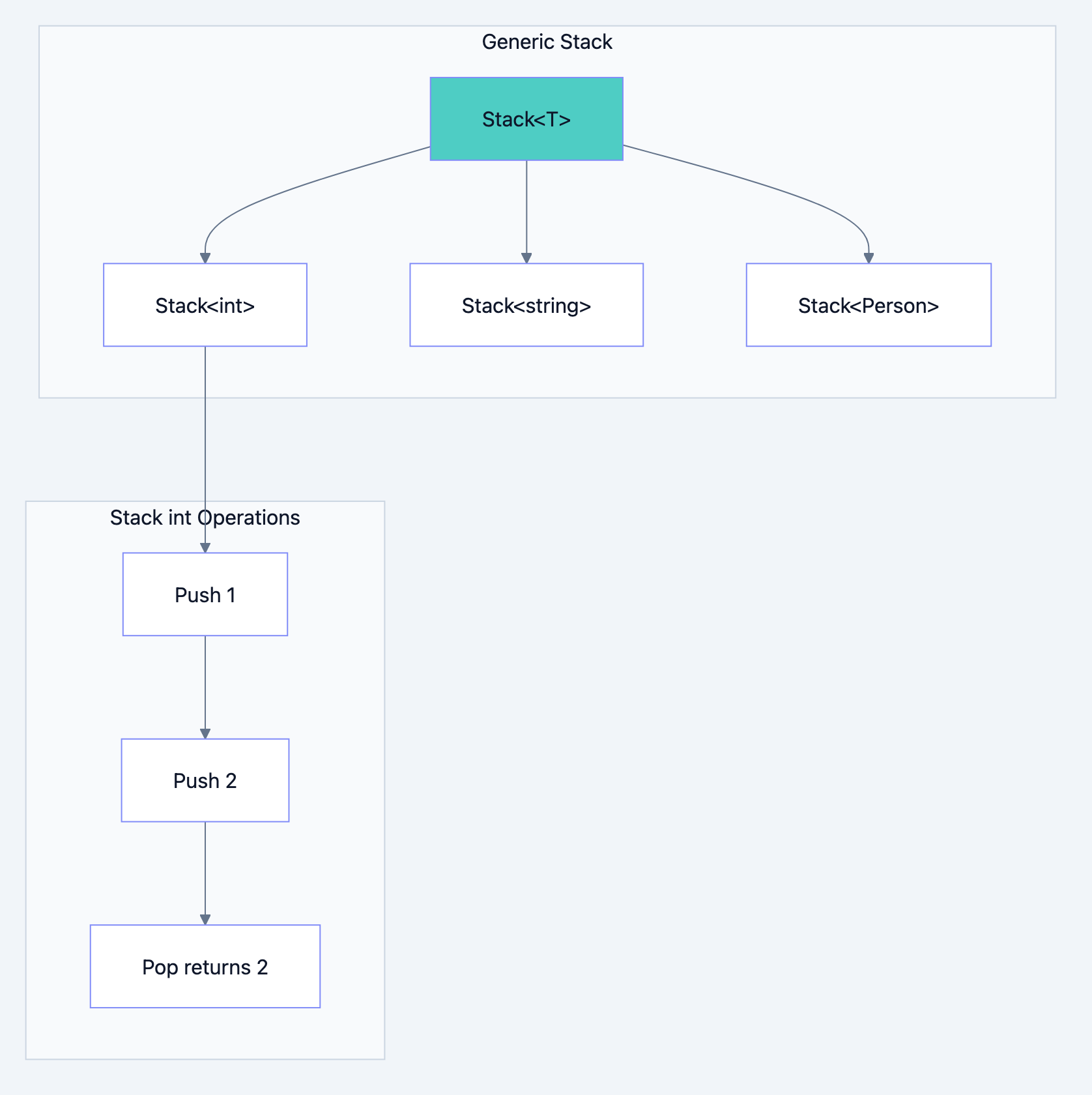
Create data structures that work with any type:
go// Filename: generic_stack.go
package main

import "fmt"

// Stack is a generic LIFO data structure
type Stack[T any] struct {
    items []T
}

// Push adds an item to the top
func (s *Stack[T]) Push(item T) {
    s.items = append(s.items, item)
}

// Pop removes and returns the top item
func (s *Stack[T]) Pop() (T, bool) {
    if len(s.items) == 0 {
        var zero T  // Zero value for type T
        return zero, false
    }

    index := len(s.items) - 1
    item := s.items[index]
    s.items = s.items[:index]
    return item, true
}

// Peek returns the top item without removing
func (s *Stack[T]) Peek() (T, bool) {
    if len(s.items) == 0 {
        var zero T
        return zero, false
    }
    return s.items[len(s.items)-1], true
}

// Len returns the number of items
func (s *Stack[T]) Len() int {
    return len(s.items)
}

func main() {
    // Stack of integers
    intStack := Stack[int]{}
    intStack.Push(1)
    intStack.Push(2)
    intStack.Push(3)

    if val, ok := intStack.Pop(); ok {
        fmt.Println("Popped:", val)  // 3
    }

    // Stack of strings
    stringStack := Stack[string]{}
    stringStack.Push("hello")
    stringStack.Push("world")

    if val, ok := stringStack.Peek(); ok {
        fmt.Println("Peek:", val)  // world
    }
}
Generic Maps and Caches
Go blog diagram 3
go// Filename: generic_cache.go
package main

import (
    "sync"
    "time"
)

// Cache is a generic thread-safe cache
type Cache[K comparable, V any] struct {
    mu    sync.RWMutex
    items map[K]cacheItem[V]
}

type cacheItem[V any] struct {
    value     V
    expiresAt time.Time
}

// NewCache creates an empty cache
func NewCache[K comparable, V any]() *Cache[K, V] {
    return &Cache[K, V]{
        items: make(map[K]cacheItem[V]),
    }
}

// Set adds or updates an item with a TTL
func (c *Cache[K, V]) Set(key K, value V, ttl time.Duration) {
    c.mu.Lock()
    defer c.mu.Unlock()

    c.items[key] = cacheItem[V]{
        value:     value,
        expiresAt: time.Now().Add(ttl),
    }
}

// Get retrieves an item if not expired
func (c *Cache[K, V]) Get(key K) (V, bool) {
    c.mu.RLock()
    defer c.mu.RUnlock()

    item, exists := c.items[key]
    if !exists {
        var zero V
        return zero, false
    }

    if time.Now().After(item.expiresAt) {
        var zero V
        return zero, false
    }

    return item.value, true
}
Common Patterns
Pattern 1: Map/Transform
Transform each element of a slice:
go// Map applies a function to each element
func Map[T, U any](slice []T, fn func(T) U) []U {
    result := make([]U, len(slice))
    for i, v := range slice {
        result[i] = fn(v)
    }
    return result
}

// Usage:
numbers := []int{1, 2, 3, 4, 5}
squared := Map(numbers, func(n int) int { return n * n })
// [1, 4, 9, 16, 25]

strings := Map(numbers, func(n int) string { return fmt.Sprintf("%d", n) })
// ["1", "2", "3", "4", "5"]
Pattern 2: Filter
Keep elements matching a predicate:
go// Filter keeps elements where predicate returns true
func Filter[T any](slice []T, predicate func(T) bool) []T {
    result := make([]T, 0)
    for _, v := range slice {
        if predicate(v) {
            result = append(result, v)
        }
    }
    return result
}

// Usage:
numbers := []int{1, 2, 3, 4, 5, 6}
evens := Filter(numbers, func(n int) bool { return n%2 == 0 })
// [2, 4, 6]
Pattern 3: Reduce
Combine all elements into a single value:
go// Reduce combines elements using a function
func Reduce[T, U any](slice []T, initial U, fn func(U, T) U) U {
    result := initial
    for _, v := range slice {
        result = fn(result, v)
    }
    return result
}

// Usage:
numbers := []int{1, 2, 3, 4, 5}
sum := Reduce(numbers, 0, func(acc, n int) int { return acc + n })
// 15

product := Reduce(numbers, 1, func(acc, n int) int { return acc * n })
// 120
Pattern 4: Keys and Values
Extract keys or values from maps:
go// Keys returns all keys from a map
func Keys[K comparable, V any](m map[K]V) []K {
    keys := make([]K, 0, len(m))
    for k := range m {
        keys = append(keys, k)
    }
    return keys
}

// Values returns all values from a map
func Values[K comparable, V any](m map[K]V) []V {
    values := make([]V, 0, len(m))
    for _, v := range m {
        values = append(values, v)
    }
    return values
}
Go blog diagram 4
When to Use Generics
Good Use Cases
- Data structures: Lists, trees, stacks, queues
- Collection utilities: Map, filter, reduce, find
- Type-safe containers: Caches, pools, registries
- Algorithm libraries: Sorting, searching
- Result/Option types: Generic error handling patterns
When to Avoid Generics
- Single concrete type: If you only ever need
int, just useint - Simple functions: Don't over-engineer simple code
- When interfaces suffice: If behavior (methods) matters more than types
- Reading/writing specific types: IO operations are type-specific
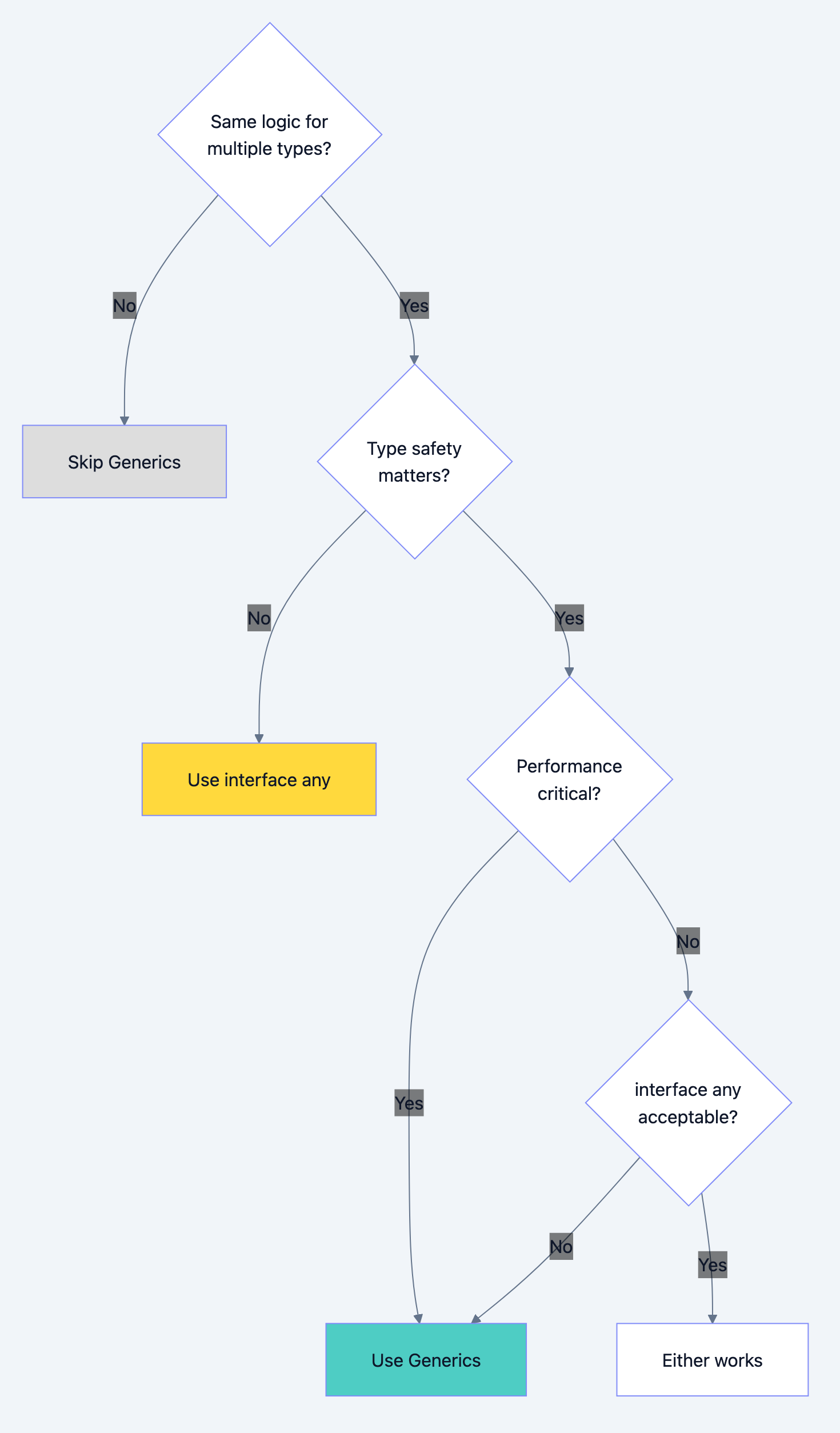
Decision Framework
Do I need the same logic for multiple types?
├── No → Use concrete types
└── Yes → Continue

Do the types share behavior (methods)?
├── Yes → Consider interfaces first
└── No → Continue

Do I need compile-time type safety?
├── Yes → Use generics
└── No → interface{} might be acceptable
Common Mistakes and Misconceptions
Mistake 1: Overusing Generics
go// OVERKILL: Only one type needed
func ProcessUsers[T User](users []T) { ... }

// SIMPLER: Just use the concrete type
func ProcessUsers(users []User) { ... }
Mistake 2: Wrong Constraint
go// BROKEN: any doesn't support +
func Sum[T any](a, b T) T {
    return a + b  // Compile error!
}

// FIXED: Proper numeric constraint
func Sum[T constraints.Integer | constraints.Float](a, b T) T {
    return a + b
}
Mistake 3: Confusing Type Parameter Names
go// CONFUSING: What do these mean?
func Process[A, B, C, D any](...) { ... }

// CLEARER: Conventional or descriptive names
func Process[K comparable, V any](...) { ... }  // For map-like structures
func Transform[In, Out any](input In) Out { ... }  // For transformations
Mistake 4: Forgetting Zero Values
go// PROBLEMATIC: What to return when empty?
func First[T any](slice []T) T {
    if len(slice) == 0 {
        // Can't return nil for non-pointer T!
    }
    return slice[0]
}

// BETTER: Return (value, ok) pattern
func First[T any](slice []T) (T, bool) {
    if len(slice) == 0 {
        var zero T
        return zero, false
    }
    return slice[0], true
}
Performance Considerations
Compilation
The Go compiler generates specialized code for each type combination used. This means:
- No runtime type assertions (unlike
interface{}) - Type-specific optimizations apply
- Binary size may increase with many instantiations
Runtime
go// Generics: Compiled to specialized code
func Sum[T constraints.Integer](values []T) T { ... }
Sum([]int{1, 2, 3})  // Uses int-specialized code

// interface{}: Runtime type assertions
func SumInterface(values []interface{}) interface{} { ... }
// Slower due to boxing/unboxing
| Approach | Type Safety | Runtime Cost | Memory |
|---|---|---|---|
| Generics | Compile-time | Minimal | Normal |
| interface{} | Runtime | Higher (assertions) | Higher (boxing) |
| Code generation | Compile-time | Minimal | Higher (code duplication) |
Summary
Key takeaways from this chapter:
-
Type parameters use square brackets:
func Name[T Constraint]() -
Constraints define allowed types: Use
any,comparable, or custom interfaces -
Generics work with structs too:
type Stack[T any] struct {...} -
Type inference reduces verbosity: Often don't need explicit type arguments
-
The ~ operator includes derived types:
~intincludestype MyInt int -
Use generics for reusable logic: Data structures, utilities, transformations
-
Don't overuse: Concrete types and interfaces are still valuable
Interview Questions
-
What problem do generics solve in Go? Why were they added in Go 1.18?
-
Explain the difference between a type parameter and a constraint.
-
What is the
anyconstraint and when would you use it versus more specific constraints? -
Write a generic function that finds the index of an element in a slice. What constraint do you need?
-
Explain the difference between
intand~intin a constraint. When would you use each? -
How do generics differ from using
interface{}for type flexibility? What are the trade-offs? -
Can generic functions have methods? Can generic types?
-
How does the Go compiler handle generics? Are they implemented through type erasure or monomorphization?
-
Write a generic
Result[T]type that can hold either a value or an error. -
When would you choose an interface over generics? Give an example.
-
Explain why you can't use
<operator with thecomparableconstraint. -
How would you implement a generic set data structure?
-
What happens when you create a zero value for a generic type?
-
Can you have multiple type parameters? How would you constrain them differently?
-
Describe a scenario where generics would make code worse, not better.